We went to Peter Pan today. It was funny. It had Tinkerbell and Wendy and John and Michael. Michael was the silliest. He got knocked over by a door because he was near the door and when somebody opened it he got knocked over. It was funny because he was wearing a baby costume! They had some volunteer kids up. One was Wendy, one was Peter Pan, and one was Captain Hook. He was a man! I was surprised because I thought it was only for kids.
We had Big John Subs after the play. But before that we went to the library. We got Hansel and Gretel from the library, and we watched it tonight. It was fun.
For school we went for a walk and got leaves. We made placemats out of them. And I made a tube doll! It's a doll with string hair that's made out of a wrapping paper tube. Her name is Sara and she's three years old. And that's the end of my post.
P.S. I love her!
Tuesday, October 24, 2006


Wednesday, October 18, 2006
Not a hack job
Check out the Carnival of Homeschooling #42--which is, of course, the Answer to Everything.
Sunday, October 15, 2006
Two down
Crayons' second tooth fell out this weekend.
And like the first one, it disappeared. Well, at least she got to hold this one before it got lost...somewhere.
Somewhere there's a tooth fairy with a migraine.
And like the first one, it disappeared. Well, at least she got to hold this one before it got lost...somewhere.
Somewhere there's a tooth fairy with a migraine.
Saturday, October 14, 2006
Of old books and great-grandmothers
(Reposted to include the photos, now that we have a faster connection and can get them uploaded!)
October 1st was a rummage sale at one of those churches that always has good rummage sales, and usually a big book table.
We got there fairly late in the morning, which doesn’t usually matter much. We have odd enough tastes in old things that what we like is usually still there by the time we get moving on Saturdays.
But there didn’t seem to be any books. Strange, but maybe books were too much of a hassle to deal with? So I asked, and they said, “There were lots of books! But someone just came in and bought them all!” Every single book at a church rummage sale? “It’s never happened before! But we couldn’t say no!” Well, it saves repacking all those books that didn’t sell!
But Humph. And I was hoping to post something in response to all those lovely posts of the DHM’s about her library-sale-to-end-all-library-sales. Not the-book-to-end-all-books, of course. Just one or two interesting finds?
Well, I did get an abridged cassette version of David Copperfield. (I guess Mr. Buy-them-out missed that one.)
But since I don’t have else anything brand new (or should I say old) to post about, I’ve employed The Apprentice and her digital photography skills to show you some books that we already had.
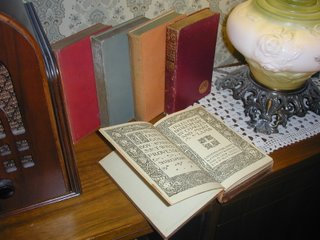
I really like the old Everyman’s Library editions “bound in cloth with gilt design and coloured top,” but they don’t photograph well, especially when the covers are a bit faded.
These are some old books that will be familiar to Ambleside Online users. The yellow book is To Far Cathay, by William C. Bagley Jr., a story of Marco Polo (published in 1935). My schoolteacher great-aunt had it on her shelf for forty years and then gave it to me; both The Apprentice and Ponytails have used it for school. The brown book is Canada’s Story, by H.E.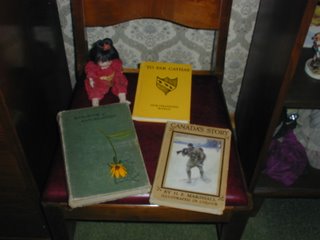 Marshall, part of her Empire Story collection. And the green one is Volume 1 of Anna Botsford Comstock’s Handbook of Nature Study (published in two volumes, this printing from 1924). The inscription in it says “Jennie M. Gaskill, Bryn Athyn, Pa.” Jennie Gaskill was an author as well (there are scattered online references to her), and Bryn Athyn is a bastion of the New Church (the Swedenborgians). But how did the book get all the way up to a used bookstore in Ontario? I was browsing in the nature section (this was several years ago) and thought, wouldn't it be amazing if...and there it was. I pulled it off the shelf, not knowing what it was (the spine is unreadable). (I did look for the other volume too, but it wasn't there.)
Abiding in Thee reminds me of The Country Diary of An Edwardian Lady, except that it’s all Christian verse, illustrated with watercolours of flowers. It was printed in Toronto and has an inscription from 1900 (my great-great-grandmother’s name).
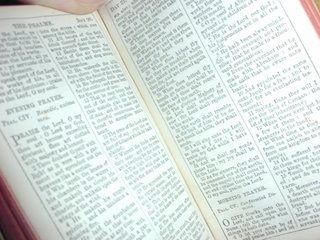
The smallest one is a Book of Common Prayer with metal edges and the findings for a clasp (the clasp is gone though). It was printed in England and it has very small print (I feel sorry for older people trying to make that out in poorly-lit churches!).
The other small book, the dark brown one, is older; it’s A Selection of Psalms, Hymns and Anthems, with a really interesting inscription: the same great-great-grandmother’s maiden name, and then “Pew No. 30, St. Paul’s Church, Yorkville, C.W.” Do you know what C.W. stands for? Canada West; that’s the pre-Confederation name for Ontario. That date’s confirmed by the book itself: it was printed in Toronto in 1861.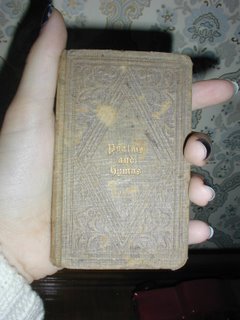
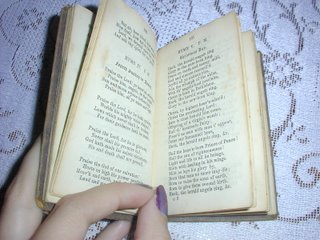
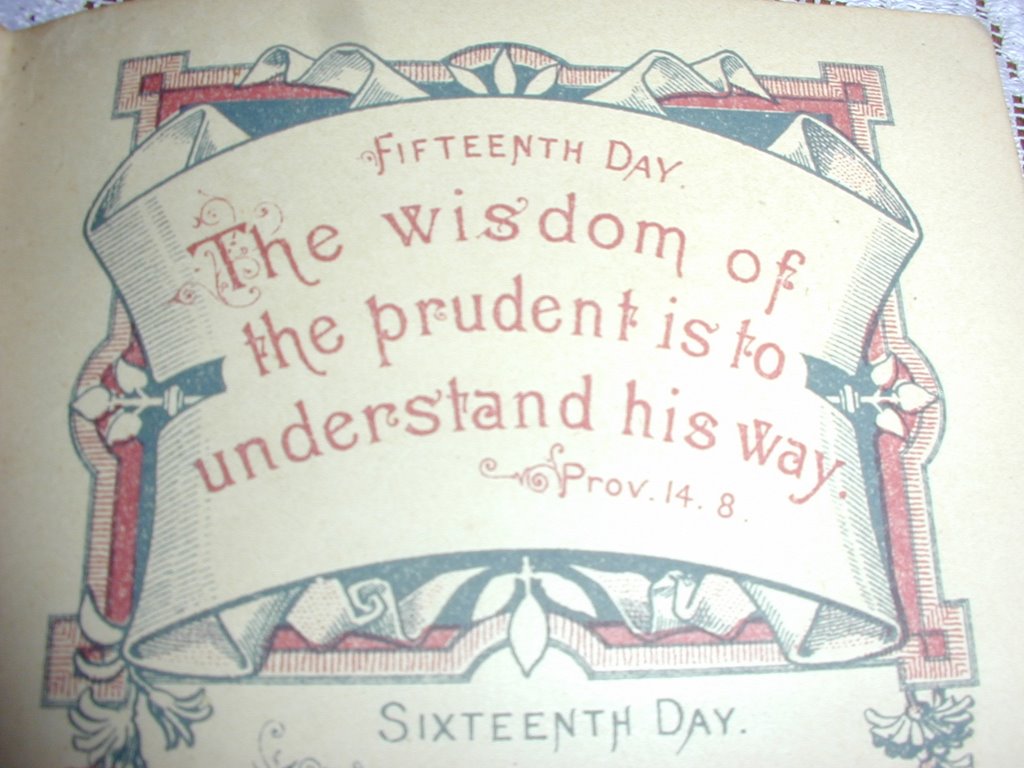
The fourth book is only about sixteen pages long. It’s called “I Am the Way,” from the “I Am Series” published by the Toronto Willard Tract Depository. No date given, although there’s an inscription in the front cover, to my great-grandmother from her cousin Lizzie, so I’m guessing from that and from the style that it’s from around the turn of the last century. It’s meant to be a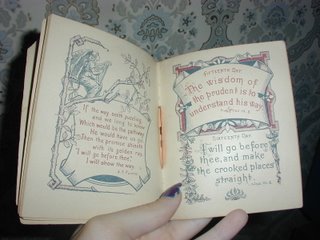 month-long devotional, almost like a copy-book. Each day’s saying or verse is separated by scrolls and borders that make the verses look like framed mottoes in Victorian parlours. One page says, “Fifteenth Day. The wisdom of the prudent is to understand his way. Prov.14.8. Sixteenth Day. I will go before thee and make the crooked places straight. Isa. 45.2.”
Then on the facing page there’s a verse decorated with drawings and borders:
“If the way seem puzzling,
And we long to know
Which would be the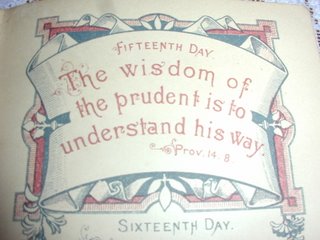 pathway
He would have us go,
Then the promise shineth
With its golden ray,
‘I will go before thee,
I will show the way.’—A.F. Purdon.”
October 1st was a rummage sale at one of those churches that always has good rummage sales, and usually a big book table.
We got there fairly late in the morning, which doesn’t usually matter much. We have odd enough tastes in old things that what we like is usually still there by the time we get moving on Saturdays.
But there didn’t seem to be any books. Strange, but maybe books were too much of a hassle to deal with? So I asked, and they said, “There were lots of books! But someone just came in and bought them all!” Every single book at a church rummage sale? “It’s never happened before! But we couldn’t say no!” Well, it saves repacking all those books that didn’t sell!
But Humph. And I was hoping to post something in response to all those lovely posts of the DHM’s about her library-sale-to-end-all-library-sales. Not the-book-to-end-all-books, of course. Just one or two interesting finds?
Well, I did get an abridged cassette version of David Copperfield. (I guess Mr. Buy-them-out missed that one.)
But since I don’t have else anything brand new (or should I say old) to post about, I’ve employed The Apprentice and her digital photography skills to show you some books that we already had.

I really like the old Everyman’s Library editions “bound in cloth with gilt design and coloured top,” but they don’t photograph well, especially when the covers are a bit faded.
| I have my grandma’s childhood copy of Tales from Shakespeare, so that’s my favourite; the rest have mostly been picked out at used book sales. | 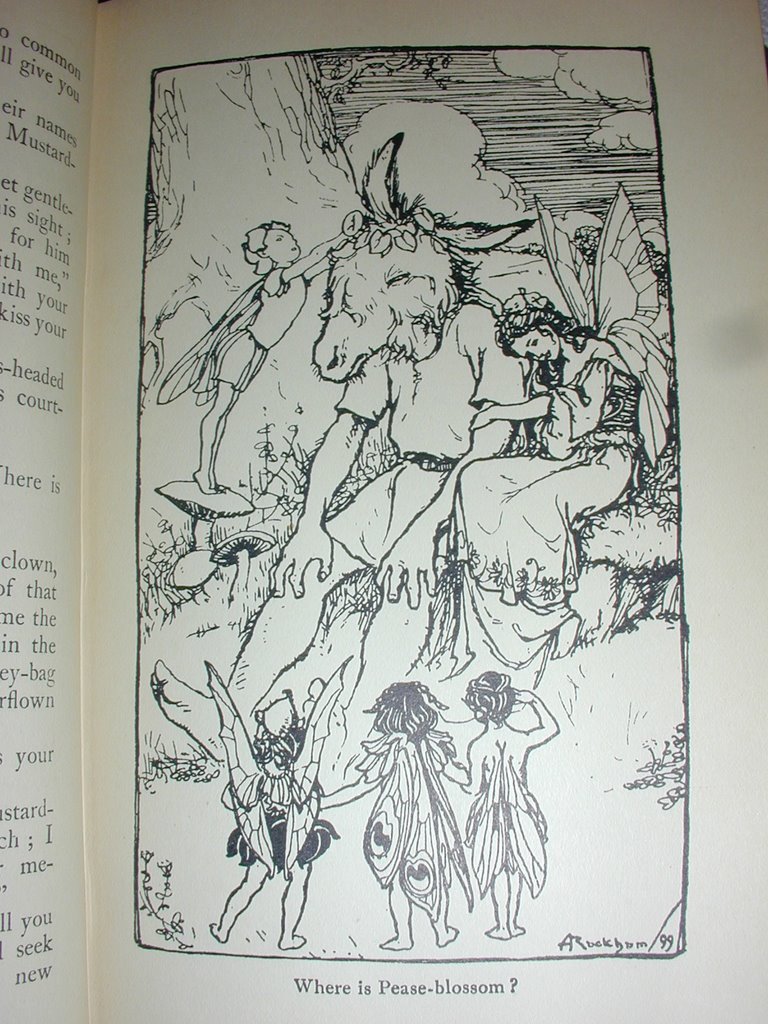 |
These are some old books that will be familiar to Ambleside Online users. The yellow book is To Far Cathay, by William C. Bagley Jr., a story of Marco Polo (published in 1935). My schoolteacher great-aunt had it on her shelf for forty years and then gave it to me; both The Apprentice and Ponytails have used it for school. The brown book is Canada’s Story, by H.E.
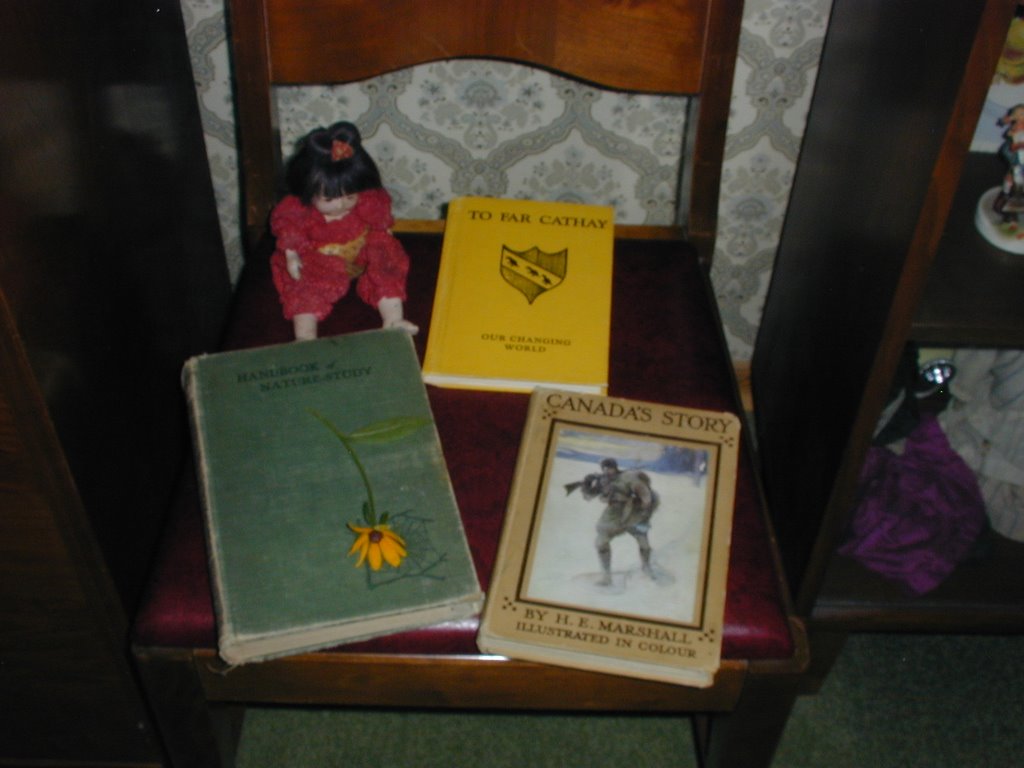 Marshall, part of her Empire Story collection. And the green one is Volume 1 of Anna Botsford Comstock’s Handbook of Nature Study (published in two volumes, this printing from 1924). The inscription in it says “Jennie M. Gaskill, Bryn Athyn, Pa.” Jennie Gaskill was an author as well (there are scattered online references to her), and Bryn Athyn is a bastion of the New Church (the Swedenborgians). But how did the book get all the way up to a used bookstore in Ontario? I was browsing in the nature section (this was several years ago) and thought, wouldn't it be amazing if...and there it was. I pulled it off the shelf, not knowing what it was (the spine is unreadable). (I did look for the other volume too, but it wasn't there.)
| And this is a collection of small books that belonged to the mother and grandmother of that great-aunt. The largest one, Abiding in Thee, is 5 by 6 inches, and the smallest is 2 by almost 4 inches. | 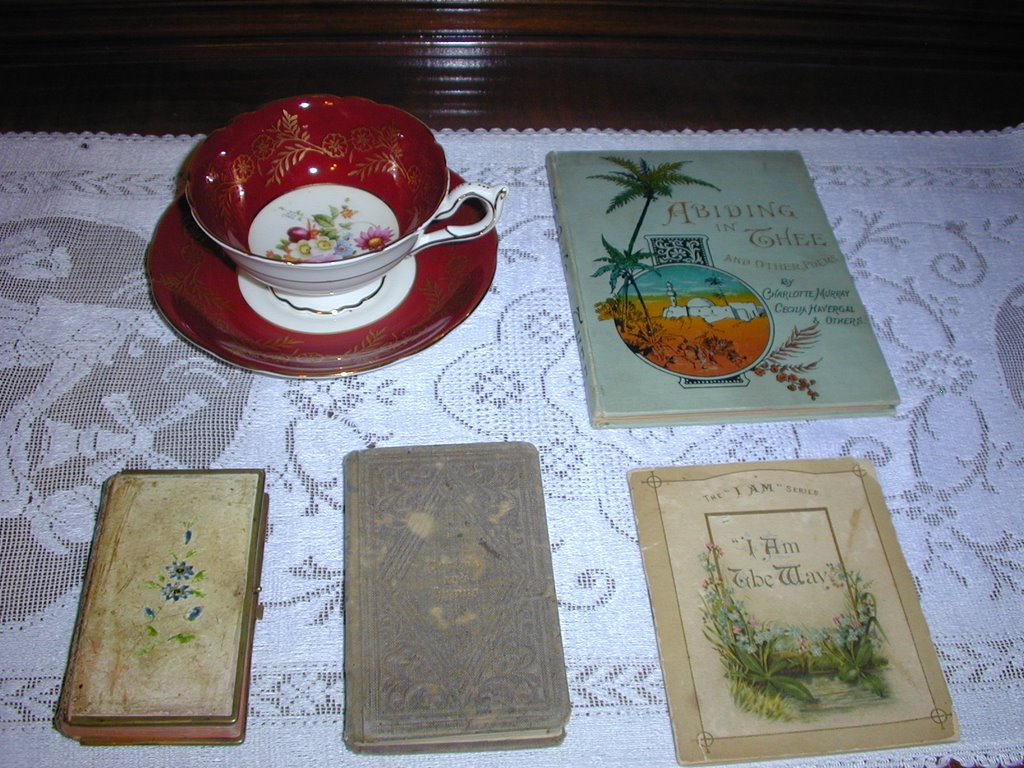 |
Abiding in Thee reminds me of The Country Diary of An Edwardian Lady, except that it’s all Christian verse, illustrated with watercolours of flowers. It was printed in Toronto and has an inscription from 1900 (my great-great-grandmother’s name).
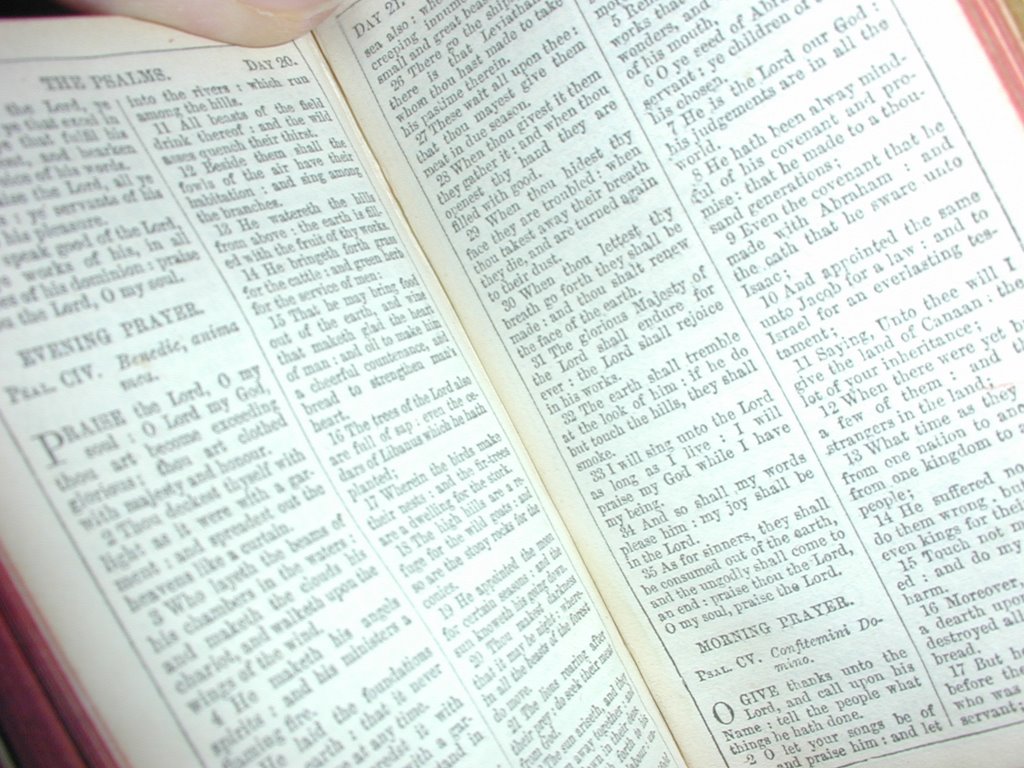
The smallest one is a Book of Common Prayer with metal edges and the findings for a clasp (the clasp is gone though). It was printed in England and it has very small print (I feel sorry for older people trying to make that out in poorly-lit churches!).
The other small book, the dark brown one, is older; it’s A Selection of Psalms, Hymns and Anthems, with a really interesting inscription: the same great-great-grandmother’s maiden name, and then “Pew No. 30, St. Paul’s Church, Yorkville, C.W.” Do you know what C.W. stands for? Canada West; that’s the pre-Confederation name for Ontario. That date’s confirmed by the book itself: it was printed in Toronto in 1861.


The fourth book is only about sixteen pages long. It’s called “I Am the Way,” from the “I Am Series” published by the Toronto Willard Tract Depository. No date given, although there’s an inscription in the front cover, to my great-grandmother from her cousin Lizzie, so I’m guessing from that and from the style that it’s from around the turn of the last century. It’s meant to be a
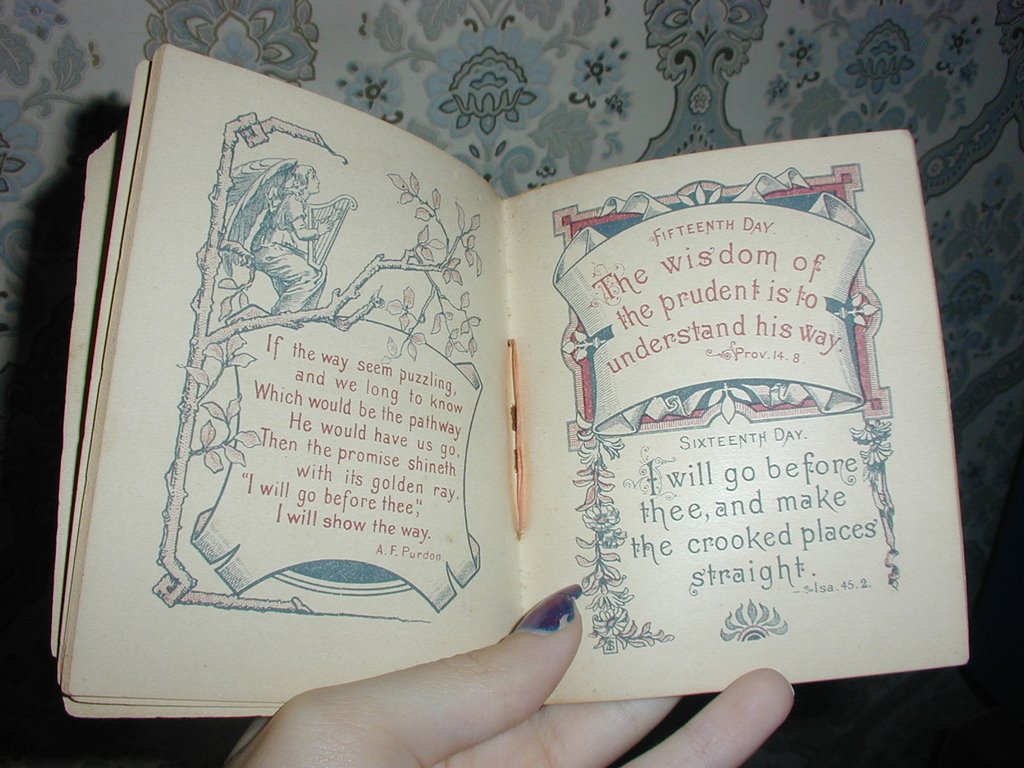 month-long devotional, almost like a copy-book. Each day’s saying or verse is separated by scrolls and borders that make the verses look like framed mottoes in Victorian parlours. One page says, “Fifteenth Day. The wisdom of the prudent is to understand his way. Prov.14.8. Sixteenth Day. I will go before thee and make the crooked places straight. Isa. 45.2.”
Then on the facing page there’s a verse decorated with drawings and borders:
“If the way seem puzzling,
And we long to know
Which would be the
 pathway
He would have us go,
Then the promise shineth
With its golden ray,
‘I will go before thee,
I will show the way.’—A.F. Purdon.”
Friday, October 13, 2006
Beatific photography
One of the Beehive inhabitants, Beatrice, has begun a blog of her photographs. I thought that might interest a couple of regular Treehouse visitors. I especially liked the egg photography in this post.
Thursday, October 12, 2006
Chef Earl's Soup (and Ruby Red Rutabagas)
In February 2003, Canadian Living Magazine published a story about chef Earl Johnson's way-better-than-your-average-cafeteria-food at Gordon Bell High School in Winnipeg. They followed up that October (after many requests) with some of his recipes. We've been making his Potage Paysanne ever since, on cold days and when we can manage to get turnip (we use rutabaga), parsnips, leeks and parsley all in our fridge at the same time. (Sometimes we leave one or the other of those things out.)
Now Mama Squirrel must be unflinchingly honest: she hates rutabaga. Rutabaga crumble, rutabaga casserole, rutabaga disguised with apples and spices--it's still rutabaga. Rutabaga raw and sliced is tolerable; and Earl's soup makes it taste...well, about as good as you're going to get a rutabaga to taste. We figured if Earl could convince the teenagers in Winnipeg to eat this, it must have something going for it.
And it gives us one way to eat our ruby-red rutabagas with a smile.
(I'm not posting the recipe, in case you wondered or missed the link; Canadian Living did it nicer than I can, here.)
Now Mama Squirrel must be unflinchingly honest: she hates rutabaga. Rutabaga crumble, rutabaga casserole, rutabaga disguised with apples and spices--it's still rutabaga. Rutabaga raw and sliced is tolerable; and Earl's soup makes it taste...well, about as good as you're going to get a rutabaga to taste. We figured if Earl could convince the teenagers in Winnipeg to eat this, it must have something going for it.
And it gives us one way to eat our ruby-red rutabagas with a smile.
(I'm not posting the recipe, in case you wondered or missed the link; Canadian Living did it nicer than I can, here.)
Wednesday, October 11, 2006
This is really, really good
I found this recipe a long time ago in an ad for Nabisco 100% Bran Cereal (Nabisco's version of All-Bran). The ad called it Coffeeberry Loaf, which makes no sense at all since it contains neither coffee nor coffeeberries. Since I don't usually bake it in a loaf pan either (takes too long), it definitely needs a new name. Cranberry-Apricot Cake isn't imaginative, but it will have to do until we can think of something better.
When you take the cake out of the oven, it will smell like a piece of orange cranberry heaven--especially if you use orange-flavoured dried cranberries. The leftovers are very good for breakfast.
Cranberry-Apricot Cake (or Loaf)
2 eggs
1 cup orange juice
1/3 cup butter, melted (I used soft margarine and I didn't melt it first, just beat it around with the other ingredients)
1 cup Nabisco 100% Bran Cereal (or another brand)
3/4 cup chopped dried apricots (I left them out this time and the cake was still good. I love apricots, but the almost two cups of dried fruit is almost too much for the amount of batter here; too many extras tend to make the cake fall apart. You might try 1/2 to 3/4 cup chopped apricots and the same amount of dried cranberries, if you find that's a problem.)
1 3/4 cups all-purpose flour (I use unbleached)
1/2 cup packed brown sugar
2 tsp. baking powder
1 cup cranberries: fresh, frozen, or dried (I use Craisins)
Whisk together eggs, orange juice and butter. Stir in cereal and apricots; let stand 5 minutes.
Mix flour, brown sugar and baking powder in a large bowl. Add cereal mixture to dry ingredients, stirring just until moistened. You may find you need a little more liquid.
Fold in cranberries (do not over-mix). Spread evenly in a greased 9 by 5 inch loaf pan, OR an 8-inch square pan.
Bake at 350 degrees F for 55 to 60 minutes (in the loaf pan) or less (in the square pan), until a tester comes out clean. (You can bake it in a toaster oven too.) Cool in the pan 10 minutes, and then turn the loaf out onto a rack to cool completely. (If you bake it in a square pan, you probably wouldn't bother turning it out.) If you eat it before it's cooled, it will taste good but be very crumbly.
When you take the cake out of the oven, it will smell like a piece of orange cranberry heaven--especially if you use orange-flavoured dried cranberries. The leftovers are very good for breakfast.
Cranberry-Apricot Cake (or Loaf)
2 eggs
1 cup orange juice
1/3 cup butter, melted (I used soft margarine and I didn't melt it first, just beat it around with the other ingredients)
1 cup Nabisco 100% Bran Cereal (or another brand)
3/4 cup chopped dried apricots (I left them out this time and the cake was still good. I love apricots, but the almost two cups of dried fruit is almost too much for the amount of batter here; too many extras tend to make the cake fall apart. You might try 1/2 to 3/4 cup chopped apricots and the same amount of dried cranberries, if you find that's a problem.)
1 3/4 cups all-purpose flour (I use unbleached)
1/2 cup packed brown sugar
2 tsp. baking powder
1 cup cranberries: fresh, frozen, or dried (I use Craisins)
Whisk together eggs, orange juice and butter. Stir in cereal and apricots; let stand 5 minutes.
Mix flour, brown sugar and baking powder in a large bowl. Add cereal mixture to dry ingredients, stirring just until moistened. You may find you need a little more liquid.
Fold in cranberries (do not over-mix). Spread evenly in a greased 9 by 5 inch loaf pan, OR an 8-inch square pan.
Bake at 350 degrees F for 55 to 60 minutes (in the loaf pan) or less (in the square pan), until a tester comes out clean. (You can bake it in a toaster oven too.) Cool in the pan 10 minutes, and then turn the loaf out onto a rack to cool completely. (If you bake it in a square pan, you probably wouldn't bother turning it out.) If you eat it before it's cooled, it will taste good but be very crumbly.
Homeschooling is an education
Things I’ve learned from homeschooling
1. How to get laundry in and start lunch between math and geography.
2. That there's no such thing as too many bookshelves.
3. That the thermosphere is hot but it's not.
4. That hymns are a good way to start the day.
5. A lot about my kids, my husband, and myself.
Things I’ve learned about homeschooling
1. Trust your instincts and your memories. If your gut reaction to something is “ugh” or “why?” or “I would never inflict this on my kids,” you’re probably right. I’ve felt an instinctive “no” about many things. One was a kindergarten math outline that consisted of making a booklet for One, a booklet for Two, a booklet for Three…a booklet for Seventeen…uh huh. Another was the long vowel-short vowel reading approach—that gave me some BAD flashbacks to a first grade class where we circled pictures of pigs and pails and pins and and pens (always fountain pens, for some unexplained reason). The Squirrelings seemed to approach learning better by getting a good running start and then jumping over as much as they could at a time.
2. But stay open minded, too. A book that a bad teacher ruined for you; something you think is too hard for kids; a subject you never thought you were good at—those things can become real and fascinating when you read or study them with children who come without those prejudices. Sometimes opening the door to a new passion is all it takes; sometimes you need a little more perseverance; but the rewards are great. You may witness the beginnings of the world’s next great artist or scientist or missionary.
3. It's okay if every school day isn't perfectly balanced. Most homeschoolers expect and deal with interruptions; and some days you just get more done than others. But you can also plan things to be a bit unbalanced so that you get other things done. The Hillbilly Housewife touched on this in something about menu planning:
4. You are always adjusting and retooling, because your children and learning and changing; because you have more or fewer of them to teach as they grow and graduate; because new books and materials come your way; and because you are learning and changing too.
1. How to get laundry in and start lunch between math and geography.
2. That there's no such thing as too many bookshelves.
3. That the thermosphere is hot but it's not.
4. That hymns are a good way to start the day.
5. A lot about my kids, my husband, and myself.
Things I’ve learned about homeschooling
1. Trust your instincts and your memories. If your gut reaction to something is “ugh” or “why?” or “I would never inflict this on my kids,” you’re probably right. I’ve felt an instinctive “no” about many things. One was a kindergarten math outline that consisted of making a booklet for One, a booklet for Two, a booklet for Three…a booklet for Seventeen…uh huh. Another was the long vowel-short vowel reading approach—that gave me some BAD flashbacks to a first grade class where we circled pictures of pigs and pails and pins and and pens (always fountain pens, for some unexplained reason). The Squirrelings seemed to approach learning better by getting a good running start and then jumping over as much as they could at a time.
2. But stay open minded, too. A book that a bad teacher ruined for you; something you think is too hard for kids; a subject you never thought you were good at—those things can become real and fascinating when you read or study them with children who come without those prejudices. Sometimes opening the door to a new passion is all it takes; sometimes you need a little more perseverance; but the rewards are great. You may witness the beginnings of the world’s next great artist or scientist or missionary.
3. It's okay if every school day isn't perfectly balanced. Most homeschoolers expect and deal with interruptions; and some days you just get more done than others. But you can also plan things to be a bit unbalanced so that you get other things done. The Hillbilly Housewife touched on this in something about menu planning:
"Monday is a big work day in homeschool, so something relatively easy is in order. Dirty Rice with ground turkey or beef will be nice, but I'll have to use celery instead of green pepper because it's out of season and outside of my budget. Wednesday is a slow day at school and I'll be baking anyway so beans will be good. While I'm at it, I might as well make enough for chili the next day. I have time for making chili on Thursday morning while the kids are doing their independent reading."
4. You are always adjusting and retooling, because your children and learning and changing; because you have more or fewer of them to teach as they grow and graduate; because new books and materials come your way; and because you are learning and changing too.
Saturday, October 07, 2006
A quick trip to the thrift shop
It was one of those quiet, sunny afternoons when nobody wanted Mama Squirrel around...sniff. So she quietly sneaked away and caught the bus downtown to her favourite thrift shop to check out the back book corner.
And came back with a few things. (A bag of books and a pink shirt, all for six dollars.)
(There, now I get to list some finds too.)
Alison Uttley, Tales of Little Grey Rabbit
Cyril Davey, Lady with a Lamp. This is a biography of Florence Nightingale, one of the Stories of Faith and Fame series published by Lutterworth Press, I think in the '50's, although this printing is from the '70's. (I think they must have been common as Sunday School prizes at one time, going by the inscriptions inside them.) We have four others from this series: Elizabeth Fry, Martin Luther, Robert Moffat, and William Carey. The ones we've read are well-written and interesting, and just right for upper-elementary students.
The Magic School Bus Plants Seeds, just because I know we are getting to a seed chapter pretty soon in the botany book.
Donald B. Kraybill, The Upside-Down Kingdom. Our own Sunday School teacher recommended this one.
Meindert De Jong, Shadrach. (Illustrated by Maurice Sendak.) About a boy and a rabbit. "A real, live rabbit! A little black rabbit, if possible. In a week, if possible. And this was in the Netherlands." I thought this might be one that Crayons could read to herself.
Gavin Maxwell, The Otter's Tale.
Janice VanCleave, Math for Every Kid. Lots of stuff here for Ponytails.
Walter Buehr, Knights and Castles and Feudal Life. You can't lose with Walter Buehr.
Two books for Mama Squirrel: My Name is Asher Lev (Chaim Potok) and Breathing Lessons (Anne Tyler). Mama Squirrel has read Breathing Lessons before (and watched the movie), but it has been awhile. Her favourite Anne Tyler novels are still Dinner at the Homesick Restaurant and Celestial Navigation...and Saint Maybe. And Ladder of Years.
And came back with a few things. (A bag of books and a pink shirt, all for six dollars.)
(There, now I get to list some finds too.)
Alison Uttley, Tales of Little Grey Rabbit
Cyril Davey, Lady with a Lamp. This is a biography of Florence Nightingale, one of the Stories of Faith and Fame series published by Lutterworth Press, I think in the '50's, although this printing is from the '70's. (I think they must have been common as Sunday School prizes at one time, going by the inscriptions inside them.) We have four others from this series: Elizabeth Fry, Martin Luther, Robert Moffat, and William Carey. The ones we've read are well-written and interesting, and just right for upper-elementary students.
The Magic School Bus Plants Seeds, just because I know we are getting to a seed chapter pretty soon in the botany book.
Donald B. Kraybill, The Upside-Down Kingdom. Our own Sunday School teacher recommended this one.
Meindert De Jong, Shadrach. (Illustrated by Maurice Sendak.) About a boy and a rabbit. "A real, live rabbit! A little black rabbit, if possible. In a week, if possible. And this was in the Netherlands." I thought this might be one that Crayons could read to herself.
Gavin Maxwell, The Otter's Tale.
Janice VanCleave, Math for Every Kid. Lots of stuff here for Ponytails.
Walter Buehr, Knights and Castles and Feudal Life. You can't lose with Walter Buehr.
Two books for Mama Squirrel: My Name is Asher Lev (Chaim Potok) and Breathing Lessons (Anne Tyler). Mama Squirrel has read Breathing Lessons before (and watched the movie), but it has been awhile. Her favourite Anne Tyler novels are still Dinner at the Homesick Restaurant and Celestial Navigation...and Saint Maybe. And Ladder of Years.
Thursday, October 05, 2006
Using Hillyer's History
The Deputy Headmistress posted some lesson plans (here, here) that she wrote for her girls to use with one of the Draw Write Now books. I made up something similar for Ponytails to use this fall along with chapters from V.M. Hillyer's A Child's History of the World. Like the DHM's guide, this is meant only to show what might be done; it includes books that we already had, and there are sure to be others that would be just as good for maps and pictures. (Usborne tends to show a bit more violence and unclothedness than I would sometimes like.)
So when I say "Read these pages in Usborne's Ancient World," it isn't heavy reading at all; the Usborne books are heavily illustrated, with many double-page spreads; one page, for instance, might have a detailed drawing of a group of Egyptians having a party. I've tried to fit those pages in AFTER the reading on that subject in Hillyer's book, except where I thought the picture or map needed to be seen ahead of time.
The lessons here go only from the beginning of Hillyer's section on Mesopotamia. We read the chapters on Egypt too, but I started the "study guide" at about the time we were finishing them. She doesn't have a large timeline book to work in yet, so she is just adding drawings and occasional comments to a blank notebook as she goes along. We have a timeline in the kitchen and we're adding occasional sticky notes to it to mark events; Hillyer's dates for ancient history are sometimes questionable, but we'll stick with them for now.
One other thing is that we are using a reproduction of Hillyer's original book, which means that the pages and chapters in updated editions won't match exactly. The point of posting this is just to show the sort of thing that Ponytails is doing.
Extra books used:
Usborne Book of World History (Update: One of the reviews on Amazon points out that World History is VERY choppy and sparse, and I agree; the reviewer says she prefers the Ancient World book, and I agree with that too! But we are still using this book here and there for pictures and bits of information.)
Usborne Ancient World
History Detectives: Ancient Greece
D’Aulaires’ Book of Greek Myths
The British Museum Timeline of the Ancient World
The Bible, Tanglewood Tales, and poems
MESOPOTAMIA (includes Sumer, Assyria and Babylonia)
Find a map showing the Tigris and Euphrates rivers (see Mom) and the Fertile Crescent.
Read Hillyer p. 42 and 43 (top), looking at the map
Read Ancient World p 6-7
Read World History p 8-9
Learn the ABC of Mesopotamia: Assyria, Babylonia, Chaldea. (Chaldea was part of Babylonia.)
Read the rest of p 43 & 44, and half of p 45.
Talk to Mom about Mesopotamia and the other names from the book.
What is a ziggurat? In your notebook, draw a Babylonian building.
Read the rest of the chapter (pages 45-48).
Read Ancient World p 8-9.
Read World History p 10-11, 12-13, 30-31.
Check the timeline in the kitchen to see how far back Mesopotamia goes.
Add anything else you like to the Mesopotamia and Babylonia page in your notebook.
Find Ur on a map (check with Mom).
Look at Ancient World page 28.
Mark the timeline: “Ur to Canaan, 1900 BC”
Read Hillyer pages 49-51
Divide a notebook page into three sections, and draw or write something about each section of this chapter.
Mark the timeline: “Canaan to Egypt, 1700 BC”
Read Ancient World p 38-39
Read Hillyer from the bottom of p 51 to the bottom of p 54.
What was the Exodus? Talk with Mom about who the Pharaoh was then. (Was it Rameses or someone else?) Talk about when this might have happened.
Mark the timeline: “Egypt back to Canaan.” Use the date that you discussed with Mom.
Finish the chapter (page 55).
Finish the notebook page for this chapter.
SOME STORIES FROM ANCIENT GREECE
Find Greece on the globe.
Read Hillyer chapter 10, pages 56-61, about the names of some Greek gods.
Look up their pictures in the D’Aulaires’ book of Greek stories or in History Detectives pages 14-15.
Find Athens on a map of Greece.
Start a notebook page for this chapter.
Finish reading the chapter (p 61-63)
Finish the notebook page.
Read the chapter “A Fairy-tale War”, up to the bottom of page 67.
Use half a page in your notebook to show the Trojan War (maybe the wooden horse?)
Read the rest of the chapter, about Homer’s poems.
Find the picture of Homer on our timeline.
Read the story of Circe in Tanglewood Tales (with Mom).
Ask Mom for more information about Homer (who was he really?).
Use the other half of the notebook page for Homer.
BIBLE STORIES ARE REAL
Read Hillyer chapter 12, Kings of the Jews.
Ask Mom why the last paragraph of the chapter is no longer true.
Make a notebook page for the Temple, including the date.
PHOENICIANS
Read pages 74 and 75, about the “Phenician alphabet.” Find out how we usually spell “Phenician” now.
Look at the Ancient World, pages 40-41. What were the Phoenicians famous for?
Read World History pages 50-51.
Read the rest of the Hillyer chapter.
Find Tyre and Sidon on a map (Ancient World page 41).
Make a notebook page for the Phoenicians.
ATHENS AND SPARTA
Find Sparta on a map of Greece (Ancient World page 50 or World History page 67).
Read Hillyer chapter 14, pages 79-81.
Write in your notebook some ways that Lycurgus tried to make his people hard and strong. (Use half a page for Sparta.)
Read the rest of the chapter.
Use the other half of the notebook page for Athens.
Read chapter 15, about the first Olympics.
Read History Detectives pages 24-25. Look at the British Museum book, page 24.
Make a notebook page about the Olympics. Include the date.
So when I say "Read these pages in Usborne's Ancient World," it isn't heavy reading at all; the Usborne books are heavily illustrated, with many double-page spreads; one page, for instance, might have a detailed drawing of a group of Egyptians having a party. I've tried to fit those pages in AFTER the reading on that subject in Hillyer's book, except where I thought the picture or map needed to be seen ahead of time.
The lessons here go only from the beginning of Hillyer's section on Mesopotamia. We read the chapters on Egypt too, but I started the "study guide" at about the time we were finishing them. She doesn't have a large timeline book to work in yet, so she is just adding drawings and occasional comments to a blank notebook as she goes along. We have a timeline in the kitchen and we're adding occasional sticky notes to it to mark events; Hillyer's dates for ancient history are sometimes questionable, but we'll stick with them for now.
One other thing is that we are using a reproduction of Hillyer's original book, which means that the pages and chapters in updated editions won't match exactly. The point of posting this is just to show the sort of thing that Ponytails is doing.
Extra books used:
Usborne Book of World History (Update: One of the reviews on Amazon points out that World History is VERY choppy and sparse, and I agree; the reviewer says she prefers the Ancient World book, and I agree with that too! But we are still using this book here and there for pictures and bits of information.)
Usborne Ancient World
History Detectives: Ancient Greece
D’Aulaires’ Book of Greek Myths
The British Museum Timeline of the Ancient World
The Bible, Tanglewood Tales, and poems
MESOPOTAMIA (includes Sumer, Assyria and Babylonia)
Find a map showing the Tigris and Euphrates rivers (see Mom) and the Fertile Crescent.
Read Hillyer p. 42 and 43 (top), looking at the map
Read Ancient World p 6-7
Read World History p 8-9
Learn the ABC of Mesopotamia: Assyria, Babylonia, Chaldea. (Chaldea was part of Babylonia.)
Read the rest of p 43 & 44, and half of p 45.
Talk to Mom about Mesopotamia and the other names from the book.
What is a ziggurat? In your notebook, draw a Babylonian building.
Read the rest of the chapter (pages 45-48).
Read Ancient World p 8-9.
Read World History p 10-11, 12-13, 30-31.
Check the timeline in the kitchen to see how far back Mesopotamia goes.
Add anything else you like to the Mesopotamia and Babylonia page in your notebook.
Find Ur on a map (check with Mom).
Look at Ancient World page 28.
Mark the timeline: “Ur to Canaan, 1900 BC”
Read Hillyer pages 49-51
Divide a notebook page into three sections, and draw or write something about each section of this chapter.
Mark the timeline: “Canaan to Egypt, 1700 BC”
Read Ancient World p 38-39
Read Hillyer from the bottom of p 51 to the bottom of p 54.
What was the Exodus? Talk with Mom about who the Pharaoh was then. (Was it Rameses or someone else?) Talk about when this might have happened.
Mark the timeline: “Egypt back to Canaan.” Use the date that you discussed with Mom.
Finish the chapter (page 55).
Finish the notebook page for this chapter.
SOME STORIES FROM ANCIENT GREECE
Find Greece on the globe.
Read Hillyer chapter 10, pages 56-61, about the names of some Greek gods.
Look up their pictures in the D’Aulaires’ book of Greek stories or in History Detectives pages 14-15.
Find Athens on a map of Greece.
Start a notebook page for this chapter.
Finish reading the chapter (p 61-63)
Finish the notebook page.
Read the chapter “A Fairy-tale War”, up to the bottom of page 67.
Use half a page in your notebook to show the Trojan War (maybe the wooden horse?)
Read the rest of the chapter, about Homer’s poems.
Find the picture of Homer on our timeline.
Read the story of Circe in Tanglewood Tales (with Mom).
Ask Mom for more information about Homer (who was he really?).
Use the other half of the notebook page for Homer.
BIBLE STORIES ARE REAL
Read Hillyer chapter 12, Kings of the Jews.
Ask Mom why the last paragraph of the chapter is no longer true.
Make a notebook page for the Temple, including the date.
PHOENICIANS
Read pages 74 and 75, about the “Phenician alphabet.” Find out how we usually spell “Phenician” now.
Look at the Ancient World, pages 40-41. What were the Phoenicians famous for?
Read World History pages 50-51.
Read the rest of the Hillyer chapter.
Find Tyre and Sidon on a map (Ancient World page 41).
Make a notebook page for the Phoenicians.
ATHENS AND SPARTA
Find Sparta on a map of Greece (Ancient World page 50 or World History page 67).
Read Hillyer chapter 14, pages 79-81.
Write in your notebook some ways that Lycurgus tried to make his people hard and strong. (Use half a page for Sparta.)
Read the rest of the chapter.
Use the other half of the notebook page for Athens.
Read chapter 15, about the first Olympics.
Read History Detectives pages 24-25. Look at the British Museum book, page 24.
Make a notebook page about the Olympics. Include the date.
Monday, October 02, 2006
It's the heart part
This is another of those posts that I’ve been trying to pull together for awhile, and it’s been even harder and slower to write than the frugal post. What’s made it hard is trying not to say exactly the same thing I’ve said so many times in different places: in homeschooling, simpler is better not only because it saves money and space, or because it’s more creative or more flexible, but because of heart.
I could write at length about how you teach with a bagful of yard sale stuff, or about how many math games we can play with a pair of dice and some file cards, but in the end, it comes down to heart. I kept circling around with ideas, trying to figure out what the “heart” of what I was trying to say—and I realized, that’s it. The best part of homeschooling is the heart part, and without that, nothing matters.
That’s why Crayons and I can just be sitting on the floor together finding numbers on a hundred chart and then reading “The Jumblies” for the umpteenth time, and I suddenly realize (for the umpteenth time) that this is exactly the way it should be. It’s about the neighbour we barely knew inviting us into her back yard to see her twenty different kinds of pterophyta (if you missed that one, pterophyta literally means “wing plant”—ferns). It’s about The Apprentice offering to help Ponytails put one of her birthday-present craft kits together. It’s what I wrote last year about coming home from somewhere and seeing dad legs and girl legs sticking out from under the car. It's about sometimes letting lessons go because Crayons is busy with Rhymes for Annie Rose and Ponytails is exploring an old adding machine that was given to us yesterday.
It’s about the Squirrelings’ growing familiarity with the photos on our ancient-history timeline; by the end of the year, Cleopatra and Homer and the Rosetta Stone will have become friends instead of strangers.
It’s about thinking through an education that is based on the knowledge gained from a wide reading of the best minds, in knowledge of God and His world, past and present. It’s about nurturing an educated conscience that is able to make moral decisions, act with wisdom, and show leadership. It’s about growing as good speakers, listeners, writers, thinkers; learning to follow a logical argument and discern a poor one. It’s about gathering all those little practical skills and bits of knowledge that help us function in daily life.
It’s about taking what you know and sharing it with others.
It's about knowing that there are bad days and even bad years and that it's still worthwhile.
And if you think this is on the short side for a post that's been percolating for awhile, let's just say that simpler is better.
I could write at length about how you teach with a bagful of yard sale stuff, or about how many math games we can play with a pair of dice and some file cards, but in the end, it comes down to heart. I kept circling around with ideas, trying to figure out what the “heart” of what I was trying to say—and I realized, that’s it. The best part of homeschooling is the heart part, and without that, nothing matters.
That’s why Crayons and I can just be sitting on the floor together finding numbers on a hundred chart and then reading “The Jumblies” for the umpteenth time, and I suddenly realize (for the umpteenth time) that this is exactly the way it should be. It’s about the neighbour we barely knew inviting us into her back yard to see her twenty different kinds of pterophyta (if you missed that one, pterophyta literally means “wing plant”—ferns). It’s about The Apprentice offering to help Ponytails put one of her birthday-present craft kits together. It’s what I wrote last year about coming home from somewhere and seeing dad legs and girl legs sticking out from under the car. It's about sometimes letting lessons go because Crayons is busy with Rhymes for Annie Rose and Ponytails is exploring an old adding machine that was given to us yesterday.
It’s about the Squirrelings’ growing familiarity with the photos on our ancient-history timeline; by the end of the year, Cleopatra and Homer and the Rosetta Stone will have become friends instead of strangers.
It’s about thinking through an education that is based on the knowledge gained from a wide reading of the best minds, in knowledge of God and His world, past and present. It’s about nurturing an educated conscience that is able to make moral decisions, act with wisdom, and show leadership. It’s about growing as good speakers, listeners, writers, thinkers; learning to follow a logical argument and discern a poor one. It’s about gathering all those little practical skills and bits of knowledge that help us function in daily life.
It’s about taking what you know and sharing it with others.
It's about knowing that there are bad days and even bad years and that it's still worthwhile.
And if you think this is on the short side for a post that's been percolating for awhile, let's just say that simpler is better.
Friday, September 29, 2006
A Friday morning
I'm finding Fridays are our more-relaxed homeschool day this year. Wednesdays are our sort-of-different day because we do some once-a-week subjects, but Fridays are more laid back.
After breakfast, Crayons was immersed in Rumer Godden's The Fairy Doll. She was most of the way through it by 9:00, when The Apprentice had headed off to school and Ponytails and I were ready to start lessons here. So the book was put down (reluctantly, with the bribe of a pretty bookmark) and we sang O Canada and some hymns from the Mennonite Bicentennial booklets. (Come We That Love the Lord; Unity (Ponytails' choice); and For God So Loved Us.) (Here's the German version of For God So Loved Us; I'll have to hunt online for the English.)
We read some of Proverbs 29 (since it's the 29th), from The Message. (We have a small copy, just Proverbs.)
Ponytails studied for dictation (and then wrote it) while Crayons went back to her book (and finished it). This was the dictation, from Peter Pan:
"I wish I had a pretty house,
The littlest ever seen,
With funny little red walls
And roof of mossy green."
Then we finished chapter 2 in A Child's Geography, mostly about the mesosphere. Ponytails drew herself out there with an oxygen mask on, surrounded by shooting stars. I'm not exactly sure what Crayons drew.
The girls wanted a snack and we had eaten up all the cookies, so I let them make peanut butter balls. After themess lovely snack, we played the Sum What Dice Game from Family Math, and read a couple of poems and a chapter from Crystal Mountain. And that's it for this morning...After lunch we're planning on taking the nature notebooks outside and looking for Gymnosperms and Pterophyta. Do you know what those are? (Google is off limits!). Virtual coloured pencils for right answers.
After breakfast, Crayons was immersed in Rumer Godden's The Fairy Doll. She was most of the way through it by 9:00, when The Apprentice had headed off to school and Ponytails and I were ready to start lessons here. So the book was put down (reluctantly, with the bribe of a pretty bookmark) and we sang O Canada and some hymns from the Mennonite Bicentennial booklets. (Come We That Love the Lord; Unity (Ponytails' choice); and For God So Loved Us.) (Here's the German version of For God So Loved Us; I'll have to hunt online for the English.)
We read some of Proverbs 29 (since it's the 29th), from The Message. (We have a small copy, just Proverbs.)
Ponytails studied for dictation (and then wrote it) while Crayons went back to her book (and finished it). This was the dictation, from Peter Pan:
"I wish I had a pretty house,
The littlest ever seen,
With funny little red walls
And roof of mossy green."
Then we finished chapter 2 in A Child's Geography, mostly about the mesosphere. Ponytails drew herself out there with an oxygen mask on, surrounded by shooting stars. I'm not exactly sure what Crayons drew.
The girls wanted a snack and we had eaten up all the cookies, so I let them make peanut butter balls. After the
Crayons on Rumer Godden
"I wish I was the Fairy Doll. Look, she's having a nice time. She's sitting on a toadstool!"
(We have the ex-library hardcover pictured on that website, with illustrations by Adrienne Adams. It's the same edition--although not the same copy--that I remember reading at my grandma's when I was young. We found it at a yard sale when The Apprentice was small--right after I'd been remembering that book and wondering if I could find a copy of it somewhere. Those things do happen! Ask me about Anna Comstock sometime...)
Tuesday, September 26, 2006
No moss growing under our feet
Our blogging has been a bit slow this week (combination of limited time on dialup plus school plus...). I know.
These are some things we've been doing:
1. Looking at moss as part of our Botany study. Did you know that moss is a non-vascular plant? Probably you did, but my knowledge of Botany is not great, so I'm learning along with the squirrelings. And we never knew that we had so much moss in our backyard until we went out with a magnifying glass to look for some.
2. Looking at angiosperms in our backyard, ditto. Did you know that rose hips have little fuzzy things inside of them? We cut one open, along with an unripe grape tomato, to see if their insides looked the same; but they're quite different.
3. Mama Squirrel is going to a focus group about breakfast cereal this afternoon (two hours' easy work, and yes, we admit we eat our share of cold cereal in the Treehouse, although not for dinner). The Apprentice will be home from school by that time, so she can sister-sit for awhile, and then we'll blow some of the proceeds on takeout food since Mama Squirrel isn't here to make dinner.
4. We made mummified apple slices as part of an Egyptian history lesson. You mix equal amounts of salt and baking soda, slice some apples, and put the apple slices into the mixture for a week. The slices are supposed to get leathery and dried out (like mummies) instead of rotting, if you put enough mixture on top of them.
It worked, sort of. The apples didn't rot...they were just very strange.
5. The Apprentice has been doing very well in her classes and on her assignments. The only trouble she got into last week was for playing with a yo-yo during lunch break. (The hall monitor didn't think she should be doing it over a stairwell...)
The strangest way she's spent a class period so far is watching Mrs. Doubtfire.
6. There's more, but I'm on dialup, remember? I'll be back later.
These are some things we've been doing:
1. Looking at moss as part of our Botany study. Did you know that moss is a non-vascular plant? Probably you did, but my knowledge of Botany is not great, so I'm learning along with the squirrelings. And we never knew that we had so much moss in our backyard until we went out with a magnifying glass to look for some.
2. Looking at angiosperms in our backyard, ditto. Did you know that rose hips have little fuzzy things inside of them? We cut one open, along with an unripe grape tomato, to see if their insides looked the same; but they're quite different.
3. Mama Squirrel is going to a focus group about breakfast cereal this afternoon (two hours' easy work, and yes, we admit we eat our share of cold cereal in the Treehouse, although not for dinner). The Apprentice will be home from school by that time, so she can sister-sit for awhile, and then we'll blow some of the proceeds on takeout food since Mama Squirrel isn't here to make dinner.
4. We made mummified apple slices as part of an Egyptian history lesson. You mix equal amounts of salt and baking soda, slice some apples, and put the apple slices into the mixture for a week. The slices are supposed to get leathery and dried out (like mummies) instead of rotting, if you put enough mixture on top of them.
It worked, sort of. The apples didn't rot...they were just very strange.
5. The Apprentice has been doing very well in her classes and on her assignments. The only trouble she got into last week was for playing with a yo-yo during lunch break. (The hall monitor didn't think she should be doing it over a stairwell...)
The strangest way she's spent a class period so far is watching Mrs. Doubtfire.
6. There's more, but I'm on dialup, remember? I'll be back later.
Tuesday, September 19, 2006
This is tofu? (Chocolate Pie)
This recipe was created by Jennifer McLain and was printed as a “Recipe Redux” (makeover feature) in Vegetarian Times, January 1994. I’ve found it in a couple of places online without any credit given.
Jennifer explained her need to create something wonderful (and somewhat healthier or at least lower in fat than other chocolate pie recipes) for a family special occasion: “it would have to have the taste and appearance of one that was spectacularly unhealthful.”
Well, it does! We’ve made it twice, once for Christmas when a vegan relative was coming, and once this year for dinner with friends. It’s very chocolaty (think mousse?) and very rich, and it really does serve 12 (because you won’t want a big piece. Well, maybe you will.).
This is the recipe as published, with my notes in brackets. (It took me longer to track down the right tofu and preserves than it did to make the pie.)
Chocolate Pie After Redux
(It can be made up to three days in advance.)
Ingredients
Crust:
*7 oz. chocolate wafer cookies or graham crackers
and
*2 tbsp. canola oil or melted margarine.
(My note: I just make a graham cracker crust following the directions in the Betty Crocker Cookbook. You can use any crumb crust recipe you like.)
Filling:
* 8 oz. unsweetened chocolate (a box of the supermarket kind is fine)
* 2 10-oz. packages silken tofu
(The first time I made this, I bought a 19-oz. box of aseptically-packaged silken tofu, because Jennifer insisted that the tofu be the silken type. The second time, I had to use what the supermarket offered, which was soft (but not silken) tofu in 300 g (about 10 ½ oz.) water-pack tubs. I used two tubs, and it worked fine.)
*10-oz. jar blackberry preserves
(Jennifer says that preserves made from any red berry (strawberry, raspberry or cherry) will work. You don't taste the particular fruit, it just adds sweetness and texture. The first time, I used a jar of black cherry preserves. The second time, I was again limited to what the discount supermarket had, and I had trouble finding anything in the jam aisle marked “preserves.” I settled for a cupful of E.D. Smith Triple Fruit Wildberry spread, which is thinner than normal jam and seemed to work well.)
*1 tsp. vanilla extract
*1 cup liquid honey
(You may think you need to cut back on the honey after putting in a cupful of preserves or jam. However, we tried cutting back, tasted it after blending, and agreed that it did need pretty much close to the whole cupful. Remember, you’re adding a lot of unsweetened chocolate.)
Directions
Crust (if you’re following the recipe here): Preheat oven to 350 degrees. In blender or food processor, combine cookies and oil or margarine and pulse to make fine crumbs. Press into bottom of springform pan or pie plate. Bake 10 minutes and cool.
Filling: Melt chocolate in double boiler or over very low heat. Put remaining ingredients in bowl of food processor or blender and add melted chocolate. Process until very smooth, stopping occasionally to scrape down the sides.
Pour filling into crust, smooth top, and refrigerate until firm, at least 4 hours or overnight. Serves 12. Per serving: 409 calories, 17 g fat, 57 mg carb.
Jennifer explained her need to create something wonderful (and somewhat healthier or at least lower in fat than other chocolate pie recipes) for a family special occasion: “it would have to have the taste and appearance of one that was spectacularly unhealthful.”
Well, it does! We’ve made it twice, once for Christmas when a vegan relative was coming, and once this year for dinner with friends. It’s very chocolaty (think mousse?) and very rich, and it really does serve 12 (because you won’t want a big piece. Well, maybe you will.).
This is the recipe as published, with my notes in brackets. (It took me longer to track down the right tofu and preserves than it did to make the pie.)
Chocolate Pie After Redux
(It can be made up to three days in advance.)
Ingredients
Crust:
*7 oz. chocolate wafer cookies or graham crackers
and
*2 tbsp. canola oil or melted margarine.
(My note: I just make a graham cracker crust following the directions in the Betty Crocker Cookbook. You can use any crumb crust recipe you like.)
Filling:
* 8 oz. unsweetened chocolate (a box of the supermarket kind is fine)
* 2 10-oz. packages silken tofu
(The first time I made this, I bought a 19-oz. box of aseptically-packaged silken tofu, because Jennifer insisted that the tofu be the silken type. The second time, I had to use what the supermarket offered, which was soft (but not silken) tofu in 300 g (about 10 ½ oz.) water-pack tubs. I used two tubs, and it worked fine.)
*10-oz. jar blackberry preserves
(Jennifer says that preserves made from any red berry (strawberry, raspberry or cherry) will work. You don't taste the particular fruit, it just adds sweetness and texture. The first time, I used a jar of black cherry preserves. The second time, I was again limited to what the discount supermarket had, and I had trouble finding anything in the jam aisle marked “preserves.” I settled for a cupful of E.D. Smith Triple Fruit Wildberry spread, which is thinner than normal jam and seemed to work well.)
*1 tsp. vanilla extract
*1 cup liquid honey
(You may think you need to cut back on the honey after putting in a cupful of preserves or jam. However, we tried cutting back, tasted it after blending, and agreed that it did need pretty much close to the whole cupful. Remember, you’re adding a lot of unsweetened chocolate.)
Directions
Crust (if you’re following the recipe here): Preheat oven to 350 degrees. In blender or food processor, combine cookies and oil or margarine and pulse to make fine crumbs. Press into bottom of springform pan or pie plate. Bake 10 minutes and cool.
Filling: Melt chocolate in double boiler or over very low heat. Put remaining ingredients in bowl of food processor or blender and add melted chocolate. Process until very smooth, stopping occasionally to scrape down the sides.
Pour filling into crust, smooth top, and refrigerate until firm, at least 4 hours or overnight. Serves 12. Per serving: 409 calories, 17 g fat, 57 mg carb.
Saturday, September 16, 2006
Birthdays, frugal and otherwise
The Deputy Headmistress has posted about her family's frugal birthday traditions. We do some things that are frugal, some that aren't, and some things that are just traditions. Some years the Squirrelings have had kid-parties, and some years they've opted for a family outing. Some years the birthday has extended over a weekend or a couple of days as we've celebrated with other relatives.
This week is Ponytails' birthday, and I should really be baking a cake right now instead of blogging. She's invited a couple of friends and her sisters to go mini-golfing with her tomorrow afternoon, and then they'll come back here for hamburgers and cake. Her birthday is sort of a Groovy theme this year; the girls are going to wear anything Groovy they can find, and we're making this Groovy Jeans cake. I don't do cakes that take a lot of skill with an icing tube; I like cut-up cakes or the kind that we can decorate with candies or plastic people or animals (NOT the kind from the cake decorating aisle--we usually use what we have in the toy box).
The best parties we've had are for Mr. Fixit--and they're almost always just for our own family, which is kind of a shame since they're usually very creative (if I do say so myself). The theme is always a surprise (unless he guesses), and it's usually based on whatever he's watching or doing that year. We've had a Dr. Who party (the Tardis was our hall closet), a time-travel-through-your-life party, a records party, a Junior-Monopoly-come-to-life party (when you landed on the Puppet Show, you got a real Puppet show and so on), and I can't remember what else. The most unusual was a Marvin the Star-Nosed Mole party which would only mean anything if you've seen the 13-episode run of the '80's TV series Four on the Floor with The Frantics. (Want to sign a petition to get it put on DVD?) We thought Marvin was wonderful so we made Mr. Fixit a board game starring Marvin and our own Dewey Squirrel (it was based on a Barbie Prom game I used to have), and a brown-dirt cake with a marshmallow Marvin coming out of a molehill. And brown streamers, of course.
Parties should be fun and have a bit of surprise to them, even if the presents are from the dollar store and we forgot to get balloons. That's pretty much the way we do it.
This week is Ponytails' birthday, and I should really be baking a cake right now instead of blogging. She's invited a couple of friends and her sisters to go mini-golfing with her tomorrow afternoon, and then they'll come back here for hamburgers and cake. Her birthday is sort of a Groovy theme this year; the girls are going to wear anything Groovy they can find, and we're making this Groovy Jeans cake. I don't do cakes that take a lot of skill with an icing tube; I like cut-up cakes or the kind that we can decorate with candies or plastic people or animals (NOT the kind from the cake decorating aisle--we usually use what we have in the toy box).
The best parties we've had are for Mr. Fixit--and they're almost always just for our own family, which is kind of a shame since they're usually very creative (if I do say so myself). The theme is always a surprise (unless he guesses), and it's usually based on whatever he's watching or doing that year. We've had a Dr. Who party (the Tardis was our hall closet), a time-travel-through-your-life party, a records party, a Junior-Monopoly-come-to-life party (when you landed on the Puppet Show, you got a real Puppet show and so on), and I can't remember what else. The most unusual was a Marvin the Star-Nosed Mole party which would only mean anything if you've seen the 13-episode run of the '80's TV series Four on the Floor with The Frantics. (Want to sign a petition to get it put on DVD?) We thought Marvin was wonderful so we made Mr. Fixit a board game starring Marvin and our own Dewey Squirrel (it was based on a Barbie Prom game I used to have), and a brown-dirt cake with a marshmallow Marvin coming out of a molehill. And brown streamers, of course.
Parties should be fun and have a bit of surprise to them, even if the presents are from the dollar store and we forgot to get balloons. That's pretty much the way we do it.
Thursday, September 14, 2006
Better late than never
I have been so busy this week that I forgot about the homeschooling carnival (it usually goes up on Tuesdays). Dana at Principled Discovery hosted this week's carnival.
Friday, September 08, 2006
When the old rules change
This post started out as a conversation--actually many conversations, many of them with Mr. Fixit. Then it graduated to scribbles and arrows on the back of a computer printout; and now I'm trying to make something coherent out of it. So you'll understand if it sounds like I'm coming from a lot of directions at once.
What we're talking about here is the thing that we call frugality, simplicity, or just making ends meet. The world has changed--not just in the last 50 years, but in the last 10 or 15. And the rules about how you make do on less (by choice or by default) have changed. I'm not sure if the principles themselves have changed, but the ways we apply them have. [Update: I keep using the word "rules." I don't like it, but it's hard to come up with another word a bit less severe. I mean it more in the sense of "rules of the game, how you play" than "rules to follow or face banishment." OK?]
The rule for thrifty transportation used to be, buy a decent used car and keep it fixed yourself. (If you couldn't get away with the bus, a bicycle, or a horse.) Up until a couple of years ago, the Squirrels had never owned a new car; we never needed to. Mr. Fixit had the tools and the know-how to buy and service older cars that still had some mileage left in them. Other than gas costs, we spent very, very little money on those cars. They were cheap to buy and insure, and if they were well taken care of, they hardly ever had to go to a garage. When they eventually died, we replaced them with similar cars.
Then came the new run of cars that aren't worth buying used. They're poorly made to start with and they have fewer user-serviceable parts. Most of the "old grandpa" cars are gone. Add to that the new realities of emissions testing, smaller parking spaces, and changes in insurance, and suddenly doing things our old way is no longer an option.
So Mr. Fixit's new rule is "find something new and moderately priced, and take care of it as well as you can (that includes things like taking it easy on the gas pedal)."
The problem of "the new things just aren't as good" applies to all kinds of things:
1. The last potential new Treehouse we looked at was about 12 years old; the windows and the roof already needed to be replaced (apparently those are the first things to go in new slammed-together houses).
2. Mr. Fixit's stereo equipment was bought in the 1980's; two of the components needed repairs this year (which Mr. Fixit managed to do with the help of the Squirrelings), and that was the FIRST TIME EVER that they hadn't worked. Try getting that mileage out of something off the shelf now.
3. FarAwaySis bought us a food processor for a wedding present. It's had several new parts over the years; there's a small fixit shop near us that used to do that sort of thing, no problem. And it's still running. But now the fixit shop is just about out of business. Nobody's bringing their food processors and whatsits in to be fixed (you'd put a new motor into something that's cheaper to buy new?), and they can't get the parts anyway.
4. Grandma Squirrel bought a new sewing machine, top of the line in 1960. She sewed on that thing--and she sewed a lot--for forty years. Mr. Fixit bought me a new sewing machine for Christmas, and he had to really look to find something solid (he chose a commercial model). And I still don't expect forty years out of it, even though I do like it very much.
5. You can get smaller and smaller on this track of things, from houses to cars to sewing machines to band-aids that don't stick and pencils that won't sharpen. The Squirrelings play with my old Barbies because the heads of their own new ones have broken off. The point is the same: mass production and moving a lot of manufacturing to third-world countries have cost us all in quality. Stuff is cheap and plentiful, but it doesn't last--small things, big things, very big things like houses. It can't be fixed, or if it can, the repairs cost more than the replacements. And you can't send houses to the junkyard.
And that means, thrifty friends, that the rules have changed. It's harder to find good stuff that's WORTH hanging onto, fixing, re-using, recycling. New laws mean that you can't even resell some stuff that someone else could use--like car seats, cribs, older cars.
Here are some of the rules [of the game, or guidelines, or principles, however you want to say it--see update above] we're currently operating under. Most of the ideas are not new--we just have to work harder at thinking of new ways to apply them.
1. Avoid excess. Everything from the plate of cookies at the office to most of the junk sold at yard sales (and I love yard sales), the gifts given for every occasions, and garages stuffed with everything. The concept of buying less and using less still works. Take fewer pictures, buy shoes that match more of your clothes, make simpler birthday cakes (without character pans).
2. Stay behind the trend. Buy the older version if you can still make it work. Sometimes this is possible now that we have the Internet--because you can buy gizmos and parts on E-bay to keep an old whatsit going. Mr. Fixit has bought older cell phones and their battery packs online--and he keeps them going.
3. Stay WAY behind the trend. Mr. Fixit's latest thing (well, you weren't going to blog about this yourself, were you?) is trying out a vintage razor, a mug of shaving soap and a brush. (You can buy those on E-bay too.) He says the soap feels better on his face, and besides, it's one less pressurized can of shaving cream in the dump.
4. Focus on time, people, and space--three things that deserve more attention than stuff. Do non-techie things together.
5. Have a favourite hobby or two--not twenty with different stuff for all of them. Put time into learning something that will pay off or benefit you and your family instead of just being short-term fun. Like making salsa, or learning to fix things (what things there are left that are fixable), or starting a rock collection.
6. Take Krakovianka's approach to decorating--go for the natural look, pottery and that sort of thing vs. plastic and particle board. Wood is still wood, and clay is still clay.
7. Use what you have (the Deputy Headmistress's approach). George Washington Carver used different colours of mud to make paint for buildings (I read that in Krakovianka's favourite book about him). Use whatever you have better and more creatively.
8. Don't focus so much on the cosmetics of things, stewing over just the perfect colour or style. I once read about a woman who had just been through a find-your-style seminar and shopping makeover, and then she went on vacation and lost her luggage (all her new clothes) at the airport. She said something like, "I didn't let it get me down at all! I just thought, I'm a beautiful person in less-than-perfect clothes, and I'm going to have a great vacation anyway."
We haven't re-papered or painted the Treehouse living room since we've lived there. Which means the paper's been up since the 1970's. It's even been patched in one place (although you have to look close to notice). We just preferred to use our money on some comfy furniture before we got around to making the walls look better. It doesn't make any difference to what we do in the room or whether we're happy there.
9. Sometimes say, "that's good enough," and leave it at that. Accept the natural way of things, like the Sultan in Jane Yolen's The Sultan's Perfect Tree (who learned that it's okay if the leaves fall off in the autumn).
What we're talking about here is the thing that we call frugality, simplicity, or just making ends meet. The world has changed--not just in the last 50 years, but in the last 10 or 15. And the rules about how you make do on less (by choice or by default) have changed. I'm not sure if the principles themselves have changed, but the ways we apply them have. [Update: I keep using the word "rules." I don't like it, but it's hard to come up with another word a bit less severe. I mean it more in the sense of "rules of the game, how you play" than "rules to follow or face banishment." OK?]
The rule for thrifty transportation used to be, buy a decent used car and keep it fixed yourself. (If you couldn't get away with the bus, a bicycle, or a horse.) Up until a couple of years ago, the Squirrels had never owned a new car; we never needed to. Mr. Fixit had the tools and the know-how to buy and service older cars that still had some mileage left in them. Other than gas costs, we spent very, very little money on those cars. They were cheap to buy and insure, and if they were well taken care of, they hardly ever had to go to a garage. When they eventually died, we replaced them with similar cars.
Then came the new run of cars that aren't worth buying used. They're poorly made to start with and they have fewer user-serviceable parts. Most of the "old grandpa" cars are gone. Add to that the new realities of emissions testing, smaller parking spaces, and changes in insurance, and suddenly doing things our old way is no longer an option.
So Mr. Fixit's new rule is "find something new and moderately priced, and take care of it as well as you can (that includes things like taking it easy on the gas pedal)."
The problem of "the new things just aren't as good" applies to all kinds of things:
1. The last potential new Treehouse we looked at was about 12 years old; the windows and the roof already needed to be replaced (apparently those are the first things to go in new slammed-together houses).
2. Mr. Fixit's stereo equipment was bought in the 1980's; two of the components needed repairs this year (which Mr. Fixit managed to do with the help of the Squirrelings), and that was the FIRST TIME EVER that they hadn't worked. Try getting that mileage out of something off the shelf now.
3. FarAwaySis bought us a food processor for a wedding present. It's had several new parts over the years; there's a small fixit shop near us that used to do that sort of thing, no problem. And it's still running. But now the fixit shop is just about out of business. Nobody's bringing their food processors and whatsits in to be fixed (you'd put a new motor into something that's cheaper to buy new?), and they can't get the parts anyway.
4. Grandma Squirrel bought a new sewing machine, top of the line in 1960. She sewed on that thing--and she sewed a lot--for forty years. Mr. Fixit bought me a new sewing machine for Christmas, and he had to really look to find something solid (he chose a commercial model). And I still don't expect forty years out of it, even though I do like it very much.
5. You can get smaller and smaller on this track of things, from houses to cars to sewing machines to band-aids that don't stick and pencils that won't sharpen. The Squirrelings play with my old Barbies because the heads of their own new ones have broken off. The point is the same: mass production and moving a lot of manufacturing to third-world countries have cost us all in quality. Stuff is cheap and plentiful, but it doesn't last--small things, big things, very big things like houses. It can't be fixed, or if it can, the repairs cost more than the replacements. And you can't send houses to the junkyard.
And that means, thrifty friends, that the rules have changed. It's harder to find good stuff that's WORTH hanging onto, fixing, re-using, recycling. New laws mean that you can't even resell some stuff that someone else could use--like car seats, cribs, older cars.
Here are some of the rules [of the game, or guidelines, or principles, however you want to say it--see update above] we're currently operating under. Most of the ideas are not new--we just have to work harder at thinking of new ways to apply them.
1. Avoid excess. Everything from the plate of cookies at the office to most of the junk sold at yard sales (and I love yard sales), the gifts given for every occasions, and garages stuffed with everything. The concept of buying less and using less still works. Take fewer pictures, buy shoes that match more of your clothes, make simpler birthday cakes (without character pans).
2. Stay behind the trend. Buy the older version if you can still make it work. Sometimes this is possible now that we have the Internet--because you can buy gizmos and parts on E-bay to keep an old whatsit going. Mr. Fixit has bought older cell phones and their battery packs online--and he keeps them going.
3. Stay WAY behind the trend. Mr. Fixit's latest thing (well, you weren't going to blog about this yourself, were you?) is trying out a vintage razor, a mug of shaving soap and a brush. (You can buy those on E-bay too.) He says the soap feels better on his face, and besides, it's one less pressurized can of shaving cream in the dump.
4. Focus on time, people, and space--three things that deserve more attention than stuff. Do non-techie things together.
5. Have a favourite hobby or two--not twenty with different stuff for all of them. Put time into learning something that will pay off or benefit you and your family instead of just being short-term fun. Like making salsa, or learning to fix things (what things there are left that are fixable), or starting a rock collection.
6. Take Krakovianka's approach to decorating--go for the natural look, pottery and that sort of thing vs. plastic and particle board. Wood is still wood, and clay is still clay.
7. Use what you have (the Deputy Headmistress's approach). George Washington Carver used different colours of mud to make paint for buildings (I read that in Krakovianka's favourite book about him). Use whatever you have better and more creatively.
8. Don't focus so much on the cosmetics of things, stewing over just the perfect colour or style. I once read about a woman who had just been through a find-your-style seminar and shopping makeover, and then she went on vacation and lost her luggage (all her new clothes) at the airport. She said something like, "I didn't let it get me down at all! I just thought, I'm a beautiful person in less-than-perfect clothes, and I'm going to have a great vacation anyway."
We haven't re-papered or painted the Treehouse living room since we've lived there. Which means the paper's been up since the 1970's. It's even been patched in one place (although you have to look close to notice). We just preferred to use our money on some comfy furniture before we got around to making the walls look better. It doesn't make any difference to what we do in the room or whether we're happy there.
9. Sometimes say, "that's good enough," and leave it at that. Accept the natural way of things, like the Sultan in Jane Yolen's The Sultan's Perfect Tree (who learned that it's okay if the leaves fall off in the autumn).
End of the week (phew)
It's been a very good first week of school here. We've actually gotten through most of things that I had planned to do! And everybody's still smiling. Yesterday we started "As You Like It" from Lamb's Tales from Shakespeare, and "Florence Nightingale" in Armed with Courage. And started the book about music and composers that goes with our Leonard Bernstein record set. (That was fun. The chapter we read (just part of it) is based on this script , "What does Music Mean?")
Today will be a bit shortened because we're going to the library after lunch. The lineup looks like this:
Read from Proverbs
Ponytails, work on math page; Crayons, do the usual math routine with Mama Squirrel (next week's math will be a bit more varied)
A Child's Geography, the second part of chapter 1
(Mr. Fixit kindly got our e-text printed out and comb-bound this week)
Memory work: the Canadian provinces
Folk songs: the same ones as before
Read about garden snails from Anna Comstock's Handbook of Nature Study
Today will be a bit shortened because we're going to the library after lunch. The lineup looks like this:
Read from Proverbs
Ponytails, work on math page; Crayons, do the usual math routine with Mama Squirrel (next week's math will be a bit more varied)
A Child's Geography, the second part of chapter 1
(Mr. Fixit kindly got our e-text printed out and comb-bound this week)
Memory work: the Canadian provinces
Folk songs: the same ones as before
Read about garden snails from Anna Comstock's Handbook of Nature Study
Thursday, September 07, 2006
I think Crayons would like Chesterton
"Lying in bed would be an altogether perfect and supreme experience if only one had a coloured pencil long enough to draw on the ceiling."
--from G.K. Chesterton, "On Lying in Bed," in Tremendous Trifles
--from G.K. Chesterton, "On Lying in Bed," in Tremendous Trifles
Subscribe to:
Posts (Atom)