The next Carnival of Homeschooling will be held at Dewey's Treehouse!
Drop off your submissions here or here--anything homeschool-related is welcome.
Entries to the Carnival of Homeschooling are due Monday evening at 6:00 PM Pacific Standard Time.
Saturday, October 30, 2010
Friday, October 29, 2010
Friday night rummage sale
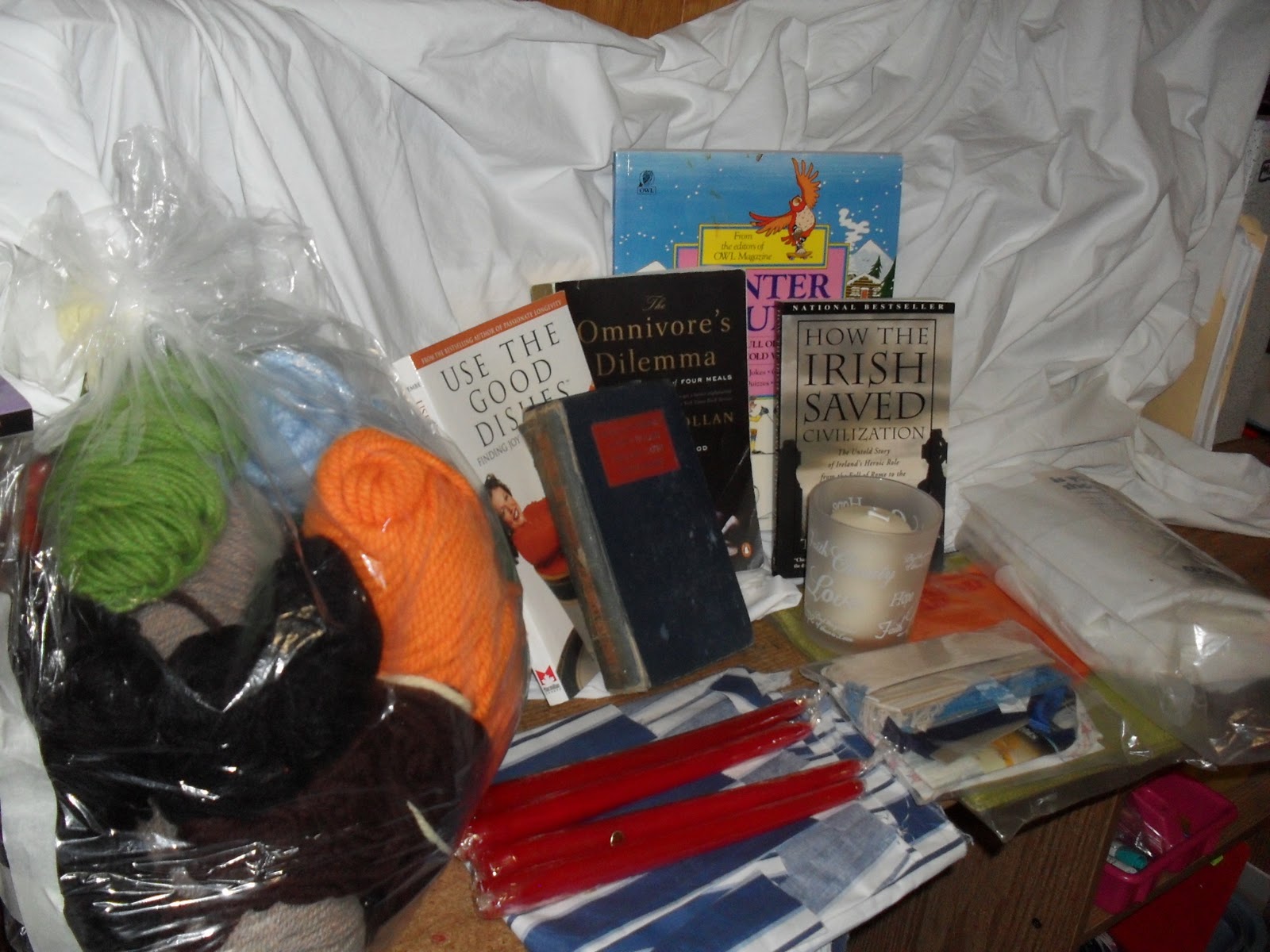
This is what came home with me:
Yet another copy of The Owl Book of Winter Fun (we have two, but another is always welcome)
How the Irish Saved Civilization
The Omnivore's Dilemma, by Michael Pollan
Use the Good Dishes: Finding Joy in Everyday Life, by Dr. Elaine Dembe
Cassell's Compact English-Latin Latin-English Dictionary (1939 printing)
One big bag of heavy yarn
One big package of interfacing
One small bag of lace and trim
One piece of blue-striped fabric
One unopened package of "decorator burlap" in an interesting avocado-greenish colour (I'd guess it's been around for awhile)
Four red candles (Advent starts in another month)
And my favourite: a three-inch candle in a four-inch frosted jar, decorated with words like "Charity," "Love," "Hope," "Faith."
Total: $8.00 Canadian.
Photos: Ponytails
Labels:
Books,
candles,
rummage sales
Wednesday, October 27, 2010
What's for dinner?
Earl's Soup (Potage Paysanne)--lots of chopping but worth the effort...and probably the only time all year that I buy leeks
Frozen pizza in the toaster oven (could have been garlic breadsticks, or Peasant Bread, or rolls, or just toast, but we got the pizza on sale and it seemed like it would bulk up a meal of what is basically vegetable soup)
Banana-peach freeze (frozen bananas and a bit of peach jam run through the food processor, with plain yogurt added if needed to make it run better) (could have been fresh bananas, but we don't have any)
Frozen pizza in the toaster oven (could have been garlic breadsticks, or Peasant Bread, or rolls, or just toast, but we got the pizza on sale and it seemed like it would bulk up a meal of what is basically vegetable soup)
Banana-peach freeze (frozen bananas and a bit of peach jam run through the food processor, with plain yogurt added if needed to make it run better) (could have been fresh bananas, but we don't have any)
Labels:
bananas,
Earl Johnson,
food processor,
groceries,
menu plans,
pizza,
soup,
What's for supper?
Reformation Day Links
Homeschool Freebie is featuring links to sites with resources for Reformation Day (which is Sunday).
And then comes All Saint's Day--we have to decide who's "coming to dinner" this year.
Labels:
All Saint's Day,
freebies,
Reformation Day
School plans on a blustery day
Since I have schoolwork written out by the month, whenever we get to the last week I have to be a bit creative trying to fit in things that slipped through the cracks. So this week we're having a daily reading from It Couldn't Just Happen; a daily folk song (You-tube is helpful); and a bit of extra push to finish off math units and sections of the history books. No special reason that we HAVE to do that--it just feels better when you start a new month fresh.
Crayons' schedule for today:
Singing and science reading with Ponytails
Having a look at a jar of beans we're sprouting (new science challenge)
Bible, spelling and math with me (we are still doing spelling every day; next month's language focus may be a bit different)
Finishing a chapter of Life of Robert Louis Stevenson
History reading from George Washington's World: "A King but not a Ruler"
Stories from Bulfinch's Age of Fable: "Dryope," "Venus and Adonis"
Latin lesson from Our Roman Roots
Poems by Charles G.D. Roberts: "The Solitary Woodsman"
One game from Word Play Cafe
Homemaking/crafts time...if we get time, a drawing lesson with Ponytails
Books from the extra reading shelf
Ponytails' schedule for today:
Keeping up with chapters in Christian studies, history, science, math
Page of grammar
Group reading and singing times with Crayons
Latin with Crayons
Extra reading
Crayons' schedule for today:
Singing and science reading with Ponytails
Having a look at a jar of beans we're sprouting (new science challenge)
Bible, spelling and math with me (we are still doing spelling every day; next month's language focus may be a bit different)
Finishing a chapter of Life of Robert Louis Stevenson
History reading from George Washington's World: "A King but not a Ruler"
Stories from Bulfinch's Age of Fable: "Dryope," "Venus and Adonis"
Latin lesson from Our Roman Roots
Poems by Charles G.D. Roberts: "The Solitary Woodsman"
One game from Word Play Cafe
Homemaking/crafts time...if we get time, a drawing lesson with Ponytails
Books from the extra reading shelf
Ponytails' schedule for today:
Keeping up with chapters in Christian studies, history, science, math
Page of grammar
Group reading and singing times with Crayons
Latin with Crayons
Extra reading
Tuesday, October 26, 2010
Baking with "spaghetti-pumpkin"
Our Apprentice went to a youth group pumpkin event last weekend, and brought home a carved creation that, unfortunately, collapsed shortly thereafter due to structural difficulties.
She offered the bottom of it to me for cooking, and there was quite a bit of veggie still there so it did seem a shame to waste it. The pumpkin piece was about as big as our round pizza pan, so I put them both, with a bit of water, into the toaster oven (at 350 degrees).
When it came out and I was scooping the cooked squashy stuff into a bowl, I noticed that the texture was more like stringy spaghetti squash than either the smaller pie pumpkins or the canned pumpkin I've used before. I wasn't sure how that would work in the Pumpkin Loaf I planned to make with it. So when I baked the next day, I put all the wet ingredients (including the cooked pumpkin) into the food processor and blended them together before adding the dry ingredients. You could use a blender too. (Obviously you could process or blend the pumpkin by itself, but I think dispersing it with the other wet ingredients gave the mixture a smoother texture. If you prefer a few lumps, process for a shorter time.)
And the pumpkin loaf turned out fine--actually better than usual. I like the fresh taste of "real" pumpkin in baking.
Using the "kitchen slaves" to blend ingredients with a less-than-ideal texture may not be terribly original...but it worked for me.
She offered the bottom of it to me for cooking, and there was quite a bit of veggie still there so it did seem a shame to waste it. The pumpkin piece was about as big as our round pizza pan, so I put them both, with a bit of water, into the toaster oven (at 350 degrees).
When it came out and I was scooping the cooked squashy stuff into a bowl, I noticed that the texture was more like stringy spaghetti squash than either the smaller pie pumpkins or the canned pumpkin I've used before. I wasn't sure how that would work in the Pumpkin Loaf I planned to make with it. So when I baked the next day, I put all the wet ingredients (including the cooked pumpkin) into the food processor and blended them together before adding the dry ingredients. You could use a blender too. (Obviously you could process or blend the pumpkin by itself, but I think dispersing it with the other wet ingredients gave the mixture a smoother texture. If you prefer a few lumps, process for a shorter time.)
And the pumpkin loaf turned out fine--actually better than usual. I like the fresh taste of "real" pumpkin in baking.
Using the "kitchen slaves" to blend ingredients with a less-than-ideal texture may not be terribly original...but it worked for me.
Labels:
baking,
Pumpkin/squash
Undercover superheroes and homeschool carnivals
Labels:
Carnivals,
Charlotte Mason,
Homeschooling
So what are we supposed to do with our weekends now?
Grandpa Squirrel brought over some Toronto papers last weekend, including several auto sections he had saved up for Mr. Fixit. I don't usually read the car pages, but the front page of the September 16th Globe Drive section stood out: there was a hand holding a wrench, and the headline "The death of do-it-yourself auto repair."
It turned out to be a column by Peter Cheney, with the subtitle "The art of home auto repair has been shuffled to the scrap heap."
If cars aren't your thing (they're not mine really--I just pressed the pedal down when requested and appreciated Mr. Fixit's talents), consider this: that's only one example of the general death, or perhaps assassination, of self-sufficiency. At what point will there be nothing left at all that we can fix, clean up, make ourselves? Will we stop even comprehending Bible verses like "where moth and rust corrupt," because there we won't have anything that lasts long enough to get moth-eaten or rusty?
Your opinions?
It turned out to be a column by Peter Cheney, with the subtitle "The art of home auto repair has been shuffled to the scrap heap."
"Knowing how to fix a car used to mean something. In university, I studied the classics. My abiding memory was of Odysseus returning home to slay the suitors who had invaded his house. To me, overhauling an engine was a less dramatic version of the same process – I had driven out the forces of mechanical disorder.My own dad was never much of a do-it-yourselfer when it came to cars; he knew his limits and preferred to trust Ernie's garage on the corner. But my mom's brothers were die-hard wrench twisters from way back; I've heard the stories about how, lacking a hoist, they pulled up the front end of their jalopy using a rope and a nearby tree branch. And when I married Mr. Fixit, most of our cars (until emissions testing killed off the Caprices) were still the kind you had to tune up; the kind you COULD tune up. I got used to sitting in the front seat during brake jobs and pressing down on the pedal, while he crawled underneath or had his head under the hood. Vrm vrm...Again...Vrm vrm...Again...Vrm vrm...this usually went on for awhile.
"So how could I imagine that the golden age of the home mechanic was approaching its end?"
"To [car designer Pete] Brock, a good machine is the elegant, real-world expression of an idea, not just something to be used and cast aside when it breaks. Machines are philosophies, expressed in metal."And yet times change. Peter Cheney says that he used to be a professional mechanic but now rarely works on his own car himself. It's the same for Mr. Fixit, and that's only partly because of middling-aged back and knee problems. It's more just a matter of, as Cheney says, our newer cars now not "needing us" as much as they used to; and, in many instances, not being able to access the parts or supplies we used to get, or finding newer cars deliberately designed too complicated for home mechanics to deal with.
If cars aren't your thing (they're not mine really--I just pressed the pedal down when requested and appreciated Mr. Fixit's talents), consider this: that's only one example of the general death, or perhaps assassination, of self-sufficiency. At what point will there be nothing left at all that we can fix, clean up, make ourselves? Will we stop even comprehending Bible verses like "where moth and rust corrupt," because there we won't have anything that lasts long enough to get moth-eaten or rusty?
Your opinions?
Labels:
Classic Cars,
Frugality,
making stuff,
Mr. Fixit,
self-sufficiency
Monday, October 25, 2010
Second-hand Pants Song
We saw this clip at church yesterday as part of a discussion on "how much is enough?"
Labels:
MCC,
Thrift Shop,
we're just normal folks he he he
Friday, October 22, 2010
Around the blog world...all kinds of things
Thrifted baby gifts from great-grandma-to-be, at Living Well on Less (what a nice grandma!)
Make a microfiber-mitt Puffer Fish at Craft Passion, linked from Dollar Store Crafts. (We liked the hedgehog too.)
These are from way back in May at Obsessively Stitching, but you Should Not Miss These Because They Are Seriously Cute: Itty Bitty Oven Mitts. (They're fridge magnets.)
For protein-seeking/alternative flour cooks: Quinoa Bean Pumpkin Pancakes at 11th Heaven's Homemaking Haven
What are your favourite blog finds?
Make a microfiber-mitt Puffer Fish at Craft Passion, linked from Dollar Store Crafts. (We liked the hedgehog too.)
These are from way back in May at Obsessively Stitching, but you Should Not Miss These Because They Are Seriously Cute: Itty Bitty Oven Mitts. (They're fridge magnets.)
For protein-seeking/alternative flour cooks: Quinoa Bean Pumpkin Pancakes at 11th Heaven's Homemaking Haven
What are your favourite blog finds?
Labels:
Blogworld,
Crafts,
Food,
pancakes,
Yard sales
From the archives, October 22 2008: "No Fairy Godmothers"
Someone at church loaned me a copy of Maeve Binchy's novel Whitethorn Woods. I'm only partway into it so I don't know what the rest of the book will be like, but the first couple of chapters were worth a book in themselves. (Some adult situations, so not for young maidens below a certain age.)
The framework of the novel is an Irish church and a place called St. Ann's Well which tourists and locals treat as a kind of wailing wall. The curate of the church doesn't care much for this, but can't seem to fight it. At the end of the introduction, he speaks his own thoughts to St. Ann, asking that he would be able to "hear" what people are asking for at the well, so that he can help them better. The book picks up that thread and moves into pairs of short stories about the people of the town.
Twice within the introduction and the first set of stories there are characters who make the most of whatever little they have. To begin with, we have a pair of immigrants who thrive on doing what nobody else wants to do:
The second example is Neddy Nolan, who describes himself as "not the sharpest knife in the drawer." Someone online compared him to Forrest Gump; I think he's also like Simple Jack, the youngest-brother character in many fairy tales--the one who shares his loaf of bread and usually gets rewarded for it. He's honest and somewhat naïve, particularly when it comes to understanding that not everyone else is as honest and well-intentioned as he is--especially his older brother who tries to take advantage of him and ends up losing. There are no fairy godmothers in this story, and Neddy has to make his own luck, with the same kind of creativity and determination that got Forrest Gump his own shrimp boat.
Neddy's first payback comes when his old father can't take care of their house any more and needs a caregiver. The solution is simple: Neddy moves back to their hometown and buys the house, to the astonishment and fury of his always-broke brother.
And unlike Forrest Gump, he ends up with a woman who, although she has her own issues, doesn't want to run away and be a folk singer; in fact, she wants to teach, and she's happy to let Neddy keep doing what he likes to do, taking care of stuff. He even manages to take care of his fiancee when she's being blackmailed--now that's real chivalry. She and he both agree that sharp knives can sometimes be too scary--the world needs more Neddys and fewer Older Brothers.
The framework of the novel is an Irish church and a place called St. Ann's Well which tourists and locals treat as a kind of wailing wall. The curate of the church doesn't care much for this, but can't seem to fight it. At the end of the introduction, he speaks his own thoughts to St. Ann, asking that he would be able to "hear" what people are asking for at the well, so that he can help them better. The book picks up that thread and moves into pairs of short stories about the people of the town.
Twice within the introduction and the first set of stories there are characters who make the most of whatever little they have. To begin with, we have a pair of immigrants who thrive on doing what nobody else wants to do:
"By the time he got back to the priests’ house, Josef, the Latvian caregiver, had arrived and got Canon Cassidy up, washed and dressed him and made his bed....Canon Cassidy liked soup for his lunch and sometimes Josef took him to a café but mainly he took the frail little figure back to his own house, where his wife, Anna, would produce a bowl of something homemade; and in return the canon would teach her more words and phrases in English....Josef had three other jobs: he cleaned Skunk Slattery’s shop, he took the towels from Fabian’s hairdressers to the Fresh as a Daisy Launderette and washed them there and three times a week he took a bus out to the Nolans’ place and helped Neddy Nolan look after his father.Josef and Anna have plans to open their own shop in a few years, and you have no doubt that they will do it.
"Anna had many jobs too: she cleaned the brass on the doors of the bank, and on some of the office buildings that had big important-looking notices outside; she worked in the hotel kitchens at breakfast time doing the washing up; she opened the flowers that came from the market to the florists and put them in big buckets of water. Josef and Anna were astounded by the wealth and opportunities they’d found in Ireland. A couple could save a fortune here."
The second example is Neddy Nolan, who describes himself as "not the sharpest knife in the drawer." Someone online compared him to Forrest Gump; I think he's also like Simple Jack, the youngest-brother character in many fairy tales--the one who shares his loaf of bread and usually gets rewarded for it. He's honest and somewhat naïve, particularly when it comes to understanding that not everyone else is as honest and well-intentioned as he is--especially his older brother who tries to take advantage of him and ends up losing. There are no fairy godmothers in this story, and Neddy has to make his own luck, with the same kind of creativity and determination that got Forrest Gump his own shrimp boat.
"And cause I was a gazillionaire, and I liked doin it so much, I cut that grass for free."--Forrest GumpWhen Neddy moves to the city and unintentionally exposes a kind of pilfering scam on the construction site where his brother has gotten him work, he is told to stay back at the flat from now on and "clean up or something." Taking his brother at his word, he goes out and swaps some cleanup work and painting for a box of paint and cleaning supplies, then starts fixing up the apartment for Older Brother and their roommates. He even manages to scrounge them a television. The guys agree that if he'll just stay away from their job site (to keep him from exposing any more of their dealings), they'll pay him a salary to "manage things." And this goes on for years--they spend, drink, and scam, but Neddy socks his money away and takes care of them all, makes friends all over the place, helps people out, and never seems to feel he's being taken advantage of.
Neddy's first payback comes when his old father can't take care of their house any more and needs a caregiver. The solution is simple: Neddy moves back to their hometown and buys the house, to the astonishment and fury of his always-broke brother.
And unlike Forrest Gump, he ends up with a woman who, although she has her own issues, doesn't want to run away and be a folk singer; in fact, she wants to teach, and she's happy to let Neddy keep doing what he likes to do, taking care of stuff. He even manages to take care of his fiancee when she's being blackmailed--now that's real chivalry. She and he both agree that sharp knives can sometimes be too scary--the world needs more Neddys and fewer Older Brothers.
Labels:
Books,
Frugality,
Ireland,
Maeve Binchy
Sewing...it gets easier with time. Really.
My mom knew her way around a sewing machine very well. Me?--no.
You could attribute some of my sewing hangups to the typical middle-school home economics class, which, if I had paid any attention to the cooking units, would have finished me in the kitchen as well. Or just the fact that I hardly ever had to machine-sew anything, because my mom could do it better and faster, and liked to.
For some reason, it was not only the machine that stymied me for many years (yes, I do have ongoing battles with things that plug in), but the whole bewilderment of patterns. And fabric stores, which not only largely disappeared around here before I ever got the hang of them, but which are usually set up to be as confusing as possible.
My first breakthrough was a pair of maternity overalls that I finished about one week before The Apprentice was born. (Better almost late than never.)
My second was a purple jumper that I retooled for toddler Apprentice from a free pair of corduroy pants. It was, honestly, quite adorable and so was she.
My third was a set of stuffed Christmas elves that The Apprentice helped me make when she was three. (No, she didn't use the machine.) I sold most of them at a craft sale and bought myself a lovely angel which we still have. Which just goes to show that people buying Christmas crafts don't care what grade you got in home economics.
Since then I've become slightly less spatially challenged when it comes to figuring out patterns. (Fabric stores still give me a headache.) I am never going to be making wedding dresses, but at least I know how to get both pajama legs right side out now. The Squirrelings have all grown up quite chummy with our sewing machine. (Maybe because they didn't feel like I knew more than they did?) The one thing I've never done yet is put in a zipper...I don't think my machine even has a zipper foot. And through the magic of You-tube, I may even get past that one. I know Ponytails' ambition is to have a serger someday, and maybe she'll let me use it.
In the meantime, if you share some of my hesitations, or even if you don't, can I recommend my favourite sewing site? Sewing.about.com. Besides basic instructions and tips, there are tons of patterns (with lovely photos) and links to more. If you click on Free Patterns, you get a choice of Beginner, Intermediate, and Advanced, all sorted and ready to go. But there's another link in the sidebar that takes you to this page, and if you keep scrolling down the page, you'll find links to using Scraps of Fabric, Sewing Slippers, Projects to keep You and Your Home Warm, and more.
Got you interested yet?
If I can do it, anybody can.
You could attribute some of my sewing hangups to the typical middle-school home economics class, which, if I had paid any attention to the cooking units, would have finished me in the kitchen as well. Or just the fact that I hardly ever had to machine-sew anything, because my mom could do it better and faster, and liked to.
For some reason, it was not only the machine that stymied me for many years (yes, I do have ongoing battles with things that plug in), but the whole bewilderment of patterns. And fabric stores, which not only largely disappeared around here before I ever got the hang of them, but which are usually set up to be as confusing as possible.
My first breakthrough was a pair of maternity overalls that I finished about one week before The Apprentice was born. (Better almost late than never.)
My second was a purple jumper that I retooled for toddler Apprentice from a free pair of corduroy pants. It was, honestly, quite adorable and so was she.
My third was a set of stuffed Christmas elves that The Apprentice helped me make when she was three. (No, she didn't use the machine.) I sold most of them at a craft sale and bought myself a lovely angel which we still have. Which just goes to show that people buying Christmas crafts don't care what grade you got in home economics.
Since then I've become slightly less spatially challenged when it comes to figuring out patterns. (Fabric stores still give me a headache.) I am never going to be making wedding dresses, but at least I know how to get both pajama legs right side out now. The Squirrelings have all grown up quite chummy with our sewing machine. (Maybe because they didn't feel like I knew more than they did?) The one thing I've never done yet is put in a zipper...I don't think my machine even has a zipper foot. And through the magic of You-tube, I may even get past that one. I know Ponytails' ambition is to have a serger someday, and maybe she'll let me use it.
In the meantime, if you share some of my hesitations, or even if you don't, can I recommend my favourite sewing site? Sewing.about.com. Besides basic instructions and tips, there are tons of patterns (with lovely photos) and links to more. If you click on Free Patterns, you get a choice of Beginner, Intermediate, and Advanced, all sorted and ready to go. But there's another link in the sidebar that takes you to this page, and if you keep scrolling down the page, you'll find links to using Scraps of Fabric, Sewing Slippers, Projects to keep You and Your Home Warm, and more.
Got you interested yet?
If I can do it, anybody can.
Labels:
Crafts,
evil sewing machines,
gifts,
patterns,
sewing
Thursday, October 21, 2010
How homeschoolers do things: a lesson on milliliters
The book: Math Mammoth's Light Blue Grade 3B, unit on measurement, lesson on "Milliliters and Liters."
The props: 250 ml measuring cup, 1 liter measuring cup, 1.2 ml measure (also known as a quarter teaspoon), several bottles and packages from the cupboard, several cups and mugs, water, towel.
Purpose of the lesson: to introduce the idea of volume, using the metric system. We have done linear measurement, first in imperial and then in metric units; we've weighed things, first in imperial and then in metric units; and now we're onto volume. I'm deliberately switching the order this time, since although we use lots of teaspoons and cups in cooking here (I cannot wrap my brain around cooking without my teaspoons and tablespoons), we don't hear as much about pints, quarts and gallons. So today's lesson focused on metric volume.
What we did: I put several bottles, jars and packages from the cupboard and fridge on the table, and asked Crayons to sort them into the ones that were marked g or kg (labelled by weight) and the ones that were marked ml or L (labelled by volume). The cereal and baking soda went to one side; the vanilla extract and juice went to the other. What was the difference? Crayons figured out quickly that the dry foods were mostly sold by weight, and the liquids were sold by volume. (Honey is an exception--I still don't know why it's sold by weight instead of volume.)
I showed Crayons how much a liter is (as big as our big measuring cup), and how much a milliliter is (about as small as the quarter-teaspoon measure which also shows 1.2 ml).
Then I had her do an activity from the worksheet: measuring the volume of cups, glasses, jars, or other small containers. We poured water into the cups and then poured it back into measuring containers. The Apprentice's giant tea cup holds 500 ml (2 cups for you Americans); an average coffee mug holds 300 ml; a small drinking glass holds 200 ml; and a tiny doll cup holds 5 ml. (We had to measure that one with a spoon.)
We skipped several of the calculating activities on the sheet--I'll probably have her go back over some of them tomorrow. Instead, we skipped to the end of the lesson, where there were three word problems. "One shampoo bottle contains 1 liter of shampoo. Another one contains 478 ml. How much more does the bigger one contain?" The other two problems were about drink bottles and juice in a pitcher.
And after all that we were very thirsty.
I told Crayons that if she wants a homework assignment, she should go ask The Apprentice if she can examine her stash of cosmetics, lotions, potions etc. and see which ones are packaged by weight and which are packaged by volume. I just thought of another fun homework assignment: figuring out how much toothpaste and shampoo you can fit in a zipper bag to get through airport security without going over the milliliter limit. See, grownups have to know about this stuff too.
The props: 250 ml measuring cup, 1 liter measuring cup, 1.2 ml measure (also known as a quarter teaspoon), several bottles and packages from the cupboard, several cups and mugs, water, towel.
Purpose of the lesson: to introduce the idea of volume, using the metric system. We have done linear measurement, first in imperial and then in metric units; we've weighed things, first in imperial and then in metric units; and now we're onto volume. I'm deliberately switching the order this time, since although we use lots of teaspoons and cups in cooking here (I cannot wrap my brain around cooking without my teaspoons and tablespoons), we don't hear as much about pints, quarts and gallons. So today's lesson focused on metric volume.
What we did: I put several bottles, jars and packages from the cupboard and fridge on the table, and asked Crayons to sort them into the ones that were marked g or kg (labelled by weight) and the ones that were marked ml or L (labelled by volume). The cereal and baking soda went to one side; the vanilla extract and juice went to the other. What was the difference? Crayons figured out quickly that the dry foods were mostly sold by weight, and the liquids were sold by volume. (Honey is an exception--I still don't know why it's sold by weight instead of volume.)
I showed Crayons how much a liter is (as big as our big measuring cup), and how much a milliliter is (about as small as the quarter-teaspoon measure which also shows 1.2 ml).
Then I had her do an activity from the worksheet: measuring the volume of cups, glasses, jars, or other small containers. We poured water into the cups and then poured it back into measuring containers. The Apprentice's giant tea cup holds 500 ml (2 cups for you Americans); an average coffee mug holds 300 ml; a small drinking glass holds 200 ml; and a tiny doll cup holds 5 ml. (We had to measure that one with a spoon.)
We skipped several of the calculating activities on the sheet--I'll probably have her go back over some of them tomorrow. Instead, we skipped to the end of the lesson, where there were three word problems. "One shampoo bottle contains 1 liter of shampoo. Another one contains 478 ml. How much more does the bigger one contain?" The other two problems were about drink bottles and juice in a pitcher.
And after all that we were very thirsty.
I told Crayons that if she wants a homework assignment, she should go ask The Apprentice if she can examine her stash of cosmetics, lotions, potions etc. and see which ones are packaged by weight and which are packaged by volume. I just thought of another fun homework assignment: figuring out how much toothpaste and shampoo you can fit in a zipper bag to get through airport security without going over the milliliter limit. See, grownups have to know about this stuff too.
Labels:
Crayons' Grade 4,
Homeschooling,
Math,
Math Mammoth,
measurement,
metric system
What homeschoolers do with birdseed (besides feed it to the birds)
This is Crayons' current science project, from the "Changes" unit in Herb Strongin's book Science on a Shoestring.
Requirements: plastic shoebox, paper towels, masking tape or painter's tape, birdseed containing several different kinds of seeds, water, patience.
Method: Sort out the birdseed so that you have about ten seeds each of as many different kinds as you can find in the package. (We used sunflower seeds, milo, and millet, and added popcorn as a fourth type.) Line the plastic container with dampened paper towels, and divide it into sections with tape. Arrange the seeds in rows in each section. Put the lid on, dampening the paper towels again if and when needed. (According to the book, some mould is to be expected.)
And watch them grow, keeping notes on your observations. We started them on Tuesday and they were sprouting by Thursday; by the time we took these photos, the tallest sprouts were 10 cm (4 inches) tall. Since then they have grown even more, some of the sunflower shells have dropped off, and the popcorn sprouts have divided in two. We also noticed that the sunflower seeds went up with their sprouts, but the other seeds stayed on the paper towels closer to the roots.
I'm not sure how much longer we'll be able to keep the sprouts going; several of them are getting taller than the box, and there is some mould growth around the roots and around a few of the seeds that didn't sprout. But it has been very interesting.
Photos by Ponytails
Requirements: plastic shoebox, paper towels, masking tape or painter's tape, birdseed containing several different kinds of seeds, water, patience.
Method: Sort out the birdseed so that you have about ten seeds each of as many different kinds as you can find in the package. (We used sunflower seeds, milo, and millet, and added popcorn as a fourth type.) Line the plastic container with dampened paper towels, and divide it into sections with tape. Arrange the seeds in rows in each section. Put the lid on, dampening the paper towels again if and when needed. (According to the book, some mould is to be expected.)
And watch them grow, keeping notes on your observations. We started them on Tuesday and they were sprouting by Thursday; by the time we took these photos, the tallest sprouts were 10 cm (4 inches) tall. Since then they have grown even more, some of the sunflower shells have dropped off, and the popcorn sprouts have divided in two. We also noticed that the sunflower seeds went up with their sprouts, but the other seeds stayed on the paper towels closer to the roots.
I'm not sure how much longer we'll be able to keep the sprouts going; several of them are getting taller than the box, and there is some mould growth around the roots and around a few of the seeds that didn't sprout. But it has been very interesting.
Photos by Ponytails
Labels:
Botany,
Crayons' Grade 4,
Frugality,
growing things,
Homeschooling,
science
Our apple butter (photo post)
The slow cooker full of apples was started at 8:30 in the morning (a slight change from the original plan) and it took until about 9:00 that night until it was thick enough...not quite as thick as some commercial apple butter, but still spreadable. We used 2 1/2 cups of sugar plus cinnamon, cloves, and salt as per the recipe.
We got 12 125 ml (half-cup) jars out of the 5 1/2 pounds of apples (19 apples, to be exact), plus a bowlful for the fridge. The bowlful is already gone--Mama Squirrel used it in a batch of muffins and in apple crisp (a cupful mixed with the chopped apples).
Jar labels and photographs: Ponytails.
We got 12 125 ml (half-cup) jars out of the 5 1/2 pounds of apples (19 apples, to be exact), plus a bowlful for the fridge. The bowlful is already gone--Mama Squirrel used it in a batch of muffins and in apple crisp (a cupful mixed with the chopped apples).
Jar labels and photographs: Ponytails.
Labels:
apple butter,
apples,
canning
Too funny: the Homeschool Misfit Blog Awards
Want to be nominated for The Wannabe Award? The Blabber Blog Award? The Harried Homeschooler Award? How about The Perfect Procrastinator Award- "I really should write that thought provoking piece about world hunger/child discipline/spiritual growth/etc. but I'd rather play on Facebook. Here's a cute puppy photo instead." Read all about it on Hearthside Homeschool Reviews and More.
Of course we should probably nominate ourselves for the Squirrel Award...
Labels:
Blogworld,
Homeschooling
Wednesday, October 20, 2010
Up in the Treehouse with Mama Squirrel
Listening to: Jazz.FM91, occasional radio chatterings from Mr. Fixit's workbench, and the rattle-clunk of Crayons building with Lego.
Coolest thing I saw tonight: the almost-full moon sailing between clouds...yeah, I know, it's the clouds that are moving, but who doesn't think the moon looks like it's moving?
Current addiction: logic puzzles (six birdwatchers wearing six different jackets went to six different parks etc.)--I am much better at those than I used to be.
Things I like in October: red maples, orange pumpkins, blue skies.
Things I could do without in October: the food-and-crafts emphasis on skeletons and other nasty stuff.
Best thing I found this week: a whole armful of books from the library discard shelf, for a total of $3.50. Highlights: a book of Joan Aiken stories, a nice edition of Pinocchio, a '70's book about gardening, another '70's book about bread baking. I'm also reading the book Brenda recommended, Food Security for the Faint of Heart.
What we've been watching on TV: Wonder Woman Season Two.
Tonight's dinner: sausage and sauerkraut in the Crockpot, sweet potatoes, baked beans (canned ones), apple crisp made with apples and apple butter. (Yes, the apple butter worked! Ponytails is going to upload some photos soon.)
Local news to think about: municipal elections next week. OK, not earth-shaking, but voting's still important.
Coolest thing I saw tonight: the almost-full moon sailing between clouds...yeah, I know, it's the clouds that are moving, but who doesn't think the moon looks like it's moving?
Current addiction: logic puzzles (six birdwatchers wearing six different jackets went to six different parks etc.)--I am much better at those than I used to be.
Things I like in October: red maples, orange pumpkins, blue skies.
Things I could do without in October: the food-and-crafts emphasis on skeletons and other nasty stuff.
Best thing I found this week: a whole armful of books from the library discard shelf, for a total of $3.50. Highlights: a book of Joan Aiken stories, a nice edition of Pinocchio, a '70's book about gardening, another '70's book about bread baking. I'm also reading the book Brenda recommended, Food Security for the Faint of Heart.
What we've been watching on TV: Wonder Woman Season Two.
Tonight's dinner: sausage and sauerkraut in the Crockpot, sweet potatoes, baked beans (canned ones), apple crisp made with apples and apple butter. (Yes, the apple butter worked! Ponytails is going to upload some photos soon.)
Local news to think about: municipal elections next week. OK, not earth-shaking, but voting's still important.
Labels:
Books,
fall,
Family,
Mama Squirrel,
October,
sauerkraut,
Treehouse,
Wonder Woman
Tuesday, October 19, 2010
Carnivals this week
Frugal Upstate hosts this week's Festival of Frugality.
The Carnival of Homeschooling is at HomeschoolBuzz.com.
Handbook of Nature Study hosts an Outdoor Hour Challenge Carnival: Fall Edition. It was posted October 4th, but if you click on the main page of BlogCarnival.com, that carnival is today's main feature! Congratulations!
The Carnival of Homeschooling is at HomeschoolBuzz.com.
Handbook of Nature Study hosts an Outdoor Hour Challenge Carnival: Fall Edition. It was posted October 4th, but if you click on the main page of BlogCarnival.com, that carnival is today's main feature! Congratulations!
Monday, October 18, 2010
From the archives: "Things to Make with Pumpkins"
This is from September 2007, three years ago; Crayons was in the first grade.
Things to make with PUMPKINS
Expecting a recipe? (They're at the end.)
No, this is a word game Crayons and I made up during school this morning. Take the letters in PUMPKINS and make as many new words (two letters or longer) as you can. We found 25 reasonable words plus a couple of other questionable/obscure ones. Can you find more than that?
(One to get you started: Crayons found "punk." When I asked her if she knew what that meant, she started dancing. I think Daddy's been playing a few too many rock albums.)
P.S. If you're doing this kind of game with younger children, it helps to use some kind of moveable letters--like Scrabble pieces or fridge letters. We have a container full of alphabet erasers that we use for spelling games.
P.P.S. If you're really looking for pumpkin recipes, check out Carnival of the Recipes: The Great Pumpkin edition. Or some of the Dewey's Treehouse favourites: Pumpkin Bars, Baked Pumpkin Doughnuts, Pumpkin Butter Pie, Pumpkin Butter, Fluffy Pumpkin Pie, Pumpkin Bread (or Cake).
Things to make with PUMPKINS
Expecting a recipe? (They're at the end.)
No, this is a word game Crayons and I made up during school this morning. Take the letters in PUMPKINS and make as many new words (two letters or longer) as you can. We found 25 reasonable words plus a couple of other questionable/obscure ones. Can you find more than that?
(One to get you started: Crayons found "punk." When I asked her if she knew what that meant, she started dancing. I think Daddy's been playing a few too many rock albums.)
P.S. If you're doing this kind of game with younger children, it helps to use some kind of moveable letters--like Scrabble pieces or fridge letters. We have a container full of alphabet erasers that we use for spelling games.
P.P.S. If you're really looking for pumpkin recipes, check out Carnival of the Recipes: The Great Pumpkin edition. Or some of the Dewey's Treehouse favourites: Pumpkin Bars, Baked Pumpkin Doughnuts, Pumpkin Butter Pie, Pumpkin Butter, Fluffy Pumpkin Pie, Pumpkin Bread (or Cake).
Labels:
dessert,
pie,
Pumpkin/squash,
recipes
Saturday, October 16, 2010
Using bits and pieces beautifully...around the blog world
"Then everyone admired Mary's bed shoes, and how they had been made of the ends of a worn-out blanket. Mrs. Boast said she was going to make some for herself, as soon as any of her blankets wore out."--Laura Ingalls Wilder, By the Shores of Silver LakeWe are surrounded by possibilities.
Most of us don't see most of them, most of the time.
But sometimes...serendipity...the raw material and the creative spirit come together, and the magic happens.
And if you're a blogger, you grab the digital camera and post about it.
There's the Vinyl Revival series of posts at Old Days Old Ways, starting with a Sept. 6 post explaining how she was challenged to use up one of those zippered vinyl cases such as sheets come in, and ending with a last piece of genius--a backpack for an 18-inch doll.
Then there are the dollar-store garbage can (at Mich L in L.A.) and wire-tie crafts (same blog) linked from one of Ponytails' Terrific Thrifty Thursday posts.
There are bags of apples, 8 pounds for $3.49 at the supermarket today, of which 5 1/2 pounds are going to go in the crockpot, after I get home from a meeting tonight, to make apple butter. (Why so late? Because it takes so long to cook...if we start cooking it late tonight, it should be done by the time we get home from church tomorrow. I did not want to have to get up at three in the morning to deal with apple butter.) Off topic, I noticed that Wellesley brand apple butter, the kind we usually buy if we buy some, doesn't use any sugar at all...they have their own process that brings out the natural sweetness of the apples. This isn't an ad for Wellesley, just a response to the question of whether or not 4 cups of sugar to 5 1/2 pounds of apples is too much. I'm going to try the Head Girl's suggestion of cutting that back about half, since what we're used to is the unsweetened kind.
There's recycling...there's re-using...there's using up...and very little of it has to do with putting wiggle eyes on empty foam cups just to keep said cup out of the landfill. It's more like seeing the possibilities for something cool in something ordinary...so that, like Mrs. Boast, we wish that the blankets would wear out a little faster to justify cutting them up for slippers.
Labels:
18-inch dolls,
American Girl Dolls,
apple butter,
Blogworld,
Crafts,
Frugality,
recycling
Friday, October 15, 2010
It's pumpkin time too (Pumpkin Bars)
Needing to keep this weekend's grocery list on the light side, I nevertheless wrote down "can of pumpkin," because I wanted to try a new recipe for pumpkin bars.
Then I read the DHM's Pumpkins And More on Frugal Hacks today. Oh, duh--I had a pie pumpkin still sitting in the dining room--table decoration from Monday's Thanksgiving dinner. I had bought it to cook in the first place, but it got lost in the pumpkin-and-maple-leaf scenery.
So I baked Mr. Pumpkin during school today, pureed it with an immersion blender, and ended up with two cups of cooked pumpkin--exactly what was needed to make the pumpkin bars. And now we have pumpkin bars on the counter, and some in the freezer (the recipe makes a big panful).
The author suggests an orange-cream cheese frosting, but that's fancier than we wanted. I just sprinkled the batter with a bit of extra cinnamon sugar before baking.
Peter's Pumpkin Bars, from The Perfect Basket by Diane Phillips
4 large eggs
1 2/3 cups sugar (I cut it back a bit)
1 cup oil
2 cups cooked pumpkin
2 cups all-purpose flour
2 tsp. baking powder
2 tsp. pumpkin pie spice mix (homemade version is given in the book; I used 1 tsp. cinnamon, 1/2 tsp. ginger, 1/4 tsp. nutmeg, 1/4 tsp. cloves)
1 tsp. baking soda
Preheat the oven to 350 degrees F and grease a 15 x 10-inch jelly-roll pan. In the large bowl of an electric mixer (or just a regular large bowl), beat together eggs, sugar, and oil. Gradually add the pumpkin, beating until smooth. Add the flour, baking powder, spices, and baking soda, and stir until the mixture is smooth. Pour the batter into the prepared pan, and bake for 25 to 30 minutes. Cut in squares. (Sprinkle before baking as described above, or cool and frost.)
This recipe is linked from Potluck Saturday at The Common Room.
Then I read the DHM's Pumpkins And More on Frugal Hacks today. Oh, duh--I had a pie pumpkin still sitting in the dining room--table decoration from Monday's Thanksgiving dinner. I had bought it to cook in the first place, but it got lost in the pumpkin-and-maple-leaf scenery.
So I baked Mr. Pumpkin during school today, pureed it with an immersion blender, and ended up with two cups of cooked pumpkin--exactly what was needed to make the pumpkin bars. And now we have pumpkin bars on the counter, and some in the freezer (the recipe makes a big panful).
The author suggests an orange-cream cheese frosting, but that's fancier than we wanted. I just sprinkled the batter with a bit of extra cinnamon sugar before baking.
Peter's Pumpkin Bars, from The Perfect Basket by Diane Phillips
4 large eggs
1 2/3 cups sugar (I cut it back a bit)
1 cup oil
2 cups cooked pumpkin
2 cups all-purpose flour
2 tsp. baking powder
2 tsp. pumpkin pie spice mix (homemade version is given in the book; I used 1 tsp. cinnamon, 1/2 tsp. ginger, 1/4 tsp. nutmeg, 1/4 tsp. cloves)
1 tsp. baking soda
Preheat the oven to 350 degrees F and grease a 15 x 10-inch jelly-roll pan. In the large bowl of an electric mixer (or just a regular large bowl), beat together eggs, sugar, and oil. Gradually add the pumpkin, beating until smooth. Add the flour, baking powder, spices, and baking soda, and stir until the mixture is smooth. Pour the batter into the prepared pan, and bake for 25 to 30 minutes. Cut in squares. (Sprinkle before baking as described above, or cool and frost.)
This recipe is linked from Potluck Saturday at The Common Room.
Labels:
Cookies,
Pumpkin/squash,
what's in your hand
Homemade Fig Newtons? Who knew?
You need fresh figs for these cookies, but if you can get some, they look really good. (Seen at the Penny-Pinching Party)
HSBA Nominations are Open
Did you notice that the HSBA button in the sidebar has changed? It now takes you to this post which has all the details about how to nominate what you think are this year's best homeschooling blogs. You can only nominate any particular blog in one of the twenty categories.
But you have until October 30th to decide.
Labels:
Homeschool Blog Awards
Thursday, October 14, 2010
In apple butter time
See our apple butter photos here.
The HeadGirl at The Common Room posted a link to a Crockpot apple butter recipe (plus a nice photo of her peeled apples waiting to get cut up). (Here's the recipe she used.) Cents to Get Debt Free posted a recipe for it last year too.
I mentioned that the HG might like the Apple Butter Pie we've posted about here.
And then I noticed that there's an Apple Butter Cake Roll linked at the Penny Pinching Party.
It's definitely that time of year.
The HeadGirl at The Common Room posted a link to a Crockpot apple butter recipe (plus a nice photo of her peeled apples waiting to get cut up). (Here's the recipe she used.) Cents to Get Debt Free posted a recipe for it last year too.
I mentioned that the HG might like the Apple Butter Pie we've posted about here.
And then I noticed that there's an Apple Butter Cake Roll linked at the Penny Pinching Party.
It's definitely that time of year.
Labels:
apple butter,
apples,
autumn,
Blogworld,
fall,
slow cooker
Virtual penny-pinching party--go on over
The 55th Penny-Pinching Party is up at The Thrifty Home, and there are lots of links already.
Wednesday, October 13, 2010
Shopping Bag Homeschool: thrifty but fun plan for an animal-loving couch potato
I wrote most of this as a sort of exercise in frugal homeschooling, several years ago, but never posted it here. I'm cleaning it up and editing it now as I go along. It wasn't meant for any of my own children, but for a hypothetical young student, and for a parent (as I imagined) who had more creativity than cash. You'll notice that it goes much lighter on history/geography/social studies than some homeschool plans for this age do; this is not Ambleside Online, it's just a simple outline that could be added to or adapted as required.
So here we go...maybe there's something here to encourage those who are thinking that this homeschooling is going to take more money than they have.
The Imaginary Student: a seven-year-old girl with two younger siblings; she tends to be a “couch potato." She needs extra work in math. She is reading at a typical gr 2-3 level; she prints well. Interests: TV, animals, drawing.
Language goals: I used Ruth Beechick's booklet A Strong Start in Language, page 9, to choose typical goals for a second grader. Since these take up most of a page, I won't type them all out here, but they include skills in oral expression, listening, writing mechanics, usage, vocabulary (including homophones, antonyms etc.), and "study skills," such as alphabetizing. Dr. Beechick also includes work on common spelling words, and gives tips on copywork and handwriting practice
As a guide for reading curriculum, I went to the booklet in the same series, A Home Start in Reading, looking at page 23, assuming that the child is now in what Dr. Beechick calls the Fluency Stage; and at page 27, activities for encouraging reading fluency--things like modelling reading/exposing your child to bookstores and libraries, and talking about books as you read them and afterwards.
For arithmetic, I looked at the third and final book in Dr. Beechick's series, An Easy Start in Arithmetic, looking at both the first- and second-grade suggestions. This, if you're not familiar with it, is not a workbook or textbook, but rather a short guide for parents that can be used with or without formal curriculum; and at this age, Dr. Beechick encourages less rather than more formal, written arithmetic. (Which is good for the budget too!)
Encouraging physical activity: Buy/make active toys (build a balance beam); encourage outdoor play, bike riding; incorporate movement into lessons; consider extra classes such as dance. Try getting together with others to play games.
Personalized Shopping Bag (will take a child through one "season")
Yard sale and thrift shop finds: (based on materials typically available)
6 easy-reader type books--any that seem appropriate for independent reading practice
2 more difficult books for literature: for example, Understood Betsy (11 chp), The Wind in the Willows (12 chp)
2 books about animals: for example, The Wilds of Whip-poor-will Farm and a book with photos of pond life
6 issues of Nature Friend or another children's nature magazine
Wee Sing Around the Campfire (book and tape of folk songs)
3 somewhat-used math workbooks
Bagful of plastic linking cubes or other math manipulatives
Board game such as Harvest Time
A book of activities, such as one of Steven Caney’s games and toys books--the sort of book that gives you things to do on a rainy day, sprouting carrot tops, making animals out of egg cartons, making things with foil or yarn, indoor and outdoor games to play, and so on
Science for Fun Experiments, by Gary Gibson, or another book of simple experiments suitable for a young primary-age student
A book about building and furnishing cardboard dollhouses--the one I had in mind was The Most Wonderful Dollhouse Book: Easy-to-make, Inexpensive Houses with Furnishings and Lovable Doll Families, by Millie Hines
Inexpensive (dollar store) things:
Construction paper, index cards, pencils, eraser, ruler, brads (to make spinners, toy clock etc.)
Markers, scissors, tape, glue stick
Pony beads--bagful
Balloons
Rubber bands
Ponytail elastics, if you want to crochet hair scrunchies [2010 note on little girls, crocheting, and scrunchies: this activity depends very much on the age and maturity of the child. I have not had much success teaching anyone under eight or nine to do more than chain stitch; something seems to kick in at about that age, and what used to be frustrating suddenly becomes fun. But some younger children might be ready to try, or to single crochet across a pipe cleaner.]
A couple of balls of yarn, some embroidery floss, and needles
Printed tea towel to embroider with a simple outline stitch
Calendar
Popsicle sticks
Bubble liquid (or make your own)
Nature notebook and a couple of other blank notebooks
A few things the parent might have on hand:
Checkers set
Bible
A book of stories and poems
Playing cards, dice
Everyday items (coins, food etc.)
Child’s toys (dolls, play dishes etc.)
Ball
Radio & tape player/CD player
Magazines (for pictures etc.)
Flashlight
Stapler/staples
Paper plates, toothpicks
Crayons
Strips of wood, a hammer and nails to make a knitting frame (or crochet hooks if you want to crochet)
Walnuts in shells
Things to buy new, besides things already mentioned:
Ruth Beechick’s 3-R’s booklets (published at that time as a set of three but now available in one volume) (could be bought used)
Package of printer paper, some toner/ink
Parent decides to print out:
Among the Pond People (18 chapters), from The Baldwin Project
Some of the 50 Famous Stories, from The Baldwin Project
Some regular, blank and partially-filled-in hundred charts, from Donna Young’s website
Some handwriting paper, from Donna Young’s website
A list of Bible stories to read, possibly the one from Penny Gardner’s website
The words to 3 or 4 hymns
A possible extra:
Making a kid-friendly dollhouse from a box, and making people and furniture to go inside it (see the book that is included in the bag). You would need to supply the box, fabric, whatever else is required for equipment and contents.
Estimated Cost of the Basic Shopping Bag
Remember you will need to add some more literature and nature books etc. as you go on—this is just to get you started. Allow another $20-$30 during the year for more yard sale finds.
Typical prices for the materials listed (remember this was a few years ago):
$10 for the yard-sale books
$25 plus tax at the dollar store
$20 (incl. tax) for Ruth Beechick’s 3-R’s booklets (unless you find them used)
$10 for printer paper and ink
TOTAL: $65 plus some tax, assuming you have a few things on hand; plus whatever you decide to spend on dollhouse-making supplies, science supplies, and things like extra reading books.
Nice extras:
Science supplies would be extra if you don’t have most of them already. Puppet or other special craft or art supplies (paint) would be extra.
Other extras would be a magnet set (kits run between $20-40 new, but you might find something used); music CDs or tapes; and books with paintings to use for picture study.
Sample Schedule
Monday
Hymn
Bible: O.T. story
Memory verses
50 Famous Stories: King Alfred & the Cakes
Math
Poem
Copywork/language
Singing (Wee Sing book)
(Possibly) Picture Study
Tuesday
Bible: N.T. story
Memory verses
Math
Read Nature Friend/magazine together (pick one or two stories and activities)
Handwriting
Literature: Understood Betsy
Poem
Fun stuff: Games, embroidery/crocheting, knitting frame, indoor gardening, magic tricks
Wednesday
Bible: O.T. story
Memory verses
Math
Literature: The Wind in the Willows
Poem
Copywork/language
Fun stuff
Thursday
Bible: N.T. story
Memory verses
Science: Light & Color experiments from the experiment book
Literature: Something from the story book
Poem
Handwriting
Singing
Fun Stuff
Friday
Bible: O.T. story or Proverbs
Memory verses
Math
Nature reading: Whip-poor-will Farm or similar book
Listening to music
Literature: probably finish a Wind in the Willows chapter
Poem
Copywork/language
Fun stuff
MATH ACTIVITIES
(3 weeks’typical work in math)
Daily: calendar activity
1. Reading numerals: play The Greatest Number with 3 cards (from Ruth Beechick's booklet)
Counting to 200: how high can you go?
2. Reading numerals: same as Day 1.
Order/counting: Put number cards in order (or slips of paper with random numbers written on them)
3. Writing numerals: Fill in the blanks on a 100 chart with some numerals missing
Counting: Count backwards from 30.
4. Reading numerals: Play The Greatest Number with 3 or 4 cards.
Time: practice with real/play clock.
5. Writing numerals: Repeat Day 3.
Counting: count from 50 backwards to 20.
6. Reading numerals: play a concentration game (make with index cards) matching 2 or 3 digit numbers
7. Writing numerals: On a blank 100 chart, you fill in some of the numbers from 100-200, and the student fills in the rest.
Counting: count by 10’s while doing jumping jacks, bouncing, or touching toes
8. Reading numerals: play concentration
Time: practice
9. Adding: Use the 100 chart, then make up story problems using cubes.
10. Writing numerals: Repeat Day 7.
Adding: Play Colour Rainbow (from Peggy Kaye's Games for Learning) with dice and crayons.
Counting by 10’s: count dimes.
11. Reading numerals: use a plastic clicker or calculator.
Time: practice with clock
Adding: Take turns rolling 2 or 3 dice and adding them together. High number gets a point. First one to get 10 points wins.
12. Adding: use the 100 chart, then make up story problems.
13. Writing numerals: You say the numeral, she writes it.
Counting by 10s: count bundles of sticks or similar objects, up to 200.
14. Reading numerals: plastic clicker or calculator.
Adding: Play Addition War (card game)
15. Counting: count by 5’s while jumping or touching toes.
Occasionally do a worksheet. Work on place value ideas to prepare for regrouping.
Misc. Activities drawn from the Shopping Bag books (These are drawn from the books we actually had on hand, such as Steven Caney's Play Book, and 215 Ideas to Keep Children Happy, edited by Magda Gray and Yvonne Deutch. But you could find similar activities in other books.)
Games to make
Round checkers
Finger Maze Cards
Kalah (egg carton game)
“Game kit” (making your own board game)
Dot & Triangle game (like Boxes: paper and pencil game)
Cootie
Battleships
Gomoku
Using things you have
Card houses (Play Book)
An “inside tent”
Variations on checkers, card games
Tic-tac-trouble game (Play Book)
Magic tricks (Play Book)
Shadow games
Drawing pictures
Cat’s Cradle
Things to make
Crochet scrunchies (or something simpler)
Puppets—different kinds
Newspaper hat (PB)
Balloon rocket (PB)
Pomander ball (PB)
Knitting frame (PB )
Bottle garden (PB)
Paper dolls, paper snowflakes
Recycled-material toy animals, other recycled toys
Yarn dolly
Pressed flowers
Indoor gardening
Walnut-shell boats
Mobiles
Embroidered tea towel
Holiday decorations, cards
Active games & ideas
Mr. Wolf
Tin can stompers
Bubble blowing
Jumping, balancing, climbing
Tag
Group games
Travel-type games
Misc. good ideas
Make applesauce
Bake cookies, cook other things
Take care of a small pet
Keep nature notebooks
Notes on Gary Gibson’s Science for Fun Experiments
Eight chapters:
Light & Color
Making Shapes
Pushing & Pulling
Making Things Change
Electricity (skip this unless you have bulbs, batteries, wire etc.)
Floating & Sinking
Magnets (skip if you don’t have magnets)
Hearing Sounds
Recommended supplies for Gibson’s book (in addition to the basic shopping bag): (check specific experiments to see if you really need whatever it is or whether you can improvise with something else)
Margarine tubs, cardboard tubes, milk cartons, plastic pop bottles, boxes, cans, jars, foam trays, cardboard
Small glass juice bottles (5)
Musical instrument-making supplies: fishing line, plastic tub, rubber bands, etc.
Paints or markers
Tracing paper, “blotting paper,” poster board, coloured cellophane, paper towels
Alum, Epsom salts
String, foil, coat hangers
Paper cups
Wire (to make a spring)
Wood blocks (to prop things up)
Paper clips, thumb tacks
Pipe cleaners, balloons
Carnations or celery (to absorb coloured water)
Food colouring
Steel wool (for a rust experiment)
Electricity supplies (optional)
Magnets (optional)
Oil, syrup, sugar, yeast, lemon, egg, onions, red cabbage
A spool, candle and matchstick to make a windup toy
Plastic tubing
Modelling clay (cheap kind is fine—used for sticking things down and adding weight)
Sewing elastic
Cress seeds
Cotton batting
Dowels
Small mirrors (to make a periscope)
So here we go...maybe there's something here to encourage those who are thinking that this homeschooling is going to take more money than they have.
The Imaginary Student: a seven-year-old girl with two younger siblings; she tends to be a “couch potato." She needs extra work in math. She is reading at a typical gr 2-3 level; she prints well. Interests: TV, animals, drawing.
Language goals: I used Ruth Beechick's booklet A Strong Start in Language, page 9, to choose typical goals for a second grader. Since these take up most of a page, I won't type them all out here, but they include skills in oral expression, listening, writing mechanics, usage, vocabulary (including homophones, antonyms etc.), and "study skills," such as alphabetizing. Dr. Beechick also includes work on common spelling words, and gives tips on copywork and handwriting practice
As a guide for reading curriculum, I went to the booklet in the same series, A Home Start in Reading, looking at page 23, assuming that the child is now in what Dr. Beechick calls the Fluency Stage; and at page 27, activities for encouraging reading fluency--things like modelling reading/exposing your child to bookstores and libraries, and talking about books as you read them and afterwards.
For arithmetic, I looked at the third and final book in Dr. Beechick's series, An Easy Start in Arithmetic, looking at both the first- and second-grade suggestions. This, if you're not familiar with it, is not a workbook or textbook, but rather a short guide for parents that can be used with or without formal curriculum; and at this age, Dr. Beechick encourages less rather than more formal, written arithmetic. (Which is good for the budget too!)
Encouraging physical activity: Buy/make active toys (build a balance beam); encourage outdoor play, bike riding; incorporate movement into lessons; consider extra classes such as dance. Try getting together with others to play games.
Personalized Shopping Bag (will take a child through one "season")
Yard sale and thrift shop finds: (based on materials typically available)
6 easy-reader type books--any that seem appropriate for independent reading practice
2 more difficult books for literature: for example, Understood Betsy (11 chp), The Wind in the Willows (12 chp)
2 books about animals: for example, The Wilds of Whip-poor-will Farm and a book with photos of pond life
6 issues of Nature Friend or another children's nature magazine
Wee Sing Around the Campfire (book and tape of folk songs)
3 somewhat-used math workbooks
Bagful of plastic linking cubes or other math manipulatives
Board game such as Harvest Time
A book of activities, such as one of Steven Caney’s games and toys books--the sort of book that gives you things to do on a rainy day, sprouting carrot tops, making animals out of egg cartons, making things with foil or yarn, indoor and outdoor games to play, and so on
Science for Fun Experiments, by Gary Gibson, or another book of simple experiments suitable for a young primary-age student
A book about building and furnishing cardboard dollhouses--the one I had in mind was The Most Wonderful Dollhouse Book: Easy-to-make, Inexpensive Houses with Furnishings and Lovable Doll Families, by Millie Hines
Inexpensive (dollar store) things:
Construction paper, index cards, pencils, eraser, ruler, brads (to make spinners, toy clock etc.)
Markers, scissors, tape, glue stick
Pony beads--bagful
Balloons
Rubber bands
Ponytail elastics, if you want to crochet hair scrunchies [2010 note on little girls, crocheting, and scrunchies: this activity depends very much on the age and maturity of the child. I have not had much success teaching anyone under eight or nine to do more than chain stitch; something seems to kick in at about that age, and what used to be frustrating suddenly becomes fun. But some younger children might be ready to try, or to single crochet across a pipe cleaner.]
A couple of balls of yarn, some embroidery floss, and needles
Printed tea towel to embroider with a simple outline stitch
Calendar
Popsicle sticks
Bubble liquid (or make your own)
Nature notebook and a couple of other blank notebooks
A few things the parent might have on hand:
Checkers set
Bible
A book of stories and poems
Playing cards, dice
Everyday items (coins, food etc.)
Child’s toys (dolls, play dishes etc.)
Ball
Radio & tape player/CD player
Magazines (for pictures etc.)
Flashlight
Stapler/staples
Paper plates, toothpicks
Crayons
Strips of wood, a hammer and nails to make a knitting frame (or crochet hooks if you want to crochet)
Walnuts in shells
Things to buy new, besides things already mentioned:
Ruth Beechick’s 3-R’s booklets (published at that time as a set of three but now available in one volume) (could be bought used)
Package of printer paper, some toner/ink
Parent decides to print out:
Among the Pond People (18 chapters), from The Baldwin Project
Some of the 50 Famous Stories, from The Baldwin Project
Some regular, blank and partially-filled-in hundred charts, from Donna Young’s website
Some handwriting paper, from Donna Young’s website
A list of Bible stories to read, possibly the one from Penny Gardner’s website
The words to 3 or 4 hymns
A possible extra:
Making a kid-friendly dollhouse from a box, and making people and furniture to go inside it (see the book that is included in the bag). You would need to supply the box, fabric, whatever else is required for equipment and contents.
Estimated Cost of the Basic Shopping Bag
Remember you will need to add some more literature and nature books etc. as you go on—this is just to get you started. Allow another $20-$30 during the year for more yard sale finds.
Typical prices for the materials listed (remember this was a few years ago):
$10 for the yard-sale books
$25 plus tax at the dollar store
$20 (incl. tax) for Ruth Beechick’s 3-R’s booklets (unless you find them used)
$10 for printer paper and ink
TOTAL: $65 plus some tax, assuming you have a few things on hand; plus whatever you decide to spend on dollhouse-making supplies, science supplies, and things like extra reading books.
Nice extras:
Science supplies would be extra if you don’t have most of them already. Puppet or other special craft or art supplies (paint) would be extra.
Other extras would be a magnet set (kits run between $20-40 new, but you might find something used); music CDs or tapes; and books with paintings to use for picture study.
Sample Schedule
Monday
Hymn
Bible: O.T. story
Memory verses
50 Famous Stories: King Alfred & the Cakes
Math
Poem
Copywork/language
Singing (Wee Sing book)
(Possibly) Picture Study
Tuesday
Bible: N.T. story
Memory verses
Math
Read Nature Friend/magazine together (pick one or two stories and activities)
Handwriting
Literature: Understood Betsy
Poem
Fun stuff: Games, embroidery/crocheting, knitting frame, indoor gardening, magic tricks
Wednesday
Bible: O.T. story
Memory verses
Math
Literature: The Wind in the Willows
Poem
Copywork/language
Fun stuff
Thursday
Bible: N.T. story
Memory verses
Science: Light & Color experiments from the experiment book
Literature: Something from the story book
Poem
Handwriting
Singing
Fun Stuff
Friday
Bible: O.T. story or Proverbs
Memory verses
Math
Nature reading: Whip-poor-will Farm or similar book
Listening to music
Literature: probably finish a Wind in the Willows chapter
Poem
Copywork/language
Fun stuff
MATH ACTIVITIES
(3 weeks’typical work in math)
Daily: calendar activity
1. Reading numerals: play The Greatest Number with 3 cards (from Ruth Beechick's booklet)
Counting to 200: how high can you go?
2. Reading numerals: same as Day 1.
Order/counting: Put number cards in order (or slips of paper with random numbers written on them)
3. Writing numerals: Fill in the blanks on a 100 chart with some numerals missing
Counting: Count backwards from 30.
4. Reading numerals: Play The Greatest Number with 3 or 4 cards.
Time: practice with real/play clock.
5. Writing numerals: Repeat Day 3.
Counting: count from 50 backwards to 20.
6. Reading numerals: play a concentration game (make with index cards) matching 2 or 3 digit numbers
7. Writing numerals: On a blank 100 chart, you fill in some of the numbers from 100-200, and the student fills in the rest.
Counting: count by 10’s while doing jumping jacks, bouncing, or touching toes
8. Reading numerals: play concentration
Time: practice
9. Adding: Use the 100 chart, then make up story problems using cubes.
10. Writing numerals: Repeat Day 7.
Adding: Play Colour Rainbow (from Peggy Kaye's Games for Learning) with dice and crayons.
Counting by 10’s: count dimes.
11. Reading numerals: use a plastic clicker or calculator.
Time: practice with clock
Adding: Take turns rolling 2 or 3 dice and adding them together. High number gets a point. First one to get 10 points wins.
12. Adding: use the 100 chart, then make up story problems.
13. Writing numerals: You say the numeral, she writes it.
Counting by 10s: count bundles of sticks or similar objects, up to 200.
14. Reading numerals: plastic clicker or calculator.
Adding: Play Addition War (card game)
15. Counting: count by 5’s while jumping or touching toes.
Occasionally do a worksheet. Work on place value ideas to prepare for regrouping.
Misc. Activities drawn from the Shopping Bag books (These are drawn from the books we actually had on hand, such as Steven Caney's Play Book, and 215 Ideas to Keep Children Happy, edited by Magda Gray and Yvonne Deutch. But you could find similar activities in other books.)
Games to make
Round checkers
Finger Maze Cards
Kalah (egg carton game)
“Game kit” (making your own board game)
Dot & Triangle game (like Boxes: paper and pencil game)
Cootie
Battleships
Gomoku
Using things you have
Card houses (Play Book)
An “inside tent”
Variations on checkers, card games
Tic-tac-trouble game (Play Book)
Magic tricks (Play Book)
Shadow games
Drawing pictures
Cat’s Cradle
Things to make
Crochet scrunchies (or something simpler)
Puppets—different kinds
Newspaper hat (PB)
Balloon rocket (PB)
Pomander ball (PB)
Knitting frame (PB )
Bottle garden (PB)
Paper dolls, paper snowflakes
Recycled-material toy animals, other recycled toys
Yarn dolly
Pressed flowers
Indoor gardening
Walnut-shell boats
Mobiles
Embroidered tea towel
Holiday decorations, cards
Active games & ideas
Mr. Wolf
Tin can stompers
Bubble blowing
Jumping, balancing, climbing
Tag
Group games
Travel-type games
Misc. good ideas
Make applesauce
Bake cookies, cook other things
Take care of a small pet
Keep nature notebooks
Notes on Gary Gibson’s Science for Fun Experiments
Eight chapters:
Light & Color
Making Shapes
Pushing & Pulling
Making Things Change
Electricity (skip this unless you have bulbs, batteries, wire etc.)
Floating & Sinking
Magnets (skip if you don’t have magnets)
Hearing Sounds
Recommended supplies for Gibson’s book (in addition to the basic shopping bag): (check specific experiments to see if you really need whatever it is or whether you can improvise with something else)
Margarine tubs, cardboard tubes, milk cartons, plastic pop bottles, boxes, cans, jars, foam trays, cardboard
Small glass juice bottles (5)
Musical instrument-making supplies: fishing line, plastic tub, rubber bands, etc.
Paints or markers
Tracing paper, “blotting paper,” poster board, coloured cellophane, paper towels
Alum, Epsom salts
String, foil, coat hangers
Paper cups
Wire (to make a spring)
Wood blocks (to prop things up)
Paper clips, thumb tacks
Pipe cleaners, balloons
Carnations or celery (to absorb coloured water)
Food colouring
Steel wool (for a rust experiment)
Electricity supplies (optional)
Magnets (optional)
Oil, syrup, sugar, yeast, lemon, egg, onions, red cabbage
A spool, candle and matchstick to make a windup toy
Plastic tubing
Modelling clay (cheap kind is fine—used for sticking things down and adding weight)
Sewing elastic
Cress seeds
Cotton batting
Dowels
Small mirrors (to make a periscope)
Labels:
Crafts,
Frugality,
Homeschooling,
literature
Something for Ponytails: Coiled Magazine Paper Bowls
A great craft at Frugal Upstate!
(Frugal Upstate will also be hosting next week's Festival of Frugality.)
Tuesday, October 12, 2010
What's for supper? Thanksgiving Leftovers
Terrific Turkey Tetrazzini
with last night's salad, a couple of sweet potatoes, cranberry sauce
Pumpkin pie, apples, almonds
with last night's salad, a couple of sweet potatoes, cranberry sauce
Pumpkin pie, apples, almonds
Labels:
leftovers,
pasta,
Pumpkin/squash,
Thanksgiving,
turkey,
What's for supper?
Carnivals this week
The Charlotte Mason Blog Carnival is posted at Fisher Academy International.
Carnival of Homeschooling is Celebrating Autumn at SmallWorld.
Also with an Autumn Leaves theme: the 250th Festival of Frugality, hosted by Before You Invest.
Carnival of Homeschooling is Celebrating Autumn at SmallWorld.
Also with an Autumn Leaves theme: the 250th Festival of Frugality, hosted by Before You Invest.
Labels:
Carnivals,
Charlotte Mason,
Frugal Hacks,
Homeschooling
Schoolwork, the day after Thanksgiving
Holidays are wonderful but they do mess up your school week as well as your mental clock.
So today isn't a very heavy day.
Crayons:
Bible
Hero Tales, read about David Livingstone
Math Mammoth Light Blue Grade 3B, two pages--learning about meters and kilometers
Spelling work
Canadian Children's Treasury--start reading a story about the Arctic by James Houston
Science--start a sprouting-birdseed experiment
Ponytails:
Bible
Mere Christianity
Math and science assignments
Einstein biography
Composition assignments
Page from Easy Grammar Plus
Watership Down
Augustus Caesar's World: Mark Antony
Group things:
Hidden Art of Homemaking--read about music (put off from last week)
Latin lesson
Singing
Sewing
Teatime, using a recipe for Cranberry Apple Tea (if I can get the Squirrelings to try it)...we might combine that with the Homemaking reading
So today isn't a very heavy day.
Crayons:
Bible
Hero Tales, read about David Livingstone
Math Mammoth Light Blue Grade 3B, two pages--learning about meters and kilometers
Spelling work
Canadian Children's Treasury--start reading a story about the Arctic by James Houston
Science--start a sprouting-birdseed experiment
Ponytails:
Bible
Mere Christianity
Math and science assignments
Einstein biography
Composition assignments
Page from Easy Grammar Plus
Watership Down
Augustus Caesar's World: Mark Antony
Group things:
Hidden Art of Homemaking--read about music (put off from last week)
Latin lesson
Singing
Sewing
Teatime, using a recipe for Cranberry Apple Tea (if I can get the Squirrelings to try it)...we might combine that with the Homemaking reading
Monday, October 11, 2010
An all-time favourite frugal food story
I can't believe this article is almost twenty years old...oh my.
Back in 1991, Vegetarian Times published "Low-Budget, Last-Minute Meals," an article very creatively written by Winona Whitney in the form of a letter to a friend, telling how she had rediscovered her grandmother's World War II economical, low-meat recipes and used them as a single parent to feed her large family (vegetarian-style). I never did try her falafel-mix Sloppy Joe recipe, but I liked her concept and her positive spirit.
Here's the link to the magazine and the article. I'm still not savvy enough about Google Books to tell you how to use it from there--can you print these things out?
I still have my original copy, but it's nice to know that it's there in case mine gets too tattered!
This post is linked from Grocery Cart Challenge Recipe Swap.
Back in 1991, Vegetarian Times published "Low-Budget, Last-Minute Meals," an article very creatively written by Winona Whitney in the form of a letter to a friend, telling how she had rediscovered her grandmother's World War II economical, low-meat recipes and used them as a single parent to feed her large family (vegetarian-style). I never did try her falafel-mix Sloppy Joe recipe, but I liked her concept and her positive spirit.
Here's the link to the magazine and the article. I'm still not savvy enough about Google Books to tell you how to use it from there--can you print these things out?
I still have my original copy, but it's nice to know that it's there in case mine gets too tattered!
This post is linked from Grocery Cart Challenge Recipe Swap.
Labels:
baking,
dinner,
Frugality,
Vegetarian Times,
vegetarianism
Want to go to a parade?
Canada's "only" Thanksgiving Day parade! (Depending on who you listen to.)
The video is of last year's parade. Today's will be broadcast on CTV stations starting at 12 noon (Eastern).
Labels:
Canada,
Oktoberfest,
Ontario,
parades,
Thanksgiving
Homeschool Blog Award Nominations start this Friday
You all did know that, right? Check out the categories for this year, because some of them have changed. It looks like the Cyberbuddy category is no more.
So start thinking of some great blogs and bloggers to nominate!
Labels:
Blogs,
Blogworld,
Homeschool Blog Awards
Sunday, October 10, 2010
Quote for Thanksgiving Sunday
From In this Mountain, by Jan Karon
"In everything, give thanks. That's all. That's this morning's message.
"If you believe as I do that Scripture is the inspired Word of God, then we see this....as a loving command issued through the great apostle....[but] Just what is this everything business?
"It's the hook. It's the key. Everything is the word on which this whole powerful command stands and has its being."
"There'll be times when you wonder how you can possibly thank Him for something that turns your life upside down; certainly there will be such times for me. Let us, then, at times like these, give thanks on faith alone...obedient, trusting, hoping, believing."
Labels:
Christianity,
Quote for the Day,
Thankfulness,
Thanksgiving
Saturday, October 09, 2010
The Wealthy Barber will be taking appointments
Canadian finance writer David Chilton--not the late Calvinist pastor David Chilton, this is the other one--has a new book coming out next year, The Wealthy Barber Returns.*
Yes! It's needed! Put us on the top of the holds list at the library.
(Is that possibly the biggest problem with marketing a book to people who want to save money?)
*(We also have a copy of The Healthy Barmaid, by Dr. W. Gifford-Jones. Squirrels like that sort of thing.)
Yes! It's needed! Put us on the top of the holds list at the library.
(Is that possibly the biggest problem with marketing a book to people who want to save money?)
*(We also have a copy of The Healthy Barmaid, by Dr. W. Gifford-Jones. Squirrels like that sort of thing.)
Labels:
Books,
Canada,
David Chilton,
Frugality,
money,
Wealthy Barber
Wednesday, October 06, 2010
What's for dinner?
Slow-cooker beef goulash
Mashed potatoes (instant)
Baked sweet and sour cabbage (chopped cabbage with a bit of brown sugar and vinegar, baked in a casserole)
Peasant Bread
Apple slices baked in apple juice
Voortman's Ginger Kids
Mashed potatoes (instant)
Baked sweet and sour cabbage (chopped cabbage with a bit of brown sugar and vinegar, baked in a casserole)
Peasant Bread
Apple slices baked in apple juice
Voortman's Ginger Kids
Labels:
apples,
Beef,
bread,
Crockpot,
dinner,
Food,
menu plans,
slow cooker,
What's for supper?
Here we go again: the state has no business in our lunchboxes
"Are healthy school lunches driving your kids to junk?"
Two years ago I posted about how frugal people supposedly "hurt the economy" by brown-bagging lunches. But this is a different slant on how what I eat (or what my children eat) will come under someone else's scrutiny in the near future:
Basically, we soon won't be able to send any lunches to public elementary or secondary schools that don't meet government nutritional standards. (The quote above mentions foods sold in schools, but most elementary schools around here don't have cafeterias or serve hot lunches; kids bring their own if they're lucky enough to actually have a lunch hour (many have shorter "nutrition breaks" instead). As I understand it, the standards will apply to food brought from home as well as food sold at school.) Pay attention: that's government nutritional standards. I may fervently believe in butter and coconut oil, but if the government dictates low-fat margarine, that's what counts as "nutritious." White bread, processed cheese, cold pizza, cookies, anything not on the okay list--will go in the garbage. Only 1-cup portions of chocolate milk will be permitted. There will be no microwaves for high school students to heat frozen dinners. Even once-a-month french fry days will disappear.
Mr. Fixit was listening to a talk radio show about this today, and mentioned it to one of his co-workers, a slightly younger man whose immediate reaction was, "Great! More nutrition! Thinner children!"
When Mr. Fixit told me that, I said he should have responded with, "How'd you like your boss to check what YOU have for lunch today?"
It's a question of my homemade wholewheat carrot cookies vs. your double chocolate fudge, and/or the fact that I bought white rolls on the weekend and that's what I have this morning to make sandwiches with, and/or my vegan soy cheese vs. your 100% Cheddar.
It's a question of my Asian or European or Caribbean leftovers vs. your tuna salad with sprouts on whole wheat. Or is tuna bad? Or are sprouts bad? What kind of sprouts? If you don't recognize the name of what I brought, do I get to eat it? How does horse-meat salami stack up beside tofu salad?
It's a question of what I can afford and what I have in the cupboard vs. what somebody else would force me to buy or not buy.
It's not a question of nutrition. It's a question of rights. Rights that are systemically being...eaten away.
Two years ago I posted about how frugal people supposedly "hurt the economy" by brown-bagging lunches. But this is a different slant on how what I eat (or what my children eat) will come under someone else's scrutiny in the near future:
"At the provincial level, nutrition standards that eliminate trans fats and reduce sugar and sodium in foods sold in schools are a patchwork effort. Food guidelines are mandatory in British Columbia, Nova Scotia and New Brunswick. Quebec has prohibited the sale of deep-fried foods and soft drinks on high-school grounds. In Ontario, schools face a deadline of September, 2011, to comply with the province’s new school food and beverage policy."--Globe and Mail, October 4, 2010This particular storm has been threatening for quite awhile now.
Basically, we soon won't be able to send any lunches to public elementary or secondary schools that don't meet government nutritional standards. (The quote above mentions foods sold in schools, but most elementary schools around here don't have cafeterias or serve hot lunches; kids bring their own if they're lucky enough to actually have a lunch hour (many have shorter "nutrition breaks" instead). As I understand it, the standards will apply to food brought from home as well as food sold at school.) Pay attention: that's government nutritional standards. I may fervently believe in butter and coconut oil, but if the government dictates low-fat margarine, that's what counts as "nutritious." White bread, processed cheese, cold pizza, cookies, anything not on the okay list--will go in the garbage. Only 1-cup portions of chocolate milk will be permitted. There will be no microwaves for high school students to heat frozen dinners. Even once-a-month french fry days will disappear.
Mr. Fixit was listening to a talk radio show about this today, and mentioned it to one of his co-workers, a slightly younger man whose immediate reaction was, "Great! More nutrition! Thinner children!"
When Mr. Fixit told me that, I said he should have responded with, "How'd you like your boss to check what YOU have for lunch today?"
It's a question of my homemade wholewheat carrot cookies vs. your double chocolate fudge, and/or the fact that I bought white rolls on the weekend and that's what I have this morning to make sandwiches with, and/or my vegan soy cheese vs. your 100% Cheddar.
It's a question of my Asian or European or Caribbean leftovers vs. your tuna salad with sprouts on whole wheat. Or is tuna bad? Or are sprouts bad? What kind of sprouts? If you don't recognize the name of what I brought, do I get to eat it? How does horse-meat salami stack up beside tofu salad?
It's a question of what I can afford and what I have in the cupboard vs. what somebody else would force me to buy or not buy.
It's not a question of nutrition. It's a question of rights. Rights that are systemically being...eaten away.
Gayle wants to spur you to save for Kipsmaca*
What can you trim back to save $500 in the next few weeks?
Well, for Mama Squirrel it's doubtful that cutting back on lattes will help...I think I've had about one latte in my whole life. New books also aren't so much of a problem, except that they're usually the thing I'm trying to save the money for!
But maybe you will see something in the list to inspire you.
*Squirrel terminology for Christmas and other December-type holidays.
Well, for Mama Squirrel it's doubtful that cutting back on lattes will help...I think I've had about one latte in my whole life. New books also aren't so much of a problem, except that they're usually the thing I'm trying to save the money for!
But maybe you will see something in the list to inspire you.
*Squirrel terminology for Christmas and other December-type holidays.
Tuesday, October 05, 2010
How homeschoolers do things: what's planned for tomorrow
Oops Update: I posted this and then remembered what was banging in the back of my brain: that Crayons is visiting Schmoo tomorrow afternoon. I knew there was some reason I had to rethink what we were doing. So picture study and board games will wait until Thursday, and Fabre will just keep until next week.
I have a daily schedule made up for October. This is what is on the list for tomorrow:
We start together with something short, like a hymn, and usually pray together before we start individual work. October's hymns are I'll Praise My Maker and Schubert's Holy Holy Holy (from his German Mass). (Those aren't the Ambleside hymns for October--we just picked our own.)
Crayons and I will go up to the kitchen and finish working on some measurement pages we didn't get done yesterday, do a bit more from the spelling book, and try and get the current Alphabetter page done in four minutes. (She was almost there today.) She will also do the day's Bible reading from her planner and read one story from Hero Tales, about the Judsons.
Ponytails will be downstairs doing her own Bible reading and either part of a Mr. Pipes chapter or some of Mere Christianity. She also has math and science (chemistry) work that Mr. Fixit assigns her, and she is reading Ordinary Genius (a biography of Einstein) by Stephanie McPherson.
Later in the morning we will get together for a chapter of Louisa May Alcott's Jack and Jill, and a Latin lesson from Our Roman Roots. It's pretty much open-the-book-and-teach; the course comes with one cassette for checking pronunciation and listening to songs like "Mica Mica Parva Stella." (Our version is, obviously, not the current one!)
After that Ponytails usually does one page from Easy Grammar Plus, and Crayons either does science or history with me. Today, Tuesday, we did a science experiment involving a glass of water and a piece of paper; but tomorrow, Wednesday, we are going to finish reading Marguerite de Angeli's The Skippack School, a short chapter book that is supplementing the Colonial-times history we're reading about in George Washington's World.
Then it's lunch break...Mr. Fixit usually comes home, and checks Ponytails' math while he's here.
After lunch, what do we have left? Crayons has a poem to read with me and a chapter from Fabre's Story Book of Science...she's going to read that one on her own while I work with Ponytails. Ponytails has some pages of Canadian history to read, and a bit of work to do on the Free Verse unit in Write with the Best Volume Two.
Then a couple of last things together: Picture study (John William Waterhouse), and a short reading from Edith Schaeffer's Hidden Art, about how we can enjoy making and listening to music, even if we're not terrifically talented or specially trained. And finally, it's Board Game Day. I don't know yet what we'll play--whatever the girls agree on. We have a whole closet full of games and, it seems, never enough time to enjoy them--so sometimes you just have to write PLAY GAMES on the schedule. This month I've written that in every Wednesday.
I don't know if it's a typical day...we have different things written in every day. Everybody has ideas for sewing projects and things like that...some days we do French...some days we go outside and jump rope in the driveway. Some days Crayons does more paper and pencil work. Some days we have fewer books.
But anyway, that's what's on the menu for Wednesday.
I have a daily schedule made up for October. This is what is on the list for tomorrow:
We start together with something short, like a hymn, and usually pray together before we start individual work. October's hymns are I'll Praise My Maker and Schubert's Holy Holy Holy (from his German Mass). (Those aren't the Ambleside hymns for October--we just picked our own.)
Crayons and I will go up to the kitchen and finish working on some measurement pages we didn't get done yesterday, do a bit more from the spelling book, and try and get the current Alphabetter page done in four minutes. (She was almost there today.) She will also do the day's Bible reading from her planner and read one story from Hero Tales, about the Judsons.
Ponytails will be downstairs doing her own Bible reading and either part of a Mr. Pipes chapter or some of Mere Christianity. She also has math and science (chemistry) work that Mr. Fixit assigns her, and she is reading Ordinary Genius (a biography of Einstein) by Stephanie McPherson.
Later in the morning we will get together for a chapter of Louisa May Alcott's Jack and Jill, and a Latin lesson from Our Roman Roots. It's pretty much open-the-book-and-teach; the course comes with one cassette for checking pronunciation and listening to songs like "Mica Mica Parva Stella." (Our version is, obviously, not the current one!)
After that Ponytails usually does one page from Easy Grammar Plus, and Crayons either does science or history with me. Today, Tuesday, we did a science experiment involving a glass of water and a piece of paper; but tomorrow, Wednesday, we are going to finish reading Marguerite de Angeli's The Skippack School, a short chapter book that is supplementing the Colonial-times history we're reading about in George Washington's World.
Then it's lunch break...Mr. Fixit usually comes home, and checks Ponytails' math while he's here.
After lunch, what do we have left? Crayons has a poem to read with me and a chapter from Fabre's Story Book of Science...she's going to read that one on her own while I work with Ponytails. Ponytails has some pages of Canadian history to read, and a bit of work to do on the Free Verse unit in Write with the Best Volume Two.
Then a couple of last things together: Picture study (John William Waterhouse), and a short reading from Edith Schaeffer's Hidden Art, about how we can enjoy making and listening to music, even if we're not terrifically talented or specially trained. And finally, it's Board Game Day. I don't know yet what we'll play--whatever the girls agree on. We have a whole closet full of games and, it seems, never enough time to enjoy them--so sometimes you just have to write PLAY GAMES on the schedule. This month I've written that in every Wednesday.
I don't know if it's a typical day...we have different things written in every day. Everybody has ideas for sewing projects and things like that...some days we do French...some days we go outside and jump rope in the driveway. Some days Crayons does more paper and pencil work. Some days we have fewer books.
But anyway, that's what's on the menu for Wednesday.
How homeschoolers do things: a drawing lesson
We are using Bruce McIntyre's Drawing Textbook this year, picked up in a free box at a homeschool meeting--today was our first lesson.
What we needed: paper (we used some pink paper just for a change from white), drawing pencils, the textbook, and a few props (a pumpkin, a bagel, and a coffee mug).
What we did: Read through McIntyre's "The Seven Laws of Perspective" at the beginning of the book, and looked at how his drawing of a doughnut illustrates all seven of those laws (overlapping, shading, density, foreshortening etc.). We didn't have any doughnuts to show how a round doughnut becomes a flattened-circle shape in a drawing, so we made do with a bagel.
Then we skipped over to exercises 1, 2 and 3 from the main part of the book: drawing a birthday cake, a television set, and a "simple candle." These involve foreshortened circles and squares. Everybody had a few tries at trying to get all the lines to go in the right direction, and nobody got too frustrated. The girls also got amusement out of showing me how younger kids would draw a birthday cake or a candle, without the understanding of perspective that they have.
Both girls have done drawing classes with groups, and they've heard lots about shading, but sometimes you just have to go back to how you make round things look round without drawing them round. This is good stuff especially for Crayons to learn along with the geometry and measurement she's doing in math.
Art lessons don't have to be expensive or fancy. Sometimes you learn more from a simple idea and a bagel.
What we needed: paper (we used some pink paper just for a change from white), drawing pencils, the textbook, and a few props (a pumpkin, a bagel, and a coffee mug).
What we did: Read through McIntyre's "The Seven Laws of Perspective" at the beginning of the book, and looked at how his drawing of a doughnut illustrates all seven of those laws (overlapping, shading, density, foreshortening etc.). We didn't have any doughnuts to show how a round doughnut becomes a flattened-circle shape in a drawing, so we made do with a bagel.
Then we skipped over to exercises 1, 2 and 3 from the main part of the book: drawing a birthday cake, a television set, and a "simple candle." These involve foreshortened circles and squares. Everybody had a few tries at trying to get all the lines to go in the right direction, and nobody got too frustrated. The girls also got amusement out of showing me how younger kids would draw a birthday cake or a candle, without the understanding of perspective that they have.
Both girls have done drawing classes with groups, and they've heard lots about shading, but sometimes you just have to go back to how you make round things look round without drawing them round. This is good stuff especially for Crayons to learn along with the geometry and measurement she's doing in math.
Art lessons don't have to be expensive or fancy. Sometimes you learn more from a simple idea and a bagel.
How homeschoolers do things: spelling cards
Last month Crayons worked at penmanship. During October her language focus has switched to spelling. What I am using, because it's handy, is Alpha to Omega: The A-Z of Teaching Reading, Writing and Spelling, by Bevé Hornsby and Frula Shear, which came from a thrift shop a month ago. I like two things about it: the gradual building up of skills, and the wealth of dictation sentences (except for the ones about getting drunk at the pub). There are also some interesting activities. But having homeschooled for so long, you do start to have your own ways of doing things, and there are always ways to improve on "just a book." Especially if you have students who like doing almost anything better than holding a pencil.
Today's activity was called "word sums." It was a list of some compound words and words built out of common parts of words. Like putting building blocks together. I think you were supposed to have the student either read the list or spell the words. This is what I did with them: I cut a small stack of index cards in half and wrote the words across the halves: mar/ket, gar/den, part/ly, sharp/er and so on. Then, since I had so much space left, I turned each piece halfway round and wrote more half-words (and a few repeats) going in the other direction. So I had half-words going north-south and some going east-west.
I gave the stack of mini-cards to Crayons and asked her to make as many (real) words as she could from the pieces, and write them on a piece of paper. Like doing jigsaw puzzles.
That was the whole language lesson today, aside from an Alpha-Better drill. Cheap, simple, and hands-on--and it worked for us.
Today's activity was called "word sums." It was a list of some compound words and words built out of common parts of words. Like putting building blocks together. I think you were supposed to have the student either read the list or spell the words. This is what I did with them: I cut a small stack of index cards in half and wrote the words across the halves: mar/ket, gar/den, part/ly, sharp/er and so on. Then, since I had so much space left, I turned each piece halfway round and wrote more half-words (and a few repeats) going in the other direction. So I had half-words going north-south and some going east-west.
I gave the stack of mini-cards to Crayons and asked her to make as many (real) words as she could from the pieces, and write them on a piece of paper. Like doing jigsaw puzzles.
That was the whole language lesson today, aside from an Alpha-Better drill. Cheap, simple, and hands-on--and it worked for us.
Labels:
Crayons' Grade 4,
Frugality,
Homeschooling,
Language Arts,
spelling
What's for dinner? Salmon patties
Hillbilly Housewife's salmon patties, without the sugar or onion (we just like them better that way)
Baked squash, and one reheated baked potato
Canned yellow beans
Spinach Salad Bar, with our garden spinach and choice of things like chopped apple, canned oranges, almonds, banana, raisins--sprouts would have been nice but we didn't have any
Oatmeal bars
Apples
Baked squash, and one reheated baked potato
Canned yellow beans
Spinach Salad Bar, with our garden spinach and choice of things like chopped apple, canned oranges, almonds, banana, raisins--sprouts would have been nice but we didn't have any
Oatmeal bars
Apples
Labels:
dinner,
Fish,
Hillbilly Housewife,
menu plans,
What's for supper?
A Grammar Lesson from Ralph

(Click to inlarge, it got cut off.) Isn't this funny? Poor Penny. What are your favourite comic strips lately? I have been enjoying "Sherman's Lagoon". Sherman got superpowers!
-Ponytails
Labels:
comic strips,
funny,
grammar,
ponytails post
Free is a nice price
Or more or less free, if you count things like printer paper and toner, and You-tube time.
1. Homeschool Freebie's daily freebie (just for today) is info and patterns for a Tower of Hanoi puzzle That's the game where you have three spindles and several disks of different sizes, and you have to get all the disks over to the other side of the puzzle without putting a larger one on a smaller one.
2.
Disney's North Avenue Irregulars movie is back on You-tube. Movies like that seem to come and go; they're online for awhile and then they disappear until someone else uploads them. If you've been looking for Reverend Hill and the crime-fighting church ladies, it's there now.
3. Lots of crochet patterns for doll clothes, including some for 18-inch dolls.
4. Ellen's Kitchen: the place to go for "impossible pie" recipes.
1. Homeschool Freebie's daily freebie (just for today) is info and patterns for a Tower of Hanoi puzzle That's the game where you have three spindles and several disks of different sizes, and you have to get all the disks over to the other side of the puzzle without putting a larger one on a smaller one.
2.
Disney's North Avenue Irregulars movie is back on You-tube. Movies like that seem to come and go; they're online for awhile and then they disappear until someone else uploads them. If you've been looking for Reverend Hill and the crime-fighting church ladies, it's there now.
3. Lots of crochet patterns for doll clothes, including some for 18-inch dolls.
4. Ellen's Kitchen: the place to go for "impossible pie" recipes.
Labels:
18-inch dolls,
American Girl Dolls,
baking,
crocheting,
dolls,
freebies,
Frugality,
Math,
puzzles,
recipes,
Walt Disney,
You-Tube
Monday, October 04, 2010
Another favourite CM post this week
Learning About Learning, from Jeanne at A Peaceful Day.
Labels:
Blogworld,
Charlotte Mason,
education,
learning,
the real thing
The most important thing you might read this week, even if you have girls
Literature and A Boy's Affections, at Ordo Amoris.
"The terrifying thing for me in all this is that ideas have consequences. But we are not talking now of the future consequences to our own sons but rather these articles and their responses illustrate that we already have a generation of consequences: parents, teachers and authors who do not understand the one key that rules us all: our affections. This, my friend, is a major reason to homeschool. We walk among the ruins."
Labels:
Blogworld,
Books,
Charlotte Mason,
education,
Homeschooling,
literature,
Reading
Friday, October 01, 2010
When a little isn't enough: experiments in poverty
In various places in southern Ontario, community leaders and media people are temporarily eating on tiny budgets or making food-hamper meals, to make points about the inadequacy of the social assistance food allowance and the realities of living without food "security." Here's one newspaper article. Here are the blog posts from that same experiment. And here's an article about a woman whose participation simply means doing what she was doing herself years ago.
I have mixed feelings about some of these experiments. I think they're effective at least as an attention-getter. Yes, people struggle to get enough food and the right kind of food for themselves and their children. Yes, there are big questions and big issues here.
But how accurate is it for one person to spend $20 Canadian on a week's food and say that his or her experiences during that week do or don't reflect what it would be like to live long-term with those limits? I've asked similar questions in the past and have been directed to people like Gayle, who feeds her whole family very well on US$60 a week.
So is this all apples to oranges? Gayle, for example, stockpiles sale and bulk foods but also buys small amounts of some things in bulk so that she doesn't end up with more than she can use; she freezes bargains, plans menus a week ahead, searches recipe sites for ways to use what she has. That is a bit different from a single person, who admits to being a poor shopper or not much of a cook, being handed $20 and trying to wrap that around a tray of hamburger, a bag of spaghetti and so on. Gayle is a good cook, a savvy shopper, can usually get to more than one store on grocery day, and is in it for the long haul. (Never mind, though, that she's also a busy mom, a student herself, etc.) And it often is cheaper overall to cook for more than one person. So in a way, yes, these experiments are both somewhat artificial and somewhat negative, because with enough knowhow and positive attitude you can overcome a limited food budget.
Not that I'm saying that people with more food in their cupboards should turn their back on food security issues and poverty, or stop donating to the food banks, or doing whatever seems right to share with others in need or to change wrong-headed policies. Not at all. In a way, living for one week on that amount of food, bothersome as that is, doesn't even begin to touch some people's reality, and the blog posts of the participants reflect that. One writer had planned to end the week with a steak dinner, but has decided to donate the money he would have spent on that. One point of the public challenge is raise awareness of what it's like not being able to just buy or eat anything you want whenever you want it.
Another experiment that has been much criticized but that has given others courage and inspiration: the original Hillbilly Housewife's $45 Emergency Menu and $70 Low Cost Menu, which were designed to work with a mostly-empty cupboard. Yes, of course prices have changed and may not reflect our geographical area; people don't "like" powdered milk and so on; but the point of those menus was that you COULD do it. You COULD get by, at least for a short time, on very, very little. And without all the...excuse me...bellyaching.
So it's hard to know how to respond to these experiments. Tell the participants that we're sorry they felt so hungry this week, but that maybe they should have loaded up on oatmeal and potatoes instead of that salad stuff? Think about how we'd manage in a similar situation? Wonder about how the government got into this business of social assistance food allowances in the first place? Ask if maybe there's something we could do to help get more people OFF social assistance instead of complaining that there isn't enough included for food? But we won't even go there right now.
What do you think?
I have mixed feelings about some of these experiments. I think they're effective at least as an attention-getter. Yes, people struggle to get enough food and the right kind of food for themselves and their children. Yes, there are big questions and big issues here.
But how accurate is it for one person to spend $20 Canadian on a week's food and say that his or her experiences during that week do or don't reflect what it would be like to live long-term with those limits? I've asked similar questions in the past and have been directed to people like Gayle, who feeds her whole family very well on US$60 a week.
So is this all apples to oranges? Gayle, for example, stockpiles sale and bulk foods but also buys small amounts of some things in bulk so that she doesn't end up with more than she can use; she freezes bargains, plans menus a week ahead, searches recipe sites for ways to use what she has. That is a bit different from a single person, who admits to being a poor shopper or not much of a cook, being handed $20 and trying to wrap that around a tray of hamburger, a bag of spaghetti and so on. Gayle is a good cook, a savvy shopper, can usually get to more than one store on grocery day, and is in it for the long haul. (Never mind, though, that she's also a busy mom, a student herself, etc.) And it often is cheaper overall to cook for more than one person. So in a way, yes, these experiments are both somewhat artificial and somewhat negative, because with enough knowhow and positive attitude you can overcome a limited food budget.
Not that I'm saying that people with more food in their cupboards should turn their back on food security issues and poverty, or stop donating to the food banks, or doing whatever seems right to share with others in need or to change wrong-headed policies. Not at all. In a way, living for one week on that amount of food, bothersome as that is, doesn't even begin to touch some people's reality, and the blog posts of the participants reflect that. One writer had planned to end the week with a steak dinner, but has decided to donate the money he would have spent on that. One point of the public challenge is raise awareness of what it's like not being able to just buy or eat anything you want whenever you want it.
Another experiment that has been much criticized but that has given others courage and inspiration: the original Hillbilly Housewife's $45 Emergency Menu and $70 Low Cost Menu, which were designed to work with a mostly-empty cupboard. Yes, of course prices have changed and may not reflect our geographical area; people don't "like" powdered milk and so on; but the point of those menus was that you COULD do it. You COULD get by, at least for a short time, on very, very little. And without all the...excuse me...bellyaching.
So it's hard to know how to respond to these experiments. Tell the participants that we're sorry they felt so hungry this week, but that maybe they should have loaded up on oatmeal and potatoes instead of that salad stuff? Think about how we'd manage in a similar situation? Wonder about how the government got into this business of social assistance food allowances in the first place? Ask if maybe there's something we could do to help get more people OFF social assistance instead of complaining that there isn't enough included for food? But we won't even go there right now.
What do you think?
Labels:
Canada,
Food,
Hillbilly Housewife,
Hungry Planet,
Ontario,
poverty,
poverty line,
social assistance
Math Mammoth Giveaway
Math Mammoth is giving away a copy of their Geometry 2 book. Details are here. Looks like there are only a couple of entries so far, so if you're interested, your chances are probably good!
Labels:
contests,
freebies,
Math Mammoth
Subscribe to:
Posts (Atom)


