Showing posts with label Group of Seven. Show all posts

Monday, October 26, 2020

An Artful Story (with clothes)

Part One: Don't Overthink This 
It's late fall, and she's trying to build a winter-wearing plan.

She realizes that the colours and the outfits she came up with for early fall aren't going to change much. And since she's not going to the Arctic, most of what she's already wearing will still work through the winter.

But it's always interesting to curate things a bit, maybe find new connections.

Part Two: Winter is somewhere between September and spring

She decides to try something that's worked for her before: choosing Canadian paintings as inspiration. A familiar one by a Group of Seven artist, and a new favourite seen at an antiques market.

Arthur Lismer, A September Gale, Georgian Bay (1921)
Donald Mackay Houstoun, Approaching Spring

She and her spouse both noticed the Houstoun picture, and they agree that it's a) amazing but b) way out of their budget. Oh well, she thinks, she will probably be able to visit it again there, since it's not likely to be flying off the wall at that price.

Part Three: Walking Backwards

The normal way to plan a wardrobe is to pick clothes, make outfits, and add accessories to match, right? But she has always been one to do things the wrong way round.

This thrifted scarf, she now thinks of as the September Gale scarf.
This one (from an antiques market) is the "Houstoun original."
And this one is Houstoun #2, with the dark leaves from September Gale thrown in.
("Poetic Nature Foliage" pink scarf from Northern Reflections)

Pink earrings like the rocks and the hills (thrifted)
Blue earrings like the sky (thrifted)
Green earrings like the waves (thrifted, gallery gift shop, and antiques market)
Teal and white bracelets (Fierce Lynx Designs)
Purse (thrifted)
Grey and pink scarf/shawl (thrifted)
 
Necklace (thrifted)

Part Four: What goes underneath

The Vivienne Files recently wrote about 21-piece capsule wardrobes, so she decides to go with that idea.

4 cardigans and pullovers

Teal-green zippered fleece shawl/poncho (thrifted). This is a multiway piece of clothing, one of those magic garments with snaps that can zip, unzip, and turn it into almost anything, like a wrap top. She appreciates the fact that it was designed and made in Canada.
Grey and blue long cardigan (thrifted for a whole dollar)
Another grey cardigan (thrifted)
Cotton cable-knit pullover (consignment store four years ago)

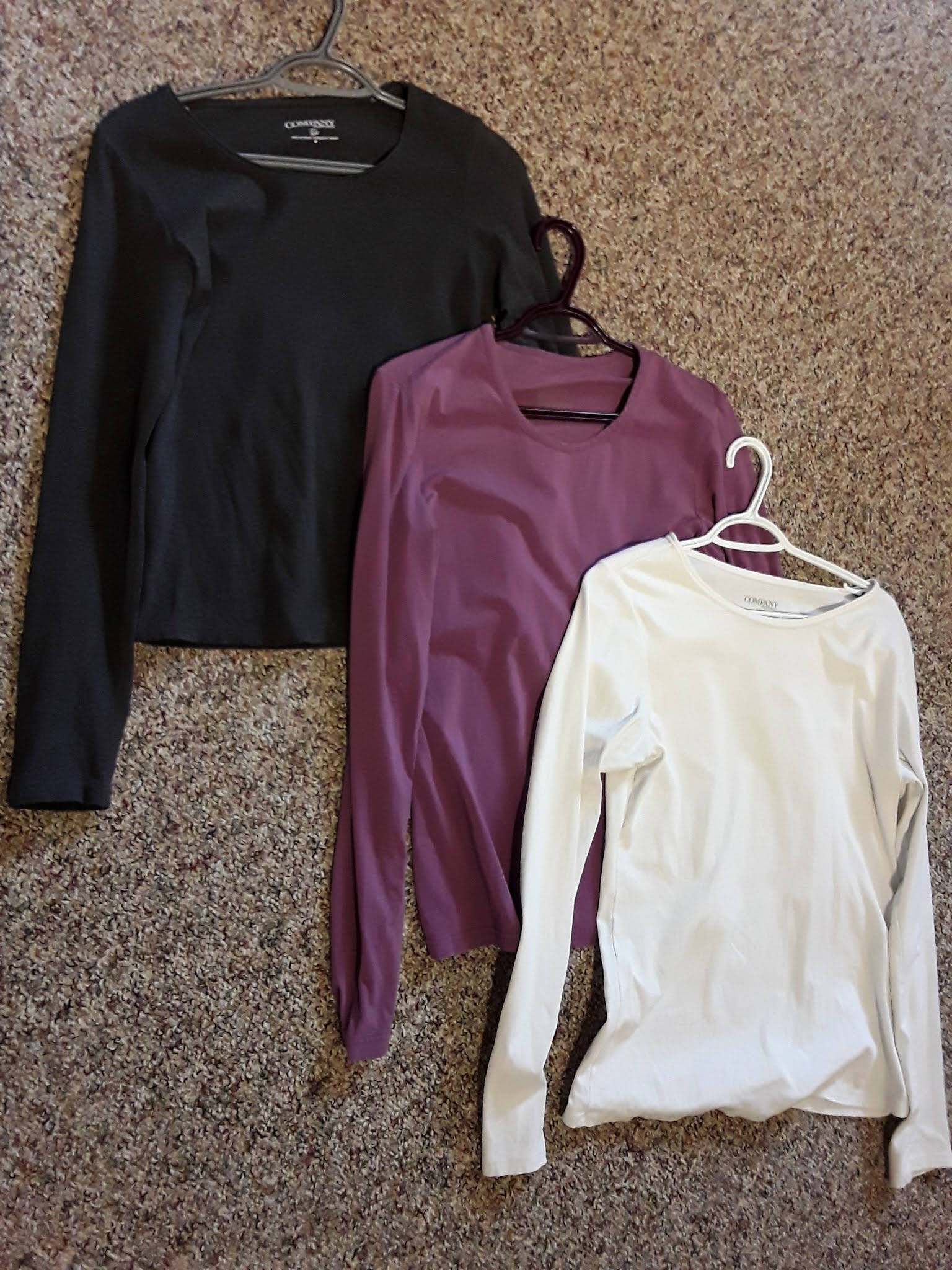
11 button-ups, turtlenecks, and t-shirts
4 pairs of pants (jeans, cords, and leggings)
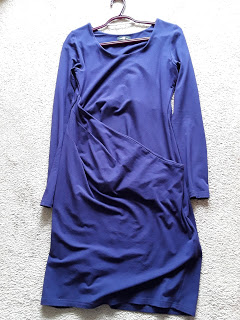
 1 sweater dress
1 denim skirt
Hmm...21 pieces? She looks carefully at what she has and what she's likely to be wearing, and decides to add three more:

Blue and white striped shirt (thrifted), because it's useful
Khaki pants (thrifted), because sometimes she wants a lighter colour
Purple jersey dress (thrifted), because sometimes she wants something not so grey
Outerwear and shoes (not counted) 

Jean jacket (thrifted)

Warm jacket, muffler, hat, gloves, snow boots

Ankle boots (Walmart clearance last year)
Arcopedico flat shoes (thrifted)
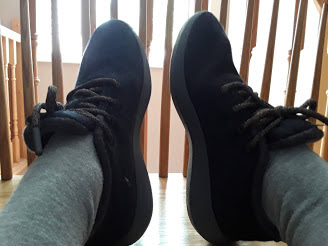
Allbirds Mizzles

Making Outfits


The end of the story

They live three-quarters of an hour from an outdoor flea market. On the weekend before it closes for the season, her spouse says, "Let's go one last time. Maybe there will be some good deals." 

It turns out to be a shivery morning, but one thing she spots hanging on a rack of pictures makes it all worthwhile:
 Yes, for less than the cost of a Dinner for Two with Spring Rolls, she now has a print of Lismer's September Gale. Her spouse cleaned the frame a bit (because he's nice like that), and it's now hanging over her workspace computer.
And the Houstoun can stay where it is.

Friday, November 25, 2016

Do you like Lawren Harris?

Do you really, really like Lawren Harris?

 Do you have about eleven million dollars sitting around?

 Somebody did.
Mountain Forms, an iconic 1926 Rocky Mountain canvas by Group of Seven founder Lawren Harris, was recently part of The Idea of North, Steve Martin's show celebrating the art of Lawren Harris.
Lawren Harris, Mountain Forms

Friday, September 14, 2012

Dollygirl's Grade Six Homeschool week: already changed

This week we will have only four days of school, because of a public-school holiday on Friday.  I also forgot that Dollygirl is going on a tour of the local airport on Thursday morning.  Also I think a couple of the days were a bit overloaded, so we'll probably have to pick and choose a couple of the readings.  Here's where things are at now.

Monday

Opening time: Bible verses, hymn, prayer, Mensa puzzle cards

Bible—Schaeffer, Basic Bible Studies. Finish verses on page 13, about the Holy Spirit.

Poetry: Robert Frost, America’s Poet, chapter 4, “Searching.” Read “Birches.”

The Hobbit, chapter 5

Math: Minds on Math pages 44-45. First, construct a clinometer using a photocopied protractor, straw, string, and washer. Go outside and use the clinometer to measure a tree (see instructions in the book). Come back inside and construct a scale drawing to determine the height of the tree. Answer questions 1-3 on page 46.

French: review the two songs we did last week. Le Voyage de Monsieur Perrichon, Act 1, Scene 6.

World history: Story of the World Vol. 4, chapter 25, first half. Explain about Manchukuo. How was this an early test case for the League of Nations? (See also Usborne Illustrated Atlas of World History, page 69.)

Computer time

School of the Woods, chapter 2

Copywork

Skills and crafts: probably start felt doughnuts, from Stitch by Stitch.

Free reading

Tuesday

Opening time

Bible—verses on page 14 (end of study 1). How do we recognize the Christian God? Reminder: “the Bible sets forth God as one God but in three persons.”

Geography: Read pages 13-15 in Hammond Discovering Maps, and narrate. Read Cool Geography, pages 10-14. (Keywords: gazetteer, atlas, marine chart.) Do Cool Geography Activity 3 on page 20: map questions about the United States.

Shakespeare: Cymbeline, Act 1, Scene IV. What is the bet that is made in this scene? What are the “prizes?”

Math: Read the description of geometric models on page 46 of the textbook. In your notebook, write out a definition of a geometric model (what is it? What is it used for?) Get out four cubes (building blocks) and set them up as shown. Compare your cubes with the drawings of top view, side view, front view. Answer questions 5 & 6 on page 47.

Copywork

Computer time

The Aeneid of Virgil. Read from page 31 to the end of page 32 and narrate what has happened to Andromache since Hector’s death and the fall of Troy. Read to the top of page 35, stop, and narrate the first part of Helenus’s instructions to Aeneas. (Who are Scylla and Charybdis?) Read the rest of his instructions, and the rest of pages 36 and 37.

Skills and crafts

Science: Read The Great Motion Mission, page 23-top of page 26. Narrate orally: what is going on at the art gallery? Read this out loud three times: “Visible light is radiation in the visible part of the electromagnetic spectrum.” Take the blue sidebar on page 26 to your father and ask him to explain it to you.

Teatime

Free reading

Wednesday

Opening time

Bible—start study 2. What is God’s sovereignty? When we speak of His sovereignty, what two thoughts must we keep in mind? God’s work of creation: Look up the first few verses on page 15.

Poetry: Robert Frost: listen to Frost read his poem “Birches.” Read “A Young Birch.” Robert Frost, America’s Poet, chapter 5, “It’s a Funny World.”

Science: 1. Read “Light Color Optics” by John Grunder, in The Old Schoolhouse Magazine, Winter 2008, pages 72-74. 2. Play the “Light Race” board game from the Eyewitness Action Pack “Light & Illusion.”

Canadian history: Read Story of Canada, pages 230-233

Folk songs

English: Write Source 2000, “Library Skills.” 1. Read the introduction and section 290. 2. Sections 291-293 show you how a "card catalogue" works. What are some reasons that most public and school libraries now use computerized catalogues instead of actual cards? Would there be any advantages to a card system? Disadvantages? 3. Review of the Dewey Decimal System.

Thursday:  Field trip morning!

Thursday afternoon:

The Hobbit: continue. Written narration chosen from several suggestions I will give you.
Computer time

French: Act 1, Scene 7.

Science biography: First, read the mini-biography of Einstein on page 27 of The Great Motion Mission. Then read chapter two in Cwiklik’s biography, and narrate.

Free reading

Next Monday:

Opening time

Bible—finish study 2.

The Aeneid of Virgil. Finish chapter 2. Study for dictation later.

Citizenship: Uncle Eric, chapter 3, “Sorting Data.” “Without good models, or paradigms, students have no way to know which facts are important and which are not.”

Math: Use the clinometer you made on Monday to measure one other object outside (p. 47, question 8). Also answer questions 9 (views of an object), 10 (matching pairs), and 12. Weekend homework: p. 49, question 16: construct an object using 8 cubes; draw the front, top, and side views of your object. Give 8 cubes and your drawings to someone else. Challenge him/her to construct an object using the drawings. Is the object the same as the object you created?

Dictation

Canadian history: Read Story of Canada, pages 234-235. Narrate.

Picture study: read about Emily Carr’s breakthrough in 1927. How did her meeting with the Group of Seven change her life as an artist? Compare Lawren Harris’s painting on page 32 (of Anne Newlands’ book) with Carr’s 1928 painting "Skidegate." Also compare "Skidegate" with her 1912 painting on page 25.
Poetry: read these poems from Florence McNeil’s Emily: “Home” (p. 36); “Discoveries II” (p. 41); “Discoveries III” (p. 44); “The Group of Seven” (p. 46).

Art Instruction: Choose something outdoors (maybe a tree?) to paint or draw in Emily Carr’s later style. Try and paint its “inside” more than its “outside.”
Free reading