Showing posts with label Ellen Raskin. Show all posts

Wednesday, December 13, 2017

Wednesday Hodgepodge: Moonlight and Serenade Edition

From this Side of the Pond

1. 'Hurry less, worry less'...what's your strategy for making that happen this holiday season? How's it going so far?

The biggest secret weapon I have is that (as often happens), I don't know till the last minute what we're doing or how many people or what we'll eat. That may not sound relaxing, but it least it means we don't focus too much on planning things like Christmas dinner; or flip out if plans change.

The other helpful thing is that we now live beside a store. So, aside from when it's closed on the actual holidays, we're pretty much covered for small emergencies.
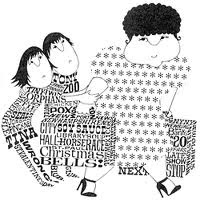
That's me in the front.
(Illustration from The Mysterious Disappearance of Leon (I Mean Noel))

2. Do you have a list of to-dos that need accomplishing in order to prepare your home and/or property for the winter season? What are some of the jobs on your list? Are you a do-it-yourselfer or do you hire someone to accomplish these tasks?

You already know what the answer to that one is.
And it's a relief.

3. According to dietitians surveyed, the most popular health foods for 2018 will be -turmeric, sprouted foods (bean sprouts, breads with sprouted grains, etc), veggies in place of grains, dairy free milk, and pulses (lentils, chickpeas, etc).  What's the first thought that ran through your head when you read this list? Of the foods listed which one might you add to your regular diet? Also, can milk really be dairy free? Is it still milk?

The first thought that ran through my head was "that sounds like the big food book, you know which one, that I bought a few years ago at a homeschool conference and resold soon afterwards to someone else." I had friends who loved that book, but it just wasn't my thing.

4. The Pantone Color of the Year for 2018 is Ultra Violet. According to the Pantone site 'Ultra Violet communicates originality, ingenuity, and visionary thinking pointing us to the future.' What say you? Do you like the color purple? Did you see the movie or read the book-ha!?  Is purple a color you wear often? Describe for us one purple item in your home without using the word purple.  If you were in charge of such things what color would you select for 2018?
Good book for purple fans

Pantone's descriptions are a bit too mystical for me, but I'd agree that purple is a nice change from all-things-green. I like the reference to the evening sky.
Moonlight 1915, Tom Thomson
I like purple (but not as much as Mrs. Carillon)

5. Favorite book read this year?

Until recently I would have said Renaissance by Os Guinness, but the sudden year-end out-of-nowhere winner is Soul Keeping by John Ortberg. The runner-up is maybe To Be Where You Are by Jan Karon.

On a practical level, probably Marie Kondo's The Life-Changing Magic of Tidying Up.

6.  Insert your own random thought here.

An interesting perk of our hi-tech age is being able to "stream" music. Recently we've had Andy Williams, Tony Bennett, Roger Whittaker singing German Christmas carols, and Bill Leslie's Mitford Christmas album (which I had never gotten to hear before). I'm hoping Mr. Fixit can find us some Finest Kind (Canadian folkies). Here's one of their songs.

Linked from the Wednesday Hodgepodge at From This Side of the Pond.

Monday, July 18, 2016

From the archives: Edith Schaeffer on environment and message

First posted July 2013. Cindy Rollins' Ordo Amoris blog (now closed) was running a weekly study of The Hidden Art of Homemaking, and this was my post about the last chapter.
I haven't read other people's posts on the last chapter of HAoH yet, but I predict their reactions will be much like they were to the previous one:  "not what I was expecting."  The last two chapters of the book don't really draw the whole picture of Hidden Art together as fully as we might desire.  Was that on purpose, or did Edith just peter out?  The last chapter in particular is surprisingly short.  It's like getting to the end of a mystery book a little too suddenly...say one of the nutty ones by Ellen Raskin...and wanting to go back and comb through the final chapter for any clues that you missed.
So are there any?

First, there's one of the recurring threads:  "There is no place where one cannot plant ivy over the mud hut and put a flower on the stump....I am sure that there is no place in the world where your message would not be enhanced by your making the place (whether tiny or large, a hut or a place) orderly, artistic and beautiful with some form of creativity, some form of 'art.'"


And then the idea that "we [ourselves] are an environment for the other people with whom we work, the people with whom we communicate.  And in this sense we do not choose an art form and create something in that form; we are an art form...an art form God can use in this area of environment."

As others have pointed out, Edith always comes back to communication, a message.
Is the message we are living clear, or is it a lot of "glub-blubs?"

Are we hiding our real identities and gifts?  Leaving clues on bits of paper towel, or doing something more?

"We should be artists in...doing something practical to show that expectancy [that God can intervene]...affects the attitudes other people are going to have to their troubles." 
Mr. Banks carved the turkey; the plates were passed and filled high to overflowing; and Mrs. Carillon asked Augie Kunkel to say grace.

Augie Kunkel didn't know how to say grace.  He just named the dishes and let the delicious smells inspire the proper reverence:


Patate douce, dindonneau truffée, airelles en couronne, petits oignons, pointes d'asperges au beurre, purée de marrons.

"Amen," said Mr. Banks, who didn't understand French; and the eating and the chatting and the celebrating began.  ~~ Ellen Raskin, The Mysterious Disappearance of Leon (I mean Noel)

Tuesday, July 23, 2013

How Edith pulls it together (Hidden Art of Homemaking, Chapter 14)

I haven't read other people's posts on the last chapter of HAoH yet, but I predict their reactions will be much like they were to the previous one:  "not what I was expecting."  The last two chapters of the book don't really draw the whole picture of Hidden Art together as fully as we might desire.  Was that on purpose, or did Edith just peter out?  The last chapter in particular is surprisingly short.  It's like getting to the end of a mystery book a little too suddenly...say one of the nutty ones by Ellen Raskin...and wanting to go back and comb through the final chapter for any clues that you missed.
So are there any?

First, there's one of the recurring threads:  "There is no place where one cannot plant ivy over the mud hut and put a flower on the stump....I am sure that there is no place in the world where your message would not be enhanced by your making the place (whether tiny or large, a hut or a place) orderly, artistic and beautiful with some form of creativity, some form of 'art.'"

And then the idea that "we [ourselves] are an environment for the other people with whom we work, the people with whom we communicate.  And in this sense we do not choose an art form and create something in that form; we are an art form...an art form God can use in this area of environment."

As others have pointed out, Edith always comes back to communication, a message.
Is the message we are living clear, or is it a lot of "glub-blubs?"

Are we hiding our real identities and gifts?  Leaving clues on bits of paper towel, or doing something more?

"We should be artists in...doing something practical to show that expectancy [that God can intervene]...affects the attitudes other people are going to have to their troubles."
Mr. Banks carved the turkey; the plates were passed and filled high to overflowing; and Mrs. Carillon asked Augie Kunkel to say grace.

Augie Kunkel didn't know how to say grace.  He just named the dishes and let the delicious smells inspire the proper reverence:

Patate douce, dindonneau truffée, airelles en couronne, petits oignons, pointes d'asperges au beurre, purée de marrons.

"Amen," said Mr. Banks, who didn't understand French; and the eating and the chatting and the celebrating began.  ~~ Ellen Raskin, The Mysterious Disappearance of Leon (I mean Noel)
Linked from the Hidden Art of Homemaking linky for Chapter 14 at Ordo Amoris.

Saturday, April 25, 2009

Book sale finds

This weekend was the big annual used book sale! We found:

Two volumes of Best in Children's Books that we didn't have

Maggie Rose: Her Birthday Christmas, by Ruth Sawyer, pictures by Maurice Sendak

The Illustrated Cider With Rosie, by Laurie Lee

Far to Go, by Noel Streatfeild (paperback in pretty rough shape)

Thomasina, by Paul Gallico

Figgs & Phantoms, by Ellen Raskin

The Dolls' House, by Rumer Godden (we have a copy but I couldn't pass it up)

The Jungle Books Vol. 2, by Rudyard Kipling

The Street of the Flower Boxes, by Peggy Mann

Aunt Charlotte's Stories of Bible History, by Charlotte M. Yonge

Gateways to Bookland (a reader)

Life of Robert Louis Stevenson for Boys and Girls, by Jacqueline Overton, with a gift inscription from 1915

Cape Breton Harbour, by Edna Staebler

Kingfishers Catch Fire, by Rumer Godden (one of her adult novels)

A Severe Mercy, by Sheldon Vanauken (a nicer copy than the one we have)

The Jesus I Never Knew, by Philip Yancey

The Oxford Book of English Verse 1250-1918, Chosen and Edited by Sir Arthur Quiller-Couch (1948 printing)

The Golden Treasury of the Best Songs and Lyrical Poems in the English Language, Selected and Arranged with Notes by Francis Turner Palgrave

Two older books of poetry that Crayons picked out


For the Scholastic shelf:

Ginnie and the Mystery Doll

Ginnie and the Mystery House

Kid Sister, by Margaret Embry