Showing posts with label Laurie Bestvater. Show all posts

Tuesday, January 05, 2021

From the archives: Epiphany, liturgy, lasagna

First posted January 2014; edited slightly

Epiphany, January 6th, celebrates Christ made manifest, and shown in His glory to the Gentiles, who are represented by the Magi.  A manifestation is when you see something, right?  And "having an epiphany" is often used, these days, to describe suddenly seeing (and understanding) something clearly.

And what is "liturgy?"  A generic definition might be "a fixed set of ceremonies."  A spiritual habit or discipline, maybe.  If you attend a liturgical church, it means that the worship time is laid out ahead of time, word for word: prescribed, observed, repeated.  As opposed to figuring it out fresh every time, or letting everything happen spontaneously.

In Jan Karon's Mitford books, Father Tim, an Episcopalian priest, often goes off by himself to "repeat the office."  He is not going to his office; he is saying his prayers, those that are laid out in the prayer book for different days and different times of day. An office is a service you do for someone, in the same way that we call worship time a service. That's where we get our word "officer."

On a site called The Daily Office West, I found this thought in their FAQs: "The Office provides a framework for your thoughts, needs, concerns, thanksgivings, confessions and resolutions, so your praying becomes extremely personal. You wouldn't build a house without a foundation; once that’s down, you follow a written plan, and after it’s done, you decorate it so it suits your personality. Ideally, the Office provides a discipline; that’s why it’s best used Daily. If you wait until you’re inspired to pray spontaneously, God may be waiting a very long time to hear from you."

Framework, written plan, discipline. What does this have to do with Epiphany, or Charlotte Mason? It's coming, hold on.

Several years ago I posted "Lasagna Without Recipes," meaning that you could add a variety of ingredients, mix and match, leave out the tomato sauce or the cheese or the meat, and still have something that's recognizably lasagna.  But you still have to give it structure with noodles or something else to keep it separated in layers, or what you end up with is not lasagna.  It might be a good casserole, but it's not lasagna, because it's the structure that gives it its shape and identity.

Like lasagna, we need a framework in our worship, our life and our learning. Or at least we can say that a framework gives it more meaning.

In her preface to The Living Page, Laurie Bestvater quotes a passage from Wendell Berry's novel Jayber Crow, about seminary students who "could tell you" but "didn't see."  They could not see the beauty of the world around them, and so did not connect it with the Creator.  She also refers to Charlotte-Mason-style notebooks as things that "teach us to see" AND that are "the liturgy of the attentive life." A framework, a discipline, a structure...and yet a place to add our individuality, our own taste.  ("Us" and "our" also meaning the students, of course.)

A big epiphany, a star in the heavens, might be experienced once in a lifetime, but we can watch for small epiphanies, glimpses of glory. And if we make use of the disciplines of learning, they may help us to keep our eyes open.

Friday, March 27, 2020

Nothing to Spend, No Place to Spend It: Toads, Butterflies, and Notebooks

Before all This Stuff broke loose, I was trying to do a couple of new things. I had splurged on a spiral-bound notebook divided into blank, lined, and dot-paper sections, to try out bullet journaling. (One of the only dot-paper books I could find at Walmart.)  I even had some flowered washi tape to make things pretty. But when things started getting closed and cancelled, my "weekly" and "daily" notes went up in smoke. "Do Laundry" did not seem to merit the same use of paper as "CM Study Night." Scheduling "Work on Computer" every day also seemed pointless.
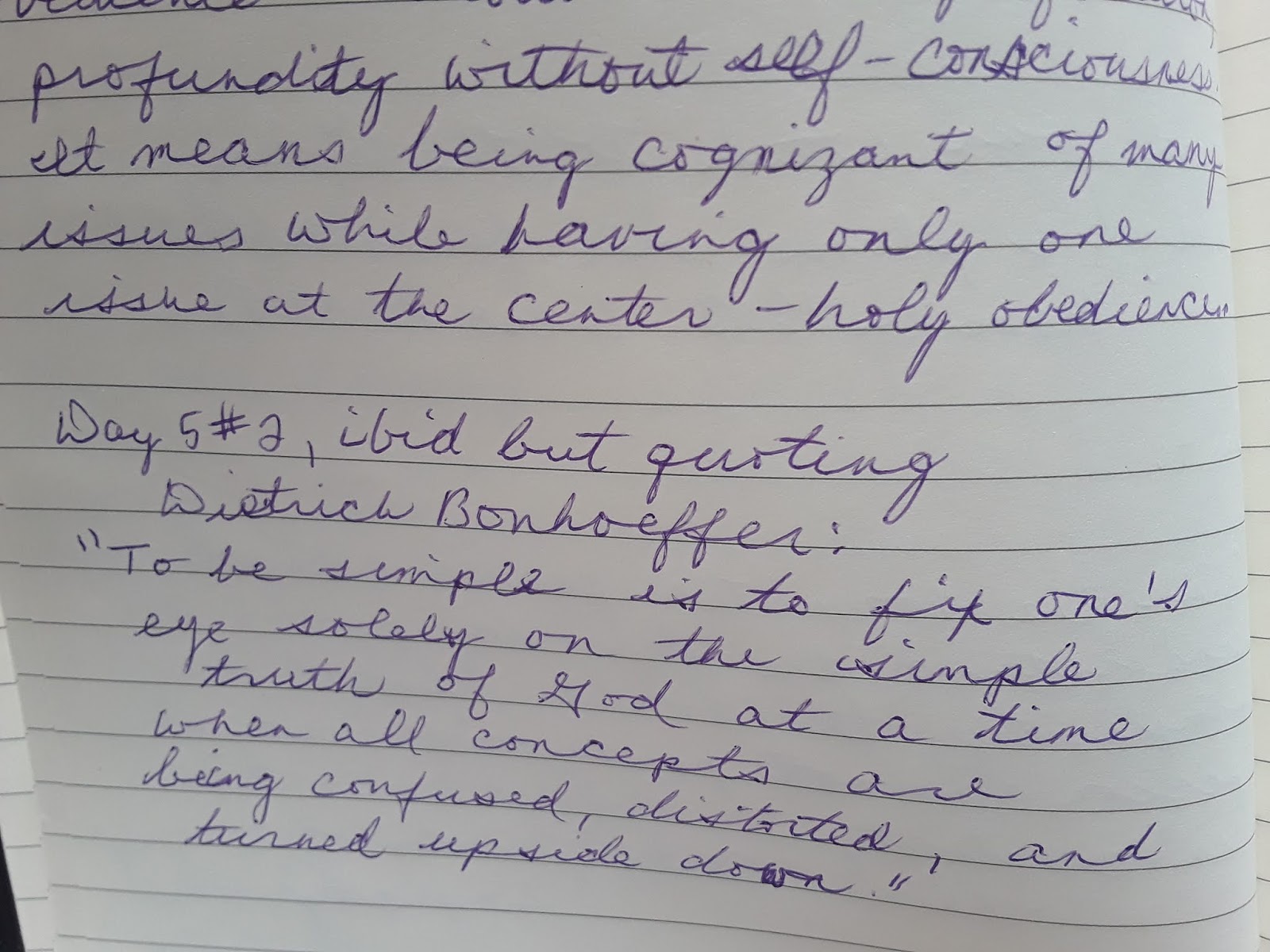
I was also trying to begin a Hundred Days of Keeping notebooking routine (started by Laurie Bestvater). I made a few entries, including this one from Freedom of Simplicity, by Richard J. Foster, which quoted Dietrich Bonhoeffer (I'll transcribe it below):
"To be simple is to fix one's eye solely on the simple truth of God at a time when all concepts are being confused, distorted, and turned upside down."

Well, Dietrich Bonhoeffer knew something about times like that. But I didn't know then how true it would be for this year.

I also didn't know how hard it was going to be to keep up all those new notebook entries. (My hundred days turned out to be about six.) I had about as much success concentrating on that as the Butterfly did praying in Prayers from the Ark:

"Where was I?
O yes! Lord,
I had something to tell you:

Amen."

What turned out to be more valuable for me was going through older entries on the same themes: simplicity, trust, faithfulness. Some of them I've posted on this blog over the years.

"'I take courage,' Aeneas said. 'Here too there are tears for things, and hearts are touched by the fate of all that is mortal.'" Edith Hamilton, Mythology

"Then there is what we may call the Courage of our Capacity--the courage which assures us that we can do the particular work which comes in our way, and will not lend an ear to this craven fear which reminds us of failures in the past and unfitness in the present." Charlotte Mason, Ourselves

"The tragedy is not that things are broken. The tragedy is that they are not mended again..." Alan Paton, Cry the Beloved Country

And this reminder:

"We do not stir. It is a hard lesson...Of course YOU know how to keep still, for you are children. And so perhaps you do not need to take lessons of teacher Toad. But I do, for I am grown up...with a world of things to do, a great many of which I do not need to do at all--if only I would let the toad teach me all he knows." Dallas Lore Sharp, The Spring of the Year

The toad is patient, still; the butterfly is simple, even foolish. Bonhoeffer's "simple Truth" is what they both know best.

 So, although I am keeping busy with the projects I've been working on (plus a couple of new ideas), and although I do have a work routine (Wake up. Do the getting-up things. Start working.), I am excusing myself from needing to document the fact that I'm planning to do it and that I did it. Instead, I've been playing with other sorts of looser, less time-sensitive "Journaling" pages. Places I want to go someday. Books to read. A page of spice mixes in my Enquire Within notebook (that's the household stuff). Things like that.

And one day I will have appointments and errands to X-off again.

Monday, January 08, 2018

From the archives: Charlotte Mason, and peeling back the veil

First posted January 2014

In one of Ellis Peters' medieval mysteries, The Leper of St. Giles, the diseased beggars living near Shrewsbury wear cloaks and veils that allow only their eyes to show. This encourages rough treatment by others passing by; the beggars are more like shadows or ghosts than real people, individuals, flesh and blood beings.  But Brother Cadfael, reflecting on the times he has treated some of their sores (through his work as the abbey's herbalist), says that he has found sharp minds, unique personalities behind the veils..."by a thousand infinitesimal foibles of character that pierced through the disguise, they emerged every one unique."  He has the gift of seeing what others miss.

In The Living Page, Laurie Bestvater says, "One of Mason's primary purposes for making history the 'pivot' of her curriculum is to allow the child to see the flow of history and to think of himself within it."  She points us to Philosophy of Education, page 273, where Charlotte Mason calls history "the proper corrective of intolerable individualism."  So history, as a way of seeing, cuts us down to size but also shows us where we belong; gives us a place and time but makes it clear that there are other places and times that matter just as much.

But we have to see it.  However we can make that happen, for ourselves and our children.

Thursday, November 06, 2014

Education is a life: the gift

So...discipline, as Kathy commented on the last post, is a gift that we give our children rather than something we impose on them.

This fits well with some of the thinking I've heard about rediscovering the monastic "horarium," with specific prayers and readings, devotions and duties--disciplines--tied to certain hours of the clock or times of the year.

It also fits with the terms that Laurie Bestvater uses in her writings on CM-style notebooking: paper postures, paper graces. Could we also say paper disciplines? Again, notebooks are meant to be a lifelong habit for the student, not an artificial, teacher-constructed demand with little longterm meaning.

What we can give is the idea to begin, and the support to continue, along with the practical tools children need. But we can't do the habits of attentiveness or the rituals of nature notebooking for them, any more than we can take over other people's spiritual disciplines.  If there is no education but self-education, there is also no true discipline but self-discipline.

Thursday, October 30, 2014

In this way delight (L'Harmas posts)

Some final thoughts from Laurie Bestvater's talk (I'm not cribbing here, just thinking about it)

You cannot stop God from speaking.  Jesus said that if the children's praises were silenced, the rocks would cry out in their place.  
I read that although Bibles were confiscated in Russia under Communist rule, the authorities forgot to ban some of the country's great novelists, like Dostoevsky. "For example, a character in one of his novels meets a young peasant woman with a baby. When the baby smiles for the first time, the woman makes the Sign of the Cross. When asked why she made this sign, the woman answers: ``All the joy that a mother feels when she sees her child smiling for the first time... God feels every time He sees... a sinner praying to him from the bottom of his heart."  (found here)

God's voice has a way of capturing our hearts, inspiring deep reactions and also actions. We learn to listen for that voice, and to see it as well.  We may seem to hear and see most clearly at certain times, at certain places, or through the words of certain authors that seem to bring us through magic doorways (sometimes found at the back of old wardrobes).  Mark Patrick Hederman calls those times and places "thresholds, where the very pores are kept open between the visible and the invisible."

And as teachers, what does all that have to do with the way we want students to learn?

We encourage the relationship between authors and readers. We direct students to the doorway, but we don't shove them through it.

We use lessons as an instrument for building relationships.

We allow grace to come as and when it will. "Grace is not so poor a thing that it cannot present itself in any number of ways,' writes Marilynne Robinson in Gilead.

We count on delight.
And in this way delight is necessary for happiness. For it is caused by the appetite being at rest in the good attained ~~ St. Thomas Aquinas
Tomorrow: one last post about L'Harmas, Charlotte Mason, and what happens when CM homeschoolers meet up. 

Wednesday, October 29, 2014

Let the wild rumpus start (L'Harmas posts)

Have you seen the movie Hop? (Terrible reviews, but it did have its moments.) The main character is an out-of-work young man named Fred.  Fred's sister takes pity on him and sets up a job interview. Fred mumbles that he'll think about it.  His sister says, "You don't think about it. You shave, you shower, and you show up."  At the least, right?

Sometimes it does start with showing up, being there, human beans getting involved. I'm thinking of the kids who showed up to play in Roxaboxen, and in Maurice Sendak's The Sign on Rosie's Door. Somebody (Marian, Rosie) had ideas...but the others had to come too.
Laurie Bestvater asked a question (at L'Harmas) that came out of her son's studies in political science. What is the moment when an idea leads to some kind of action, positive or negative?  If the air is charged with something about to happen, how do you get from thinking about it to doing something about it?  What moves you from just considering an idea to acting on it?

And when it's an idea that you're taking in, from someone or somewhere else, how do you define that moment of learning, the lightbulb flash?   If there's an element of mystery about how this happens, what is our part as teachers?  Is it something we can control, or do we just help set up the conditions for that to happen? Charlotte Mason had some things to say about not getting in the way of the Holy Spirit, even in religious instruction.
On the other hand, are there things that teachers and parents do (or hopefully don't do) that kill the mystery, that strip the body down to the bones?  Last  Friday, Lydia and I read this in Adler's How to Read a Book:  "The vice of 'verbalism' can be defined as the bad habit of using words without regard for the thoughts they should convey and without awareness of the experiences to which they should refer...'verbalism' is the besetting sin of those who fail to read analytically. [Note that 'analytically' is used here in a positive sense, meaning the reader searches for the big ideas in an argument by noting the key words, terms, and sentences, and not in the synthesis vs. analysis argument of classical education.] Such readers never get beyond the words ...lack of such discipline results in slavery to words rather than mastery of them."

As Laurie pointed out, another way of killing books (and the enjoyment of reading) is to drag them to pieces in unit studies (or blog posts). Or to give multiple-choice tests on them. (Do you notice that that test is part of a unit on Imagination?)

Roxaboxen is set in Arizona.  It mentions cactus and ocotillo. It gives us an idea of what it was like to play outdoors in a desert climate. But it is not a botany or geography book, any more than Miss Rumphius is a scientific study of lupines. The text has to be taken on its own terms. (That is where synthesis, not analysis in its pulling-apart sense, becomes important.)

Dallas Willard said that the Kingdom of God means that God is doing something, and that He invites us to join in whatever this thing is that he is doing, this divine conspiracy.  There's a clear invitation but also a certain sense of mystery, something that calls to us, something that we can give to our children so clearly that they themselves dream of a place they've never seen.  As our friend Cindy says, that "thing" is more often found in poetry than in grammar lessons, unless, again, our 'verbalism' destroys the poem that "should not mean but be."

In The Sign on Rosie's Door, Rosie entices her friends into spending a hot afternoon sitting on her cellar door with her, waiting for someone called "Magic Man" to show up.
"That evening, when their mothers asked them what they had done all afternoon, they said they had done so much there wasn't even enough time to do it in and they were going to do it all over again tomorrow.  'Good!' all their mothers said." ~~ Maurice Sendak, The Sign on Rosie's Door

Wednesday, March 12, 2014

Charlotte Mason and Wide Open Spaces

"Ultimately, the blank page makes us examine our thoughts for metacognition, and intrinsically, it insists upon space and time for learning." ~~ Laurie Bestvater, The Living Page

I've learned so many new words lately.  From going to free lunchtime concerts, I've learned quodlibet. From doing newspaper crosswords, I've added "olio" (a mixture of things) and "ana" (a miscellaneous collection of information). And while rereading Laurie Bestvater's chapter "The Grand Invitation," I had to look up "metacognition."

Metacognition is knowing about knowing, or thinking about thinking, or noticing that we are noticing.  So how does a blank page (in a notebook) make us examine our thoughts for metacognition?  Laurie says it's because it forces us to stop before we start.

It's like the difference between me grabbing a pencil and trying to fill in crossword blanks as quickly as I can, scanning for a few easy or obvious definitions that will get the thing moving, and facing a diagramless puzzle that begins with a blank grid and doesn't even tell you where to start.  You can't cherry-pick the easy bits on an empty grid, or on a blank page.
(not my puzzle--I found this one online)
But the advantage, rather than just the fearsome aspect, of a blank page is that it gives you space to learn. Laurie says (page 65) that it insists on it.  If our children should learn to run and climb and do all those gross-motor things that Charlotte Mason encouraged and that we're now finding out actually put little bodies in right relationship with the planet--that is, if we must find ways to give them physical space and let them find out what they can do in it--doesn't the same thing apply to other areas of learning?

Narration begins with silence. Silence, like blank pages, or a tree to climb, can be disconcerting.

One of my children was once handed a cassette recorder and sent off  to record some examination answers. In an attempt to cover up the fact that she couldn't remember anything about one particular story, she recorded a few words and then gave us several minutes of feigned static, via some noisy crinkling paper. The cassette recorder had inexplicably developed technical trouble.  And I believed it, for about twenty seconds.

But often it's the adults who don't welcome large spaces, white pages, silences.  There is some risk involved with these things.  Multiple-choice questions give you a defined start, a fixed stop, and, if they're to be computer-answered, you had better not colour outside the little circles.

It's a bit like imagining ourselves flying through the air, or sailing over the sea, or galloping across an open field, vs. staying on the footpath.  Yes, there are lots of places where habit and duty and reason make life easier.  Some things just have to be roads, rails, and structure, and that's a good thing too.  But here we're talking about giving our students' minds room to stretch, play, run, and fly.
"Mr. Quimby set his cup down. 'I have a great idea! Let's draw the longest picture in the world.' He opened a drawer and pulled out a roll of shelf paper....Together she and her father unrolled the paper across the kitchen and knelt with a box of crayons between them.
'What shall we draw?' she asked.
'How about the state of Oregon?' he suggested. "That's big enough.'
Ramona's imagination was excited. 'I'll begin with the Interstate Bridge,' she said.
'And I'll tackle Mount Hood,' said her father....
Ramona glanced at her father's picture, and sure enough he had drawn Mount Hood peaked with a hump on the south side exactly the way it looked in real life on the days when the clouds lifted." ~~ Beverly Cleary, Ramona and her Father

Sunday, February 23, 2014

On notebook keeping and copybooks, slightly controversial here?

The ongoing Living Page discussion on Wildflowers and Marbles is up to the several kinds of notebooks that fall in between Nature Notebooks and Books of Centuries. As Jen at Wildflowers says, "many of the notebooks discussed in this section can be accurately described as themed commonplace books with a couple of exceptions."  I mentioned some thoughts on the Fortitude Notebook last week.

But many of these sorts of notebooks are most suitable for the highest grades, or for adult notebook keepers.  As many of us know from our own or our children's early attempts at "keeping," the risk with young children is either that the parent or teacher does the majority of the work, such as by providing printed forms to fill out, or that you end up with personal journals (one form of notebooking that is not part of the CM canon, at least not as part of the educational experience), or multiple drawings of pink ponies.

There are a few notebooks described in this section that would be useful for the elementary grades, including copybooks.  I agree with Laurie Bestvater that Charlotte Mason really does reach far ahead of her time here, in suggesting that students use "words that spoke to their hearts" (Bestvater, page 28).  I thought I was doing pretty well a few years ago in creating "left hand, right hand" type copybooks for my children; that is, I printed out a few words, a sentence, or a verse on the left hand page of an exercise book, and they copied it on the right hand side--just once, not multiple times.  I also used some of the make-your-own-handwriting ideas with the various fonts that our computer has been able to provide over the years--such as graying-out a font similar to manuscript or cursive, and printing it out in a size big enough for them to first trace over, then to copy.  This doesn't even take into account the various workbooks and other writing systems we have tried.  Having two lefties and another child who, though right-handed, just did not seem wired to produce beautiful handwriting, presented some challenges that we never quite overcame. 

Can we just put it that I felt like we were doing our best at the time, though we never did achieve such beautiful written work as some other homeschoolers I knew did? And that I sincerely did attempt to keep the writing practice personalized and meaningful, even if often it was my choice of text rather than the children's?  Perhaps that really is what works well for many of the youngest ones, especially those who have difficulty copying directly from a book; although Charlotte Mason does suggest that young ones be encouraged to copy out verses from their favourite poems.  But at least for those of upper elementary age and over, it seems important that they begin to choose, just as they should be choosing what to write about and draw in their nature notebooks, just as they will begin to choose what to enter in their Books of Centuries.  They may not exactly be keeping commonplace books yet, but they should begin to be given the choice of material to transcribe, even if the "choice" is limited to "from the term's play" or "from this poetry anthology."

Unhappy as this makes me to say it, that emphasis on choice pretty much rules out a lot of the other uses of copywork as we know it, and most of the commercial copybooks and penmanship programs (I mean those that go beyond teaching the formation of letters and how you connect them into words). Many of us have made much use of the Ruth Beechick methods of teaching grammar through copywork, or at least choosing copywork (even for older students) based on spelling patterns, particular forms of sentence construction, or just valuable thoughts.* It may provide great "natural" spelling practice (a term Dr. Beechick likes), it may be a good way to practice handwriting (something even my middle schooler still needs), and it does help to model great writing style and examples of character.  But here, I think, is Charlotte's point: other than demonstrating particular points of spelling or grammar, most of those benefits can be had even if the student chooses his or her own texts to transcribe.  And possibly there are some side benefits that we haven't fully realized.

Your thoughts?

*In fairness, I think Dr. Beechick does offer a good, useful method of evaluating older students' handwriting, in her book You CAN Teach.  She suggests periodically having a sort of "handwriting clinic," where the teacher/parent examines a sample of handwriting and makes suggestions of areas that could be improved; and/or a few weeks out of the year are used to focus on handwriting improvement.  That way it doesn't seem like such a never ending source of friction, but rather puts responsibility for correction on the student herself.  Rather CM there, don't you think?

Linked from The Living Page Discussion #3 at Wildflowers and Marbles.  Linked from the Charlotte Mason Blog Carnival, Feb. 25/14.

Sunday, February 16, 2014

School plans and fortitude (Dollygirl's Grade 7)

This is a short week because Monday is a holiday. The Apprentice is here for a few days too because it's reading week.  On Friday, a local museum is offering cheap admission for homeschooled kids, and parents get in free.  So we'll have to fit school in from Tuesday to Thursday.

In Ourselves Book Two, we will finish the chapter on Fortitude (don't show off your suffering like the lady in Our Mutual Friend who tied a black ribbon around her face*).  And look what pops up at the end of that paragraph on page 47: "...it would not be a bad plan to keep a note-book recording the persons and incidents that give a filip to conscience in this matter of Fortitude." This is one of the incidental notebooks mentioned in The Living Page.  Really, it's not hard to come up with good literary examples, in both children's and adult literature. Charlotte even suggests a list of examples on the same page. Charlotte also answers any objection to why she has placed "fortitude" under the heading of the "house of body" rather than the mind or the heart; she says that "it is in the body we must endure hardness, and the training comes in the cheerful bearing of small matters not worth mentioning."  In other words, we're not entitled never to feel cold, or tired, or hungry, or overworked, or unwell, and it's a mark of maturity to be realize that and to put up with at least some discomfort without complaining.  I'm always impressed by the characters, even children, on long journeys, in books like Narnia and Lord of the Rings, who sleep wherever it's safest and eat (mostly) what's available along the road.  It's people like whiny Cousin Eustace who spoil the adventure by fussing over hard beds and no lunch.

What else is up this week?  "Bacterial Growth" in science class.  "Quebec Culture and Pea Soup" in French.  Sounds like the makings of a bread and soup meal sometime in the week (or maybe a batch of yogurt).

We move on to Henry the First in English history.  More chapters from Ivanhoe, Watership Down, and Tolkien.  A lesson from Plutarch's Life of Demosthenes; more Bible study on the topic of salvation; an alliterative poetry assignment; and some work in math.  If we get all that done in three days, I'll be very content.

*I am not sure that Charlotte remembered the details of Our Mutual Friend quite exactly here; Mrs Wilfer does go around with a handkerchief tied around her head, but not a black ribbon that I know of.

Thursday, January 16, 2014

Peeling back the veil: a thought on Charlotte Mason and history

In one of Ellis Peters' medieval mysteries, The Leper of St. Giles, the diseased beggars living near Shrewsbury wear cloaks and veils that allow only their eyes to show.  Sometimes this appears almost to encourage rough treatment by others passing by, as if it is easier to abuse someone you can't really see; the beggars are more like shadows or ghosts than real people, individuals, flesh and blood beings.  But Brother Cadfael, reflecting on the times he has treated some of their sores (through his work as the abbey's herbalist), says that he has found sharp minds, unique personalities behind the veils..."by a thousand infinitesimal foibles of character that pierced through the disguise, they emerged every one unique."  He has the gift of seeing what others miss.

In The Living Page, Laurie Bestvater says, "One of Mason's primary purposes for making history the 'pivot' of her curriculum is to allow the child to see the flow of history and to think of himself within it."  She points us to Philosophy of Education, page 273, where Charlotte Mason calls history "the proper corrective of intolerable individualism."  So history, as a way of seeing, cuts us down to size but also shows us where we belong; gives us a place and time but makes it clear that there are other places and times that matter just as much.

But we have to see it.  However we can make that happen, for ourselves and our children.

Monday, January 06, 2014

Epiphany, liturgy, lasagna (and Charlotte Mason)

Epiphany, January 6th, celebrates Christ made manifest--shown in His glory to the Gentiles, who are represented by the Magi.  A manifestation is when you see something, right?  And "having an epiphany" is often used, these days, to describe suddenly seeing (and understanding) something clearly.

And what is "liturgy?"  A generic definition might be "a fixed set of ceremonies."  A spiritual habit or discipline, maybe.  If you attend a liturgical church, it means that the worship time is laid out ahead of time, word for word: prescribed, observed, repeated.  As opposed to figuring it out fresh every time, or letting everything happen spontaneously.

In the Mitford books, Father Tim, an Episcopalian priest, often goes off by himself to "repeat the office."  He is not going to his office; he is saying his prayers, those that are laid out in the prayer book for different days and different times of day. An office is a service you do for someone, in the same way that we call worship time a service. That's where we get our word "officer."

On a site called The Daily Office West, I found this thought (in their FAQs: "The Office provides a framework for your thoughts, needs, concerns, thanksgivings, confessions and resolutions, so your praying becomes extremely personal. You wouldn't build a house without a foundation; once that’s down, you follow a written plan, and after it’s done, you decorate it so it suits your personality. Ideally, the Office provides a discipline; that’s why it’s best used Daily. If you wait until you’re inspired to pray spontaneously, God may be waiting a very long time to hear from you."

Framework, written plan, discipline. What does this have to do with Epiphany, or Charlotte Mason? It's coming, hold on.

Several years ago I posted "Lasagna Without Recipes," meaning that you could add a variety of ingredients, mix and match, leave out the tomato sauce or the cheese or the meat, and still have something that's recognizably lasagna.  But you still have to give it structure with noodles or something else to keep it separated in layers, or what you end up with is not lasagna.  It might be a good casserole, but it's not lasagna, because it's the structure that gives it its shape and identity.

Like lasagna, we need a framework in our worship, our life and our learning. Or at least we can say that a framework gives it more meaning.

In her preface to The Living Page, Laurie Bestvater quotes a passage from Wendell Berry's novel Jayber Crow, about seminary students who "could tell you" but "didn't see."  They could not see the beauty of the world around them, and so did not connect it with the Creator.  She also refers to Charlotte-Mason-style notebooks as things that "teach us to see" AND that are "the liturgy of the attentive life."  A framework, a discipline, a structure...and yet a place to add our individuality, our own taste.  ("Us" and "our" also meaning the students, of course.)

A big epiphany, a star in the heavens, might be experienced once in a lifetime, but we can watch for small epiphanies, glimpses of glory. And if we make use of the disciplines of learning, they may help us to keep our eyes open.

Linked from Hot Homeschool Hop: January 2014, at the HSBA Post.

Friday, November 08, 2013

The Living Page, by Laurie Bestvater (Book Review)

Have you noticed that Charlotte Mason seems to be keeping unusual company these days?

Over the last few years, Miss Mason's philosophy has taken on what she herself might have called a new small-c catholicity, and it's not unusual to hear her quoted along with Wendell Berry, St. Benedict, and scientists researching brain function. Like Anne of Green Gables with her hair up and her skirts down, CM has taken on a possibly unexpected but not unbecoming seriousness.  At a recent gathering in Ontario, we heard the word "homeschooling" from the speakers much less than we heard both literary language (myth, metaphor) and spiritual vocabulary (transformation, meditation, sacrament, Glory).  As a community, we seem less determined now to "use" Charlotte Mason for our own purposes, and more interested in discovering and discussing the truths of her philosophy.  (The fact that we can even identify a "CM community" is a milestone in itself.)   Even if you haven't attended CM conferences or retreats, you might still have noticed that the general image of Charlotte Mason education is maturing, partly because there is more previously-unavailable information available, and partly because there are some tenacious individuals digging through those resources and sharing their finds.

Laurie Bestvater's recent book The Living Page, published by Underpinnings Press, reflects that different, more contemplative view of CM, and at the same time manages to be a practical resource not only for homeschooling parents, but for classroom teachers and anyone with an interest in lifetime education.  It does not attempt to cover the how-to's of every school subject, and omits the already-well-known history of Charlotte Mason, her college and correspondence school.  Instead, The Living Page puts the focus on the role of Mason's "paper graces," or student-kept notebooks.  Using many quotations from Mason's own writings, as well as archived examples such as the nature notebooks of student teachers, Laurie Bestvater defends the idea that these notebooks are not optional or peripheral, but absolutely central to a Mason-style, living-ideas, relationship-based education. She shows how and at what ages certain activities were begun in Charlotte Mason's schools, and discusses not only specifics of the various books, but the balance and connections between them.  Taken together, they form a large and vital part of a child's self-education.

Giving students choice in what to write and draw, allowing them time to contemplate and observe, may have been unusual in Mason's day; but it is no less rare and threatened in our own time, in these days of easily- reproduced fill-in pages and visual examples at our fingertips.  How does this style of notebook-keeping reflect Mason's consistent rationale, her overall vision that culminates in what she called The Way of the Will?  Laurie Bestvater's detailed descriptions, along with photographs of new and vintage examples, give shape to ideas that may have previously seemed too abstract or not important enough to work into an already-full curriculum. But the book goes well beyond a simple description of how to keep the Book of Centuries, the commonplace book, and the nature notebook as Charlotte Mason knew them, and becomes a plea for a more human heartbeat in children's education.  If a child keeps a notebook that gives her a "sense of possession and delight," and the delight is not so much because the end product is beautiful but because it reflects her own learning," the connections she has noticed, the relationships she is creating, is that not more valuable than many worksheets that will be filed away somewhere and then discarded?

The Living Page is, especially in its final section, a manifesto for what, throughout the book, is variously referred to as being "Keepers," living fully, and knowing Glory.  It echoes what Susan Schaeffer Macaulay wrote in For the Children's Sake: that Charlotte Mason, with her emphasis on the value of the person, had insights that went beyond teaching children to read and do math, that there are important truths in her work that cross the lines of sacred/secular, school/homeschool, child/adult, then/now.

Laurie Bestvater's ability to combine literary examples with personal insights, while staying true to Charlotte Mason's philosophy and practice, makes The Living Page a unique and significant contribution to CM literature. Well recommended.


Disclaimer:  I was provided with a copy of The Living Page to review, but did not receive any other compensation.  The opinions expressed are my own.

Friday, October 11, 2013

When CMers get together, or, Mama Squirrel's upcoming weekend off

This is Thanksgiving Weekend in Canada.  Around here it's also Oktoberfest.
Next weekend is the 44th Migration Festival in Kingsville, Ontario (not far from Detroit).

But that's not why Mama Squirrel is going there.  There's something else going on in Kingsville next Friday and Saturday.
"Welcome to our 1st Annual Charlotte Mason Retreat at l'HaRMaS.  
A gathering
 where we will look closely,
think deeply and consider ideas 
as they unfold through presentations and conversations."


CMers from the U.S. and Canada will be getting together to talk, listen, look at nature notebooks, and hear about Laurie Bestvater's fear of bathmats.  Really.
If you're going, I'll see you there!