Monday, June 12, 2006

Class Field Trips. Family Field Trips.

Last week our family had the chance to visit the African Lion Safari--a sort of zoo near here where animals roam pretty much free. (Note of caution: stay away from the monkey area unless you want the trim ripped off your car.) Our homeschool support group went together to get a group rate, so I guess you could call it a group field trip; but really every family was on its own once we'd gone through the gates.

One of the attractions of the Lion Safari is the Elephant Swim. Every day at noon, the elephants walk down to the water near the picnic area for a swim. They walk lined up, holding each others' tails, and they have a sort of sheep dog that keeps them in line. We've been there before and knew what to expect, so we had our lunch at a picnic table fairly close to the water and brought along a couple of lawnchairs. However, this was also a big day for school field trips. As soon as the parade of elephants appeared, what seemed like hundreds of children and parents and teachers (all carrying heavy backpacks and smelling of sunblock) scurried down to the water to watch. Well, scurried isn't the word exactly. Do you remember the Flintstones episode where they're all sitting on the quiet beach and they suddenly remember that this is the place where there's a big surfing competition--and at the same second they get stampeded by hundreds of teenagers carrying surfboards?

They all crowded in there, pushing to see the elephants swim across the lake, and the parents were yelling things like "Mrs. Vanderboggles, come over here so I can get a picture of you and the kids." The kids who weren't really watching the elephants were all yelling and playing tag around the trees.

And then--this is the funny part--within five minutes, they all disappeared again. I don't know whether it was that the kids had a very short attention span, or whether their itinerary didn't allow them to watch elephants playing for more than five minutes, but anyway, suddenly they were gone.

And we sat in our lawnchairs, and our kids went down to the water's edge, and we got a peaceful and clear view of the elephants for as long as we wanted.

Retro Recipe Challenge

Now this is a recipe carnival like you've never seen before. Put on your high heels and enjoy the Retro Roundup (including a mystery meat casserole)--Mrs. MacGrady would be so proud.

Friday, June 09, 2006

Where I'm From

There is a kind of meme going around based on a poem by George Ella Lyons,"Where I'm From."The poem has become so widely imitated that you can now print out a template to help you write your own version. (The template seems to have been around for at least a couple of years, but I only heard about it recently.)

This is my attempt. I didn't do very well trying to use the template, so I just did it my own way. (I realize that for many of these things you'd need an annotated version or at least hyperlinks to know what I'm talking about (unless you came from the same place), but for now it's going to have to stand on its own.)

Where I'm From

I am from glass baby bottles, Buffalo markers in a tin, snowboots with buckles, Jelly Tots, and Brownie scarves with orange maple leaves

I am from the hard red swings in Soper Park, bike rides down McNaughton Street hill, Galt Arena skating races, and sunburnt afternoons on the sand of Georgian Bay.

I am from long voyages in creaking ships and Conestoga wagons. I am from weavers and blacksmiths and small-town storekeepers, from Branchton and Glen Morris and Killean, and other places gone from the map. From been-here-forever and make-the-best-of-it.

I am from the United Church of Canada, from Messengers and strawberry socials and stewardship and the Threefold Amen. I’m from the shakeup time and if you’re thirsty and dry lift your hands to the sky. And I’m from the after time too.

I am from Aunt Alma’s pastels and tubes of paint, and her shelves of old school books. I’m from Aunt Katie’s funny poems and card tricks. I’m from Grandma McKellar’s paperback mysteries and her backyard-plum jam—-bottled and sealed like the things we kept inside ourselves.

Wednesday, June 07, 2006

How to fool smart people

The EduWonks host this week's Carnival of Education. I didn't see much I wanted to check out until right at the end: Paul's Tips offers The Easiest Way to Fool Smart People. (Hint: make them feel they're smart.) Apprentice, you need to read this, after all the discussions we've had about logic and reading critically.

Paul's Tips also has a discussion of why high-school style popularity isn't all it's cracked up to be--especially after you graduate. He says:
In the adult world what clothes you wear, what music you listen to, how cool your friends are, and so on are of almost no consequence. Things like ability and maturity are much more important.

Even the ultimate status-symbol in teenage life - beauty - isn't worth that much in the adult world. There are plenty of beautiful people out there working in poorly-paid, degrading jobs. And there are plenty of ugly people at the top of the status tree.
Hmmm...that may be true, but how many adults do you know who are actually living in the "adult world"? (Can you say Brangelina?)

Oh, okay (I read further down)--Paul caught that one too.
Of course, some people never really manage to escape high-school. The keep up the petty rivalries and irresponsibility and look to celebrity culture to replace the cool-kids they used to admire. They long to return to the simple world of teenage life. Such people rarely succeed in the adult world.
Well, maybe. (Can you say Brangelina?)

Tuesday, June 06, 2006

23rd Carnival of Homeschooling

I always look forward to the weeks when Palm Tree Pundit hosts a carnival--her blog makes me think of tropical fish and coconuts. And wow, there are a lot of things to read on there this week (including our own Planning Process post). Have a look also at Life in a Shoe's Approach to Math, and The Thinking Mother's post about her Charlotte Mason support group meeting.

Aloha!

Monday, June 05, 2006

Crayons' Treehouse

~~~~~~~~~~~~~~~~~~~~
(Photo credit to Mr. Fixit)

The way of the dodo

Homeschoolbuzz.com posted a link to this article about the rather posh homeschooling option of hiring a professional teacher or tutor. ("Another variant of school at home very different from the homeschooling most know," comments Homeschoolbuzz.)

What struck me most was this comment by Bob Harraka, president of Professional Tutors of America:
[he] cannot meet a third of the requests for in-home education that come in, he said, because they are so specialized or extravagant: a family wants a teacher to instruct in the art of Frisbee throwing, button sewing or Latin grammar.
My goodness, Latin grammar? What will they think of next? I guess one would really have to hunt far and wide to find a teacher versed in something so specialized and extravagant.

I could recommend a few homeschooled teenagers, though...

Sunday, June 04, 2006

Funny post of the weekend

MerryK's Book Lover's Odyssey gives us a peek at the truly grinding work involved in going to used book sales (and coming home).

Thursday, June 01, 2006

A narration about Theseus, by Ponytails

(Note from Mama Squirrel: Ponytails dictated this to me recently. It's from the middle of the story of Theseus in Charles Kingsley's The Heroes. Some background: Theseus has been on a quest to find his father, King Aegeus (who doesn't know him), and on the way he has had to kill various monsters and so has gained a reputation for himself; one of these slayings turned out to be some kind of a kinsman, so he had to go and get purified for that (forgiven, as Ponytails says here). When he finally arrives at the palace, he finds it has been taken over by his partying cousins.)

~~~~~~~~~~~~~~~~~~~~~~~~~

Theseus went and got forgiven, and then he went on to the palace. He looked around for his father, but he wasn't there. He said, "Where is the master Aegeus?" "We are all masters here! You can ask one of us instead. Come and eat and drink with us (hic!)! Heh heh heh!" Theseus looked around, but he did not see Aegeus. Then he said, "Go and tell him Theseus is here!" "Yes, your majesty--Mr. Theseus--I will go and summon him!"

So he went, and next to him [Aegeus] was Medea, and she was a snake woman. So Aegeus turned pale, red and then white. He went out because he knew this was going to be important.

Theseus said in his mind, "I'm going to test him first before I say I am his son." So he said, "I have come for a reward." Aegeus said, "I cannot afford it." But Theseus said, "All I want is dinner." "Okay, I can give you that."

Medea was watching. She went back into her room, and she came back out. She said, "This is a troublemaker." She saw him [Aegeus] go red and white when he heard the word Troezene. So she was going to get rid of him, Ah ha ha ha! She dressed in jewels and got a golden bottle full of magic wine and a golden cup. And she came out to Theseus and said in a soft voice, "Theseus! Please drink from this cup! It
will give you strength and heal your wounds, it will give you fresh blood in your veins, so please drink." But Theseus saw the look in her eyes, the black smoky evil look with a tint of red, it turned up at the corners to make her look evil. He said, "You drink first." But she said, "I can't, I'm ill, I'm very ill. So I cannot drink." (But it's supposed to HEAL wounds!) He said, "Drink from it or you die!", swinging his club. She dropped the cup and ran. She called for her dragon carriage and went off, far away from the kingdom.

The stones bubbled from the wine she had spilled, and they just kind of disappeared.

Aegeus said, "What did you do? That was sort of my wife!"

But then he pulled out the sword and the sandals, and he said the words his mother bade him to say. And they hugged and wept until they could weep no more. The end!

The planning process

Melissa Wiley at the Bonny Glen (actually this is on her other blog), and others (linked from Melissa's post), have been posting in answer to some non-homeschoolers' questions about why we’d want to homeschool, or how we have the nerve to do this without courses in pedagogy etc., etc.

An analogy I used last year was that of a professional chef vs. cooking for your own family. I made supper tonight (in the middle of a heat wave) and we ate it (in the middle of a thunderstorm). Aside from the freaky weather, how did I know how to do that? How did I manage to get it all on the table, in the right amount, at the right time? We had chicken breasts baked in canned pasta sauce (in the toaster oven), whole wheat fusilli, spaghetti squash (cooked on top of the stove), raw broccoli and carrots (cut up yesterday), and a frozen ricotta dessert topped with leftover canned pineapple. And it wasn't a complicated meal to make; it was just experience, knowing how much chicken to thaw, how to thicken the sauce at the end, remembering that we had leftover veggies, figuring that the pineapple would go nicely on top of the dessert. At home, you learn to cook (see #s 18 and 19 there) based on experience, reading, watching, asking other people how they do things. Family meals aren't like restaurant cooking, and they're not meant to be (unless you're Anne Tyler). Homeschooling compares better to home cooking than it does to the surgery-on-the-kitchen-table analogy. If the math lesson doesn’t connect, you can try it another way tomorrow, or wait awhile and then try it again. Surgeons don’t have that option; homeschoolers do.

But back to the pedagogy, qualifications question that keeps coming up: somebody out there has an idea that I (or any homeschool parent) must have a little schoolroom in my house with a blackboard and a pointer, or at least a kitchen table with chains to keep the students there; plus a piece of paper from the government that says I took a course in how to teach and what to teach; and that if I don't, then I don't know what I'm doing and shouldn't be teaching.

So this post is meant to show anybody who's interested how the process of planning a school year works, after ten years at this. These are some of my real-life thoughts and experiences as I plan for Ponytails' grade 4.

1. Mathematics: I order Making Math Meaningful Level 4, since we'll be done Miquon Math and I need to find something that has a good dose of word problems in it--something Ponytails is still weak on. When I get the books, I realize there’s some repetition of what she's already done, so I figure we can complete it in 3 days a week next year, and that leaves 2 days for activities in geometry, and other topics that MMM doesn't cover. How did I get the general idea of grade 4 math topics? I compared a couple of scope and sequences and made a list of goals for next year. I checked those that aren't included in our main book against a list of good library math books (not textbooks--there are a lot of other books on the 500's shelf) and a couple of our other resources like Family Math--for instance, I want to work on using a calculator, and Family Math includes several calculator games.

2. Language arts: again, I have a list of typical grade 4 skills, which I’ve gone over with Ponytails in mind, eliminating what she already knows and adding in a couple of other things I would like her to work on. I have two main goals for the year—-increased independent reading skills (especially in non-fiction) and improved ability in writing—-not her ability to express herself so much (see Theseus here) as her level of comfort with written work—-mechanics, handwriting, spelling, all the boring but important stuff. Also she'll be working on skills in finding things out—-choosing resources (a dictionary? A thesaurus?) and using them.

And how will we be working towards those goals? By checking off pages in a language textbook? Am I ordering a creative writing program, a speller, and basal readers? No, we've never done things that way. At our house it's more like this:

Reading skills: This will be the year I ask her to read more school books on her own—-not setting her adrift, but giving her 15 minutes to read a section and then following up. We will start with short sections and see if she can work up to reading a whole chapter and then telling back what she's read. It means working on habits like attentiveness, not getting distracted. (Do we need readers with chapter-end questions? No, we have books, magazines, newspapers, emails...)
Writing: again, beginning short written narrations—-or writing some and then dictating the rest. Knowing Ponytails, she will probably initiate some of her own writing projects as well.

Mechanics: we will use copywork and dictation, from books across the curriculum, as a place to work on mechanics and very basic grammar (just parts of speech, not diagramming); on noticing story details and picking out homonyms; on experimenting with synonyms or changing tense. Will I have all those lessons prepared ahead of time? No, it’s not practical. If something needs extra work, we spend extra time on it. It’s a waste of time for me to write out 36 weeks of language lessons for Ponytails, just like I don’t buy her new shoes until she needs them. (We do have a couple of yard-sale grammar workbooks to fall back on too.)

Handwriting: besides copywork, we will use Ruth Beechick’s 3-week cursive improvement course (from You CAN Teach Your Child Successfully Grades 4 to 8). (That's less involved than it sounds; it just means having her write sentences and then looking at specific things that need improvement.)

Spelling: I don’t know yet how much extra time Ponytails will need on this next year, so we'll just keep working on it along with her other language activities.

3. Latin (the thinking continues here): I look at the Latin program a friend loaned us, and decide this is not the year to be adding another language. We’ll include some Latin roots when we talk about prefixes and suffixes.

4. Nature studies: I look at the fat handbook we’ve had forever but hardly use,and realize we can use it next year for some book lessons about ladybugs, spiders, ants, worms, and other wiggly crawly things we have close at hand. I was going to add to our collection of magnifiers and bug-lookers anyway, and this will give us some things to examine and maybe draw.

5. Music: At a rummage sale, I find a book & record set of Leonard Bernstein’s 1960’s young peoples’ concerts. There’s a whole kid-size music appreciation course in there, and I know our library has some of the videos too. At our support group's annual conference I buy 2 new Music Maker packs for our lap harp, including a basic music theory pack.

6. I list books we own and can use for history, Bible, science, poetry and more. I write down a couple of others to ask for on a swap board or to look for at the library. Something with legs crawls out of Five Little Peppers, so I toss the book in case the little thing is thinking about multiplying (it was an old tattered copy anyway) and make a note to replace it (the book, not the bug). (No, I do not want to do nature study on a silverfish.) I plan to use one book of Greek myths, but then pick up something I like even better at a library sale and cross out the first one. I decide to order an audio book of Robinson Crusoe, because it's probably the hardest book we’ll be doing this year. An online friend has written her own geography e-text, so I decide to use that for both of our elementary-aged students. I also plan for each of them to make a scrapbook about Canada.

Interlude: I re-read some of my favourite Charlotte Mason chapters and Parents' Review articles and underline key points about why we do what we do. Call it inspiration.

7. I write down the plans in a binder, print out ideas for memory work, favourite songs, and a few other Internet printouts. I divide them up into terms, then roughly by weeks. I collect the books, find CDs, save cardboard and pop bottles for science experiments. We’re ready to begin again.

And did you remember the point of all this? Does this sound like homeschoolers are competent to make curriculum choices, to find resources, to teach lessons, to modify and supplement when needed, to set goals and evaluate progress?

I hope so.

Tuesday, May 30, 2006

A funny from Crayons

Crayons came to me all excited, holding one of our fairy tale books. She'd just discovered that this particular book had a story she recognized. "Look! Handsome and Gretel!"

Saturday, May 27, 2006

Let's go bowling

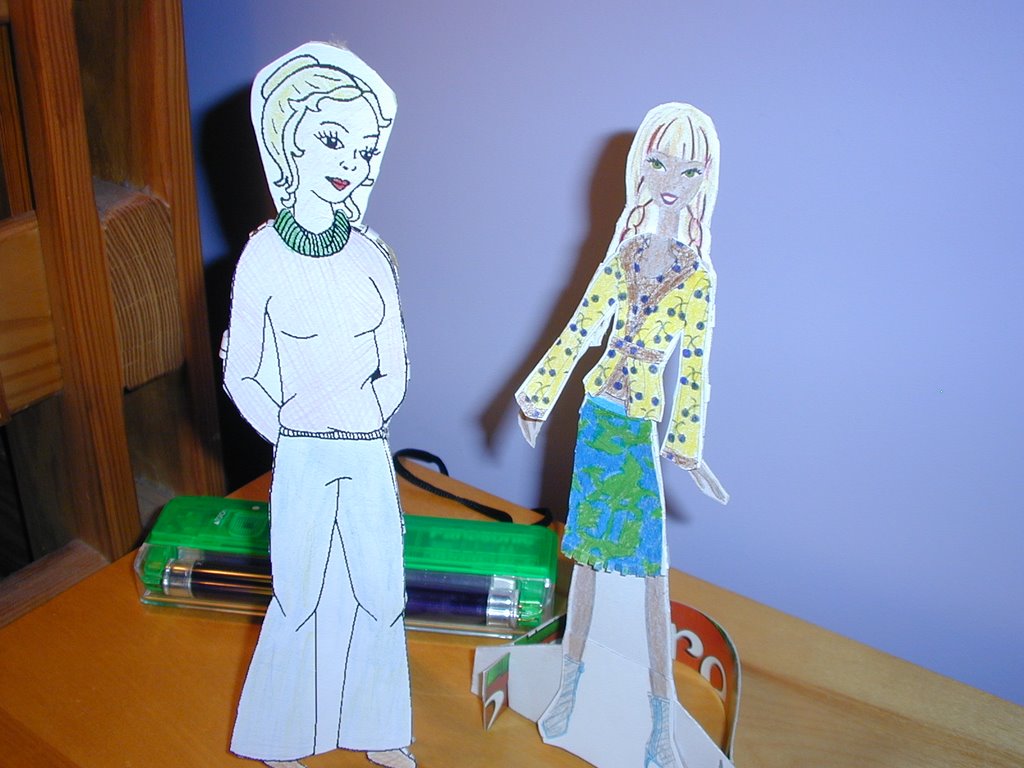
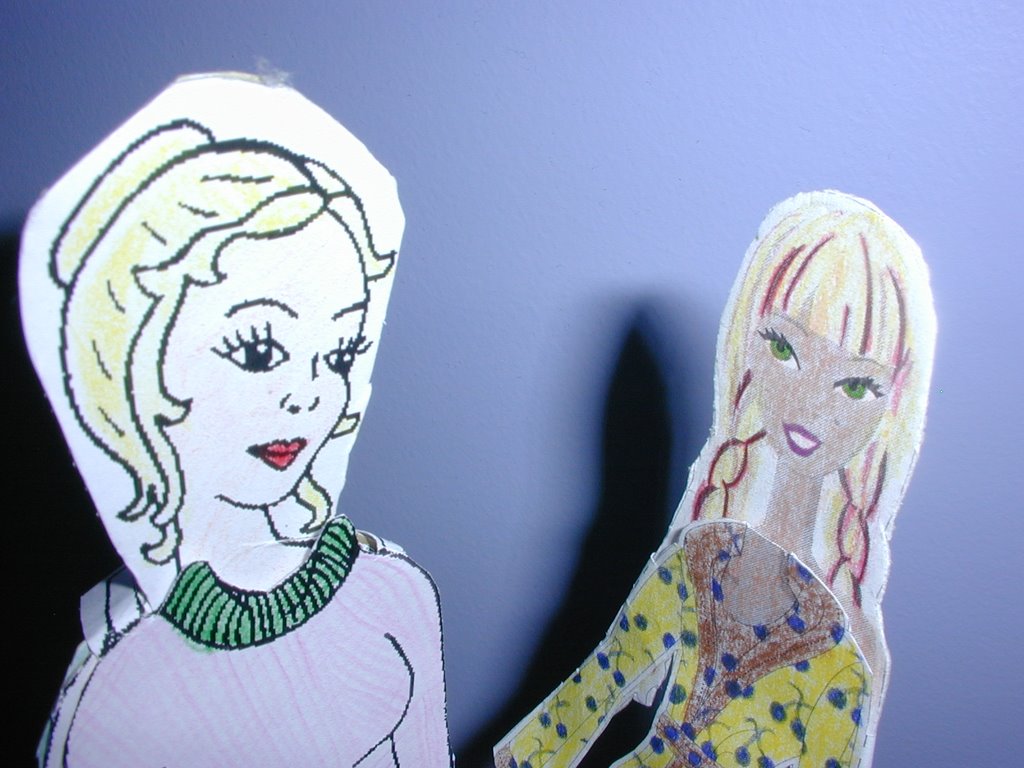
These pretty girls are Christina and Delancey. They're best friends.


They do fun things together, like try on silly hairstyles!


One day, they were just walking along when...


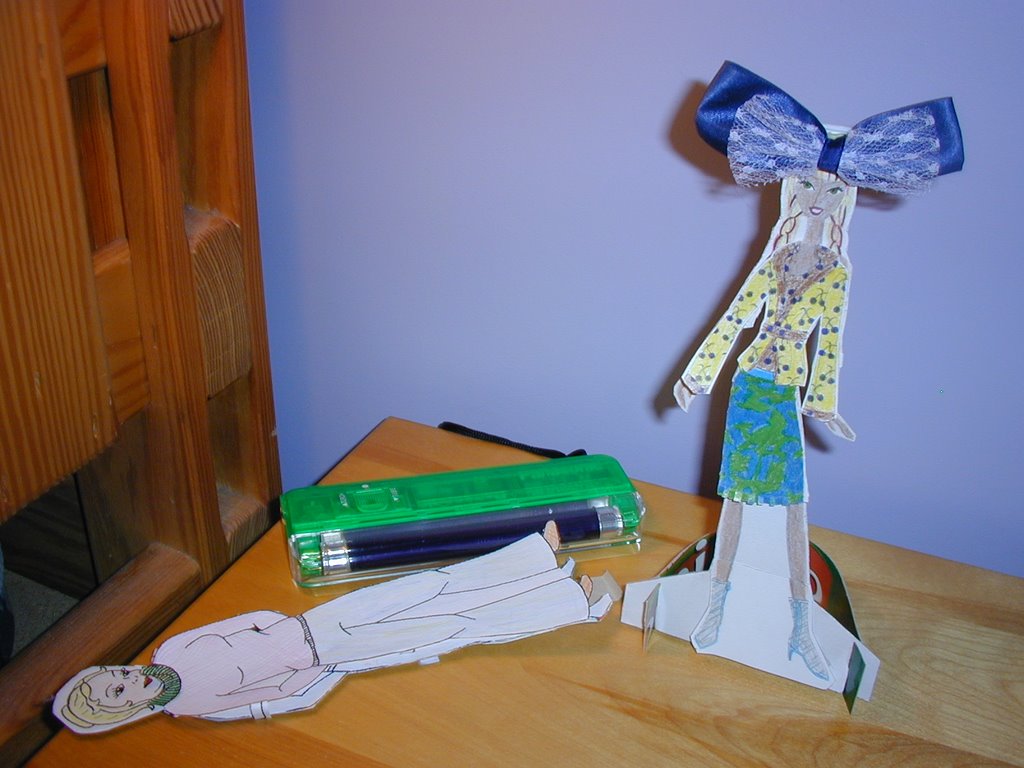
Whoops! They stumbled into a cosmic bowling lane! Those girls must have been really not paying attention...


But as they walked out, Delancy had a great idea.
"Christina! Let's go bowling with all our friends!"
"That's a great idea!"


So they made a couple calls.


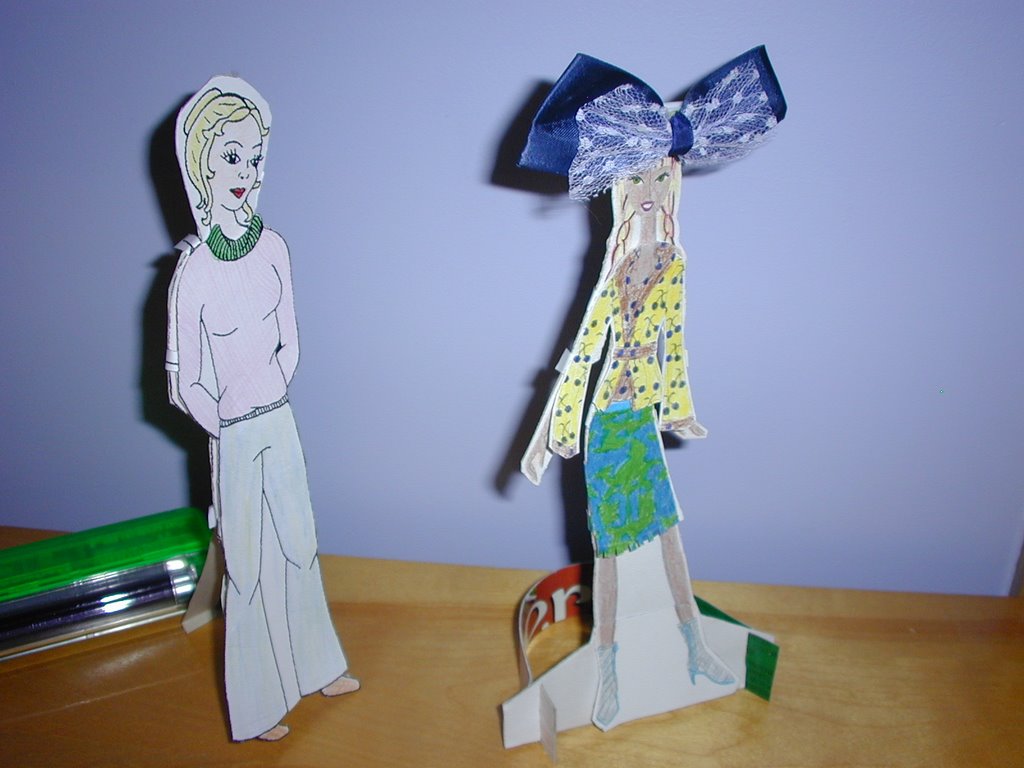
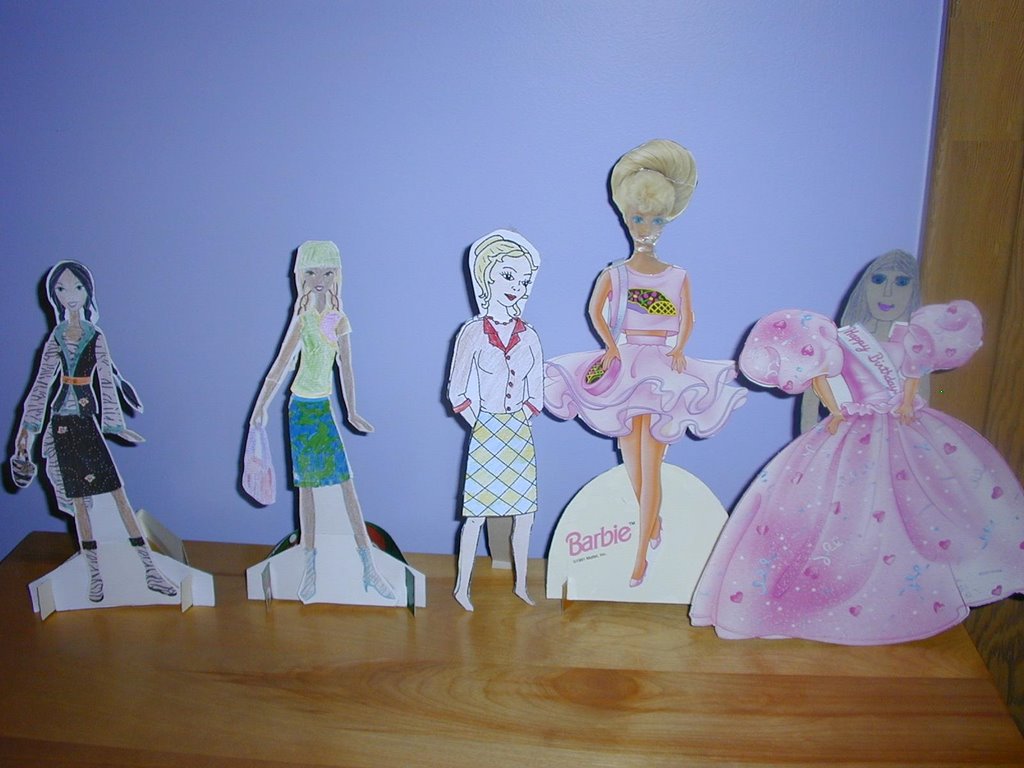
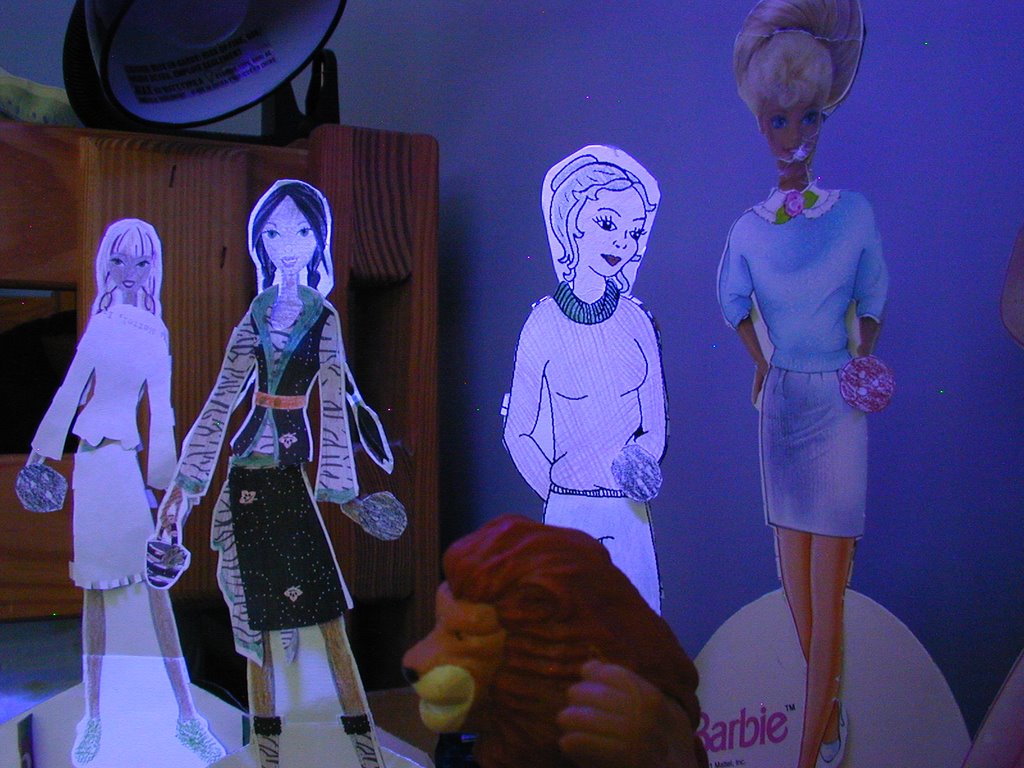
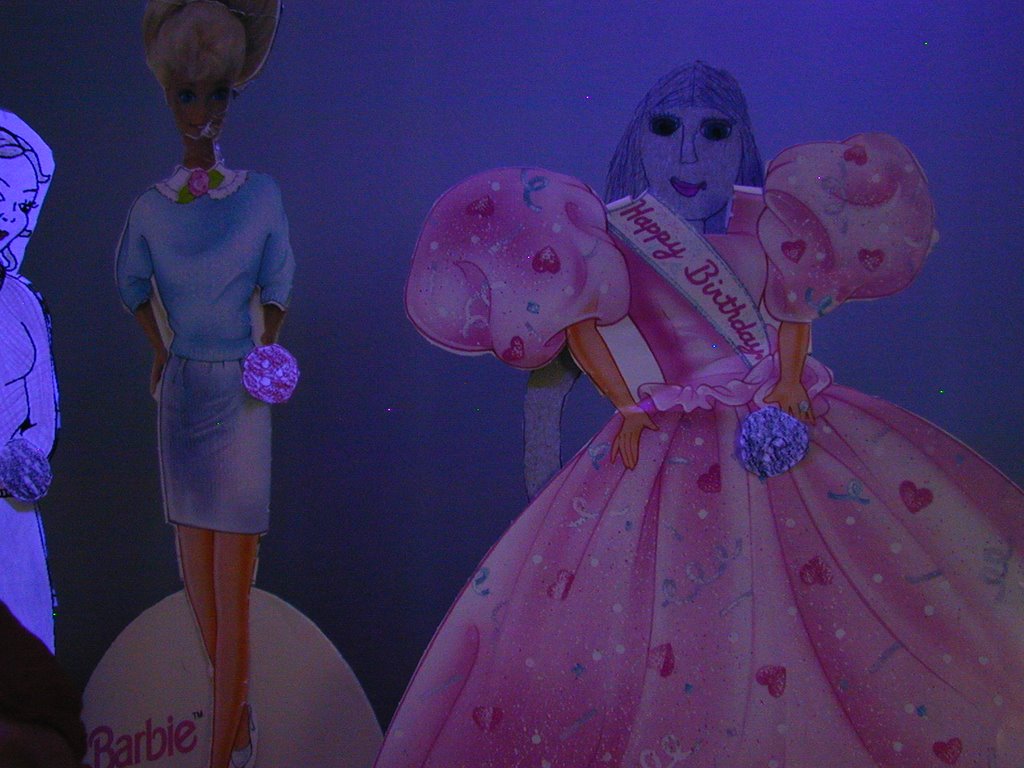
And all the girls came: Chelsea, Delancey, Christina, Barbie, and Susan.


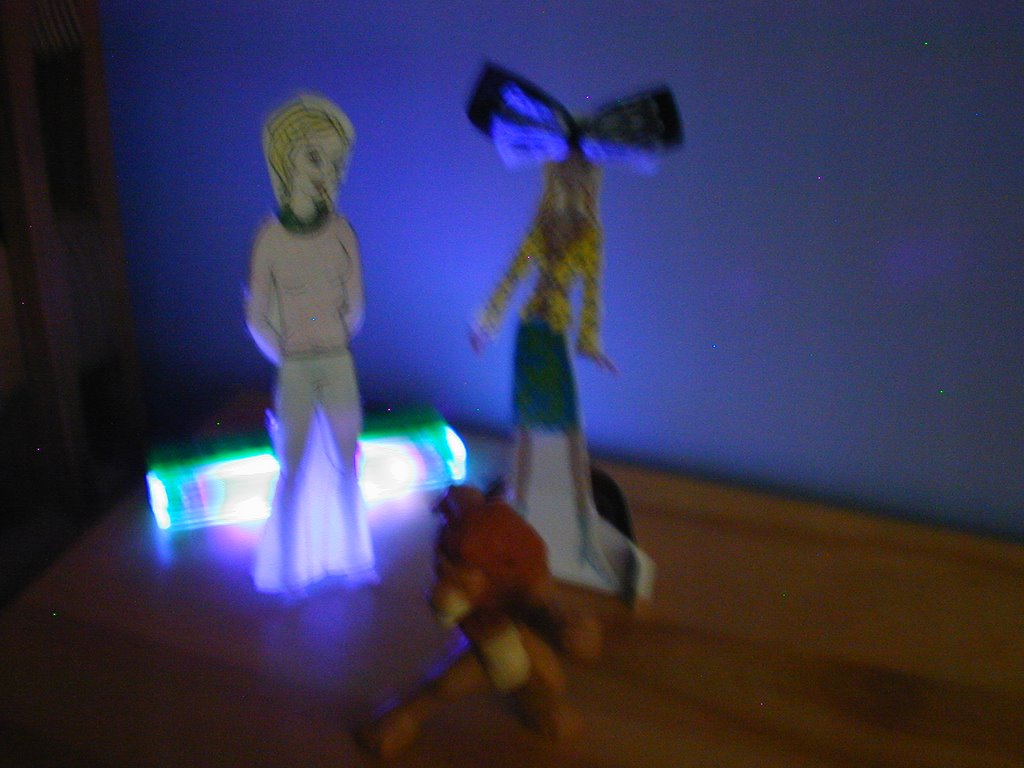
And bowled under blacklights!


What a groovin' time.

RARRRR!


P.S. Would you like paperdolls like mine? Here's Christina, Chelsea, and Delancey. I made Susan, and Barbie is an old punch-out paperdoll. I looked for pictures of her on Google, but she wasn't there. Pretty sure she was a Golden Book though!

Wednesday, May 17, 2006

Math stuff

Maria at The Homeschool Math Blog pointed out this post: Number Bonds = Better Understanding, by Denise in IL at A Home for Homeschoolers. [Update: Denise's blog has moved; that post is now here.]

This is the way we teach math too! Kids find it easier to see relationships between numbers when you show that a whole can be separated into two or more parts--and you can demonstrate that with a group of things (like a pile of blocks, as Denise's post describes), or a whole thing split into pieces (there we might get into fractions). The post and comments refer to Singapore Math, but we do much the same thing with Miquon Math and Cuisenaire Rods (picture here). [OK, that's changed too. Try this one instead--scroll down a bit to see the photo.] If an orange rod is understood to be ten units long (assuming a white rod is the basic unit), then you can make a "train" just as long as the orange rod by grouping two yellow rods (each 5 cm long), or a light green plus a black (3, 7), or a white plus a blue (1, 9) and so on. You reverse that by showing a white plus a blue and asking what rod will be just as long as that "train"--that's addition. Then you get even more complicated by showing the orange rod with a white rod underneath it, and ask for the missing piece that completes the "train." That's the beginning of subtraction. (Update: If you still can't get the idea of this, you can play with some virtual Cuisenaire Rods here--click on "Start the Integer Bars Applet." This site (www.archytech.org) calls the rods Integer Bars, and the only real disadvantage to them is that they can slide on top of each other in a way that real 3-D rods can't; so you might accidentally overlap your two yellow rods and think that they were equal in length to a blue rod instead of an orange one. The real thing is definitely better, but these at least can give you the sense of how the rods work.) [2012 UPDATE:  the virtual rods are long gone--sorry!]

When Ponytails was in first grade, we got a lot of math ideas from the Miquon First Grade Diary (not a diary you write in--it is a day-by-day description of a first grade math class back in the '60's). Lore Rasmussen (the author) described some hollow wooden tubes she had, each 10 cm long, into which you could insert Cuisenaire rods--any number of them that would fit into the tube. The idea was to play a guessing game. If I put a white and a blue rod into the tube, and cover up the blue end so that you can see only the white end--and I tell you that there are only two rods in the tube--then you can guess that the other rod must be blue. The game can get more complicated when three rods are used--if you can see the colours of the two ends, what is the hidden rod in the middle?

And where do you buy these tubes? I have no idea, but I made my own out of 3 x 5 inch file cards. I cut several cards to a 10 cm length (how do you like that for mixing measurements?), folded each one several times around an orange rod, and taped them shut. Instant rod tubes. When they wear out, you can make new ones in a couple of minutes.

We played other games too that develop the idea of whole/parts, particularly relating to the number 10. One game The Apprentice played in kindergarten came (I think) from Peggy Kaye's book Games for Learning. You need a bowl or other container, and five paperclips (for a young child). The bowl goes a short distance away, and you take turns chucking the five paperclips into the bowl. When you're done with your five, you say something like, "Oh, I got one on the floor and four in the bowl. I get four points." Then the child throws her five, and you say, "Oops, you got just two in the bowl and three on the floor." The point of the game is not to get to be a great paperclip chucker, but to get acquainted with all the "parts" of the number five.

Another whole/parts activity I've done with all the Squirrelings is to take several crayons, or blocks, or any small objects, hide them behind my back, and bring some of them back out--how many are still behind my back? Then they have a turn to hide the objects. Sometimes we just put a few objects on the floor--hide your eyes and somebody takes some away--you have to figure out how many are gone.

The Squirrelings have occasionally run into math blocks in other areas, but understanding addition and subtraction has never been a problem!

P.S. Here's a bonus for reading to the end: how do you say "Cuisenaire rods" in other languages?
French: les réglettes Cuisenaire
German: Cuisenairstäbe
Spanish: las regletas Cuisenaire
Portuguese: as barras Cuisenaire
Italian: I regoli Cuisenaire
Swedish: Cuisenaire-stavar
Polish: klockami Cuisenaire'a (Krakovianka, did I get that one right?)

Tuesday, May 16, 2006

Rhubarb, Year Two

What I'm eating: Coffeemamma's Rhubarb Muffins, made out of the skinny little fresh rhubarb stalks from our garden. We put the plant in last year (actually more than one, but this is the survivor), but it produced nothing all last summer. This spring it started getting leaves very early, and I managed to get enough from it today to make a double batch of the muffins that we never got to try last year. (See Coffeemamma's comment on last year's post; the comments in the recipe are hers as well.) (Update: Coffeemamma has been taking a break from blogging, for various very good reasons, but she's posted a Blue Castle Update today.)

Sour Cream Rhubarb Muffins

Blend these together in a small bowl:
1/2 cup sour cream
1/4 cup vegetable oil
1 large egg

Stir these ingredients together:
1 1/3 cup flour (I have successfully substituted 1 cup unbleached, 1/3 cup whole wheat)
1 cup diced rhubarb
2/3 cup brown sugar (or raw cane sugar)
1/2 tsp. baking soda
1/4 tsp. salt

Stir in sour cream mixture until moistened (batter will be thick).
Drop large spoonful into 12 greased muffin cups or paper-lined muffin cups.

In small bowl, combine these ingredients:
1/4 cup brown sugar
1/2 tsp. cinnamon
2 tsp. melted butter

Spoon this over batter (or lightly brush muffins with melted butter and sprinkle with sugar-cinnamon if you have a jar on hand). Bake muffins at 350 degrees for 20 - 25 minutes. (A note from the Treehouse: you might want to put a cookie sheet under your muffin pans just in case of drips--the sugar mixture bubbles a bit.)

I always double this recipe, and they are still gone the same day they are made ;-) Enjoy!

Friday, May 05, 2006

Big math, big ideas

Another culling from the Toronto Star Ideas section...The Curious Side of Big Math, by Siobhan Roberts, special to The Star from Atlanta (April 30/06).

One interesting thing about this story is the reason that Siobhan Roberts was in Atlanta to start with: G4G7, the seventh gathering of mathematicians in honour of Martin Gardner. (Get it?--Gathering 4 Gardner, number 7.) It's "all about invoking Gardner's abiding love for the play and fun in math." In other words, if you're a Lewis Carroll type of person, this is your place. It's a "four-day curiosity cabinet of....brainteasers." But there's a catch: you have to be invited. You have to be smart. And you have to be a mathematician.

That doesn't mean you have to be old. One of the invitees was Robert Barrington Leigh, a 19-year-old math student at the University of Toronto. This is a guy who's won a lot of math contests and is majoring in math...but think about this:
"[Barrington Leigh's mentor, Professor Andy Liu of the University of Alberta in Edmonton] said that Barrington Leigh was able to maintain his mathematical curiosity through his first two years at university....[but] his university syllabus of mathematical study doesn't allow him time [now] to do playful math. And finding himself [at the conference] among those who do have the time to indulge makes him a bit apprehensive, at first. 'I used to be more [into playful math] when I was younger,' said Barrington Leigh. 'It helps keep you sharp. But right now my work is more about remembering than being creative.' [Liu] noted that therein lies the value of G4G7, and the weakness in typical mathematics education. 'The worst thing the education system does is take away students' natural curiosity,' said Liu...."
Wow--even for math majors who get invited to G4G7.

Couldn't they just give somebody like that a degree and then let him go off and do "big math?"

And if that's the case for our best math students, how much more should we be concerned for those who aren't as highly motivated in math to begin with?

P.S. Oh yes--the other neat thing (if you didn't read the article) was this:
Gardner, now 91, lives in Norman, Okla. He did not attend his namesake conference; he has never liked travel (he spent the weekend at home, writing his umpteenth book, this one on the works of the "prince of paradox," G.K. Chesterton).

Thursday, May 04, 2006

We still like Frye

Grandpa Squirrel made his usual weekend Toronto Star/Globe and Mail drop Sunday night, but I haven't had a chance till now to blog about one of the Really Interesting articles in the papers.

Between April and June of last year, I posted several times (here, here, here) about the Canadian literary critic Northrop Frye. The last time was here. Since then I've gotten a couple more of his books, become slightly more confused about his theology (was he ever really clear on it himself?) but even more interested in his ideas on literature.

Last Sunday's Toronto Star had this article by Philip Marchand, called "McLuhan, Frye and the falling towers." Marshall McLuhan, for Americans or others who don't know, was another professor of Frye's vintage, and as Marchand says, he's best known for the phrases he coined: "the global village" and "the medium is the message." As Marchand also points out, Frye and McLuhan were rivals and each "thought the other was on the wrong track."

And neither of them, according to Marchand, is exactly on key with today's academic thinking. Frye in particular is "a distinct minority taste in an age when literary studies are heavily influenced by radical politics and the philosophy of deconstruction--twin wrecking balls sworn to destroy any literary cathedral in sight."

Yep, I know. Frye doesn't have enough duende. He's not hip. And neither is McLuhan, although you would think, of the two, that somebody so interested in the media would have held up better.

However, we at the Treehouse are not too much into hip anyway, and we still like Frye. So, apparently, does B.W. Powe, a York University professor who has "written brilliantly about both Frye and McLuhan in his books A Climate Charged and The Solitary Outlaw....". Powe recently got one of his classes to stage a debate about how Frye and McLuhan would have viewed events such as 9/11. Actually the class is about Frye and McLuhan, which sounds very cool. (Powe was a pretty cool professor anyway. How do I know? I was in one of his senior writing classes in my last year at York.)

It's amazing that there is a Frye-McLuhan class offered these days. It's amazing that anybody takes it. It's amazing that this debate sounds (from the description in the article) like at least some of the students peered out of their millennium-sized boxes long enough to get a handle on what these pre-deconstructionist geezers (dead white guys and all that) were saying. I would have liked to have been there.

Saturday, April 29, 2006

Cookin' with math

We use Cuisenaire Rods as one of our main math manipulatives.  People always wonder about that strange name; actually, like many inventions, the rods were named for their inventor, Georges Cuisenaire.

Because the name's unfamiliar, people often misspell it. I've seen information online about Cuisinaire Rods, Cuisanaire, Quisenaire, Cuisonaire, Cuisinnaire, Cuisenarie, Cuisenare, Cuisennaire, Cuisenair, and just about every other spelling. (Even Ruth Beechick got it wrong once!) But this one (from the transcript of a legal proceeding involving mentally handicapped students) was new to me.
Mr. RHODES: ....We believe that to do this they've got to get a little messy, maybe, and from that mess we think something good comes. By way of example, I'm sure you're familiar with cuisinart sticks?

Mr. DICKEY. No. I'm from Arkansas.

Mr. RHODES. They're small sticks that are used to teach mathematics.

Mr. DICKEY. Are you saying cuisinart?

Mr. RHODES. Yes, cuisinart. They are small sticks that are generally in units of one to ten, and they are used to teach mathematics to preschool children. And that activity, that hands-on nature, is what seems to work. I know it did wonders for my daughter when she was three.
Not only that, they julienne and shred salad too.

(The quote was found here.)

Friday, April 28, 2006

Monday, April 24, 2006

A funny from Crayons

New readers can unintentionally provide a lot of humor.

At lunch, Mr. Fixit was looking at something that came in the mail, and Crayons was looking over his shoulder. "Real...Easter...Update," she read. A real Easter update?

Oh, a real estate update.

I think I preferred Crayons' version!