Tuesday, May 30, 2006
A funny from Crayons
Crayons came to me all excited, holding one of our fairy tale books. She'd just discovered that this particular book had a story she recognized. "Look! Handsome and Gretel!"


Sunday, May 28, 2006

Saturday, May 27, 2006
Let's go bowling
These pretty girls are Christina and Delancey. They're best friends.
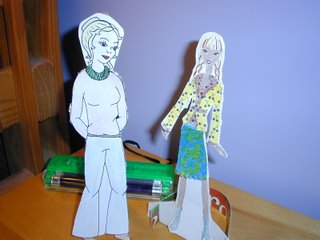
They do fun things together, like try on silly hairstyles!
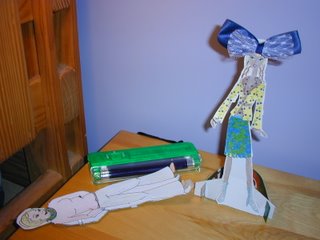
One day, they were just walking along when...
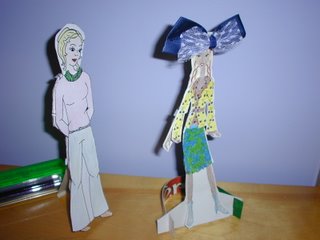
Whoops! They stumbled into a cosmic bowling lane! Those girls must have been really not paying attention...
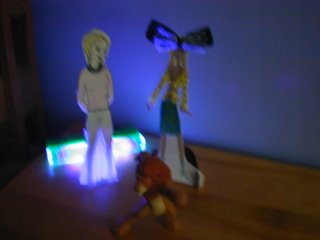
But as they walked out, Delancy had a great idea.
"Christina! Let's go bowling with all our friends!"
"That's a great idea!"
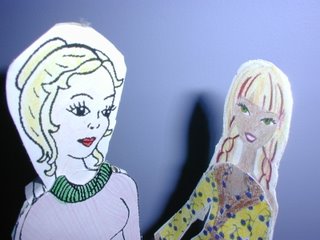
So they made a couple calls.
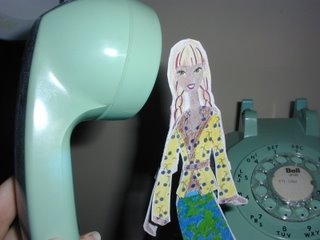
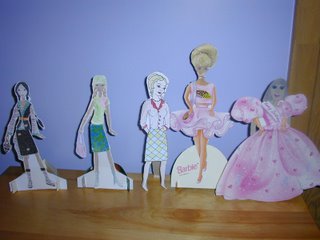
And all the girls came: Chelsea, Delancey, Christina, Barbie, and Susan.
And bowled under blacklights!
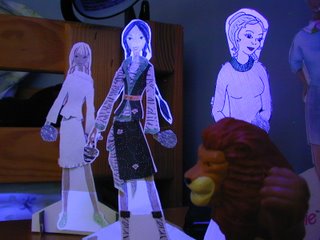
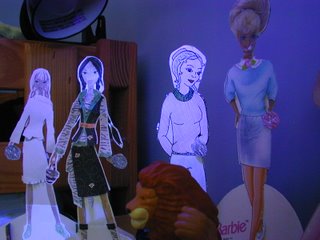
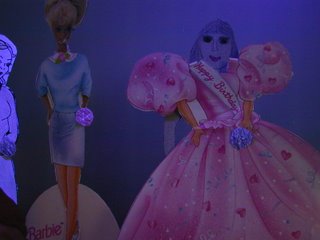
What a groovin' time.
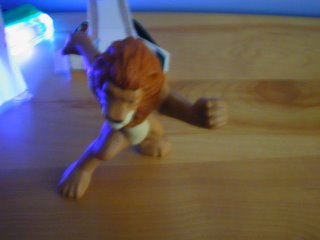
RARRRR!
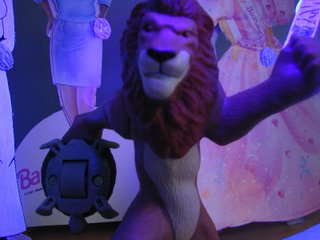
P.S. Would you like paperdolls like mine? Here's Christina, Chelsea, and Delancey. I made Susan, and Barbie is an old punch-out paperdoll. I looked for pictures of her on Google, but she wasn't there. Pretty sure she was a Golden Book though!
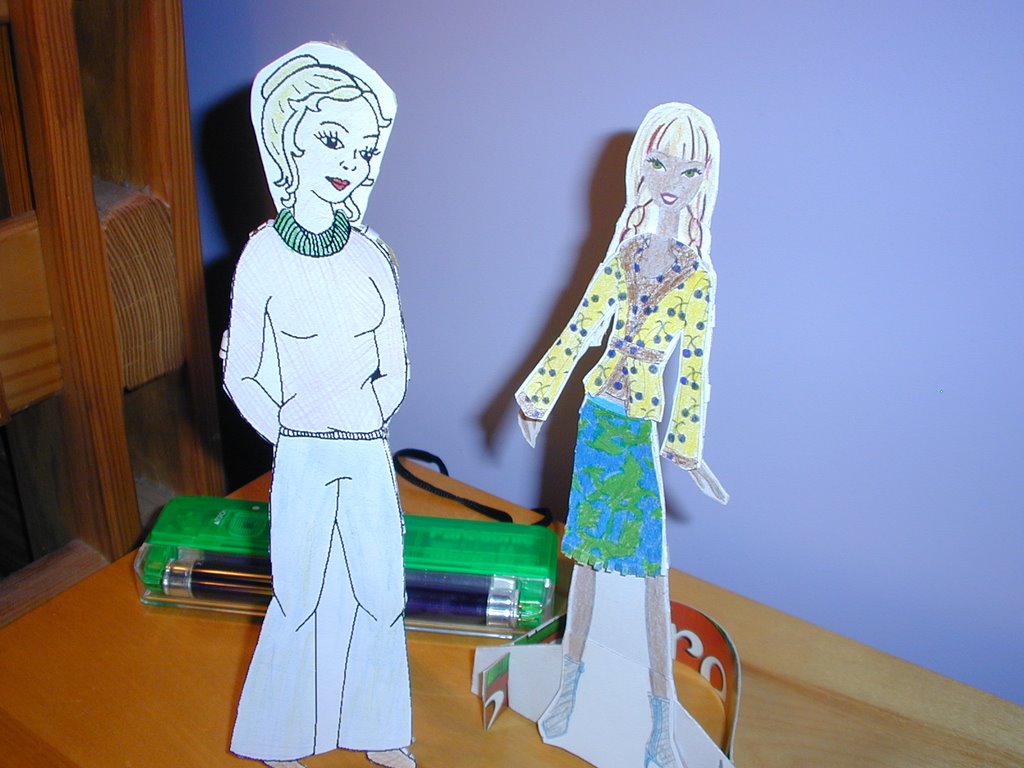
They do fun things together, like try on silly hairstyles!
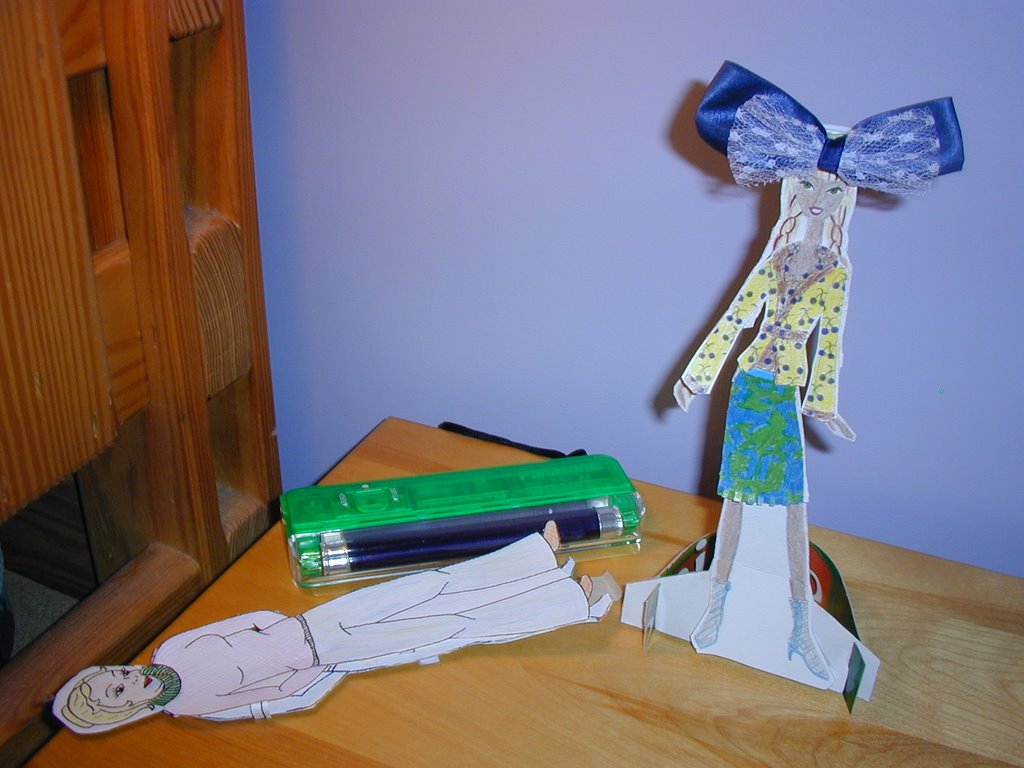
One day, they were just walking along when...
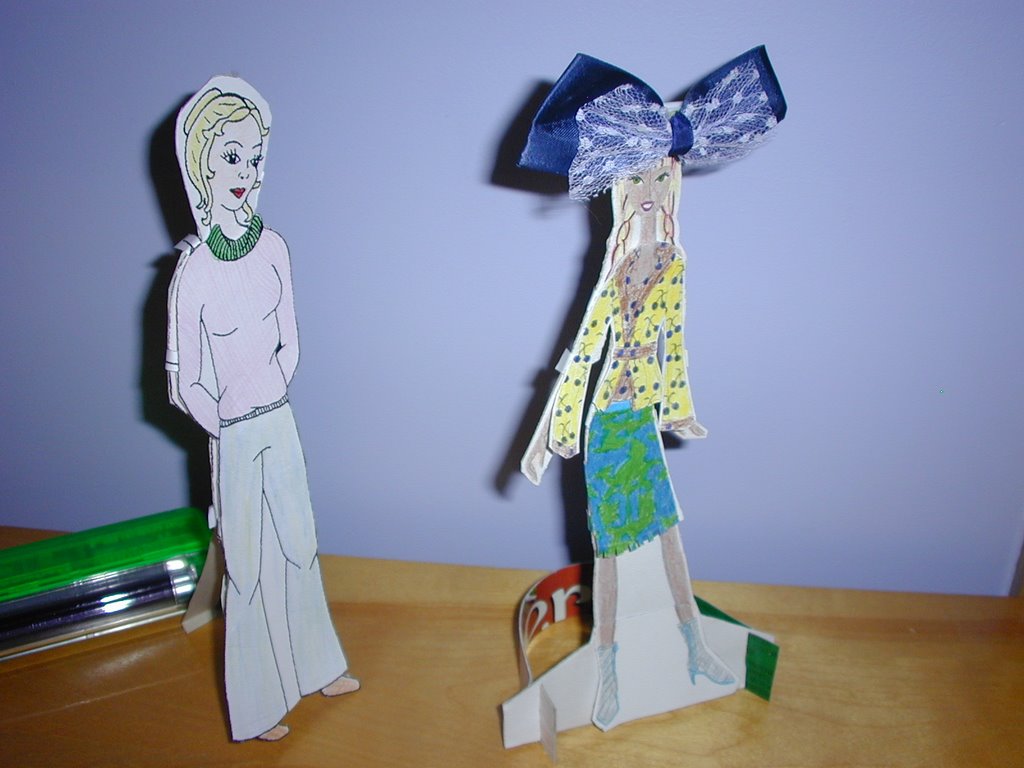
Whoops! They stumbled into a cosmic bowling lane! Those girls must have been really not paying attention...
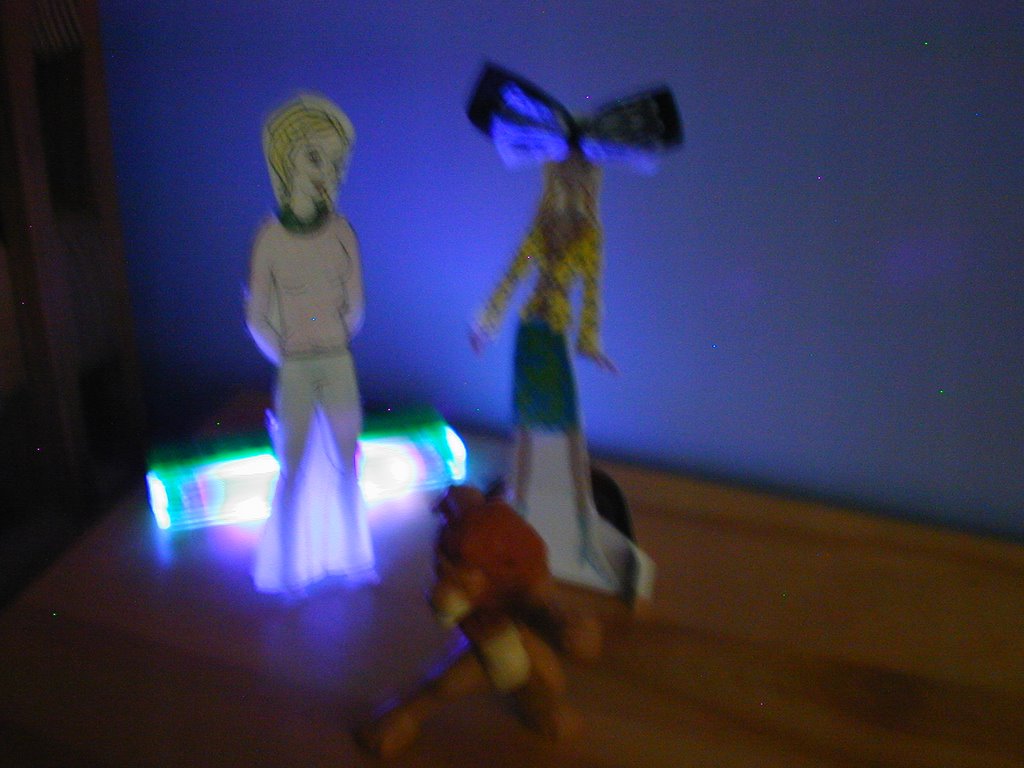
But as they walked out, Delancy had a great idea.
"Christina! Let's go bowling with all our friends!"
"That's a great idea!"
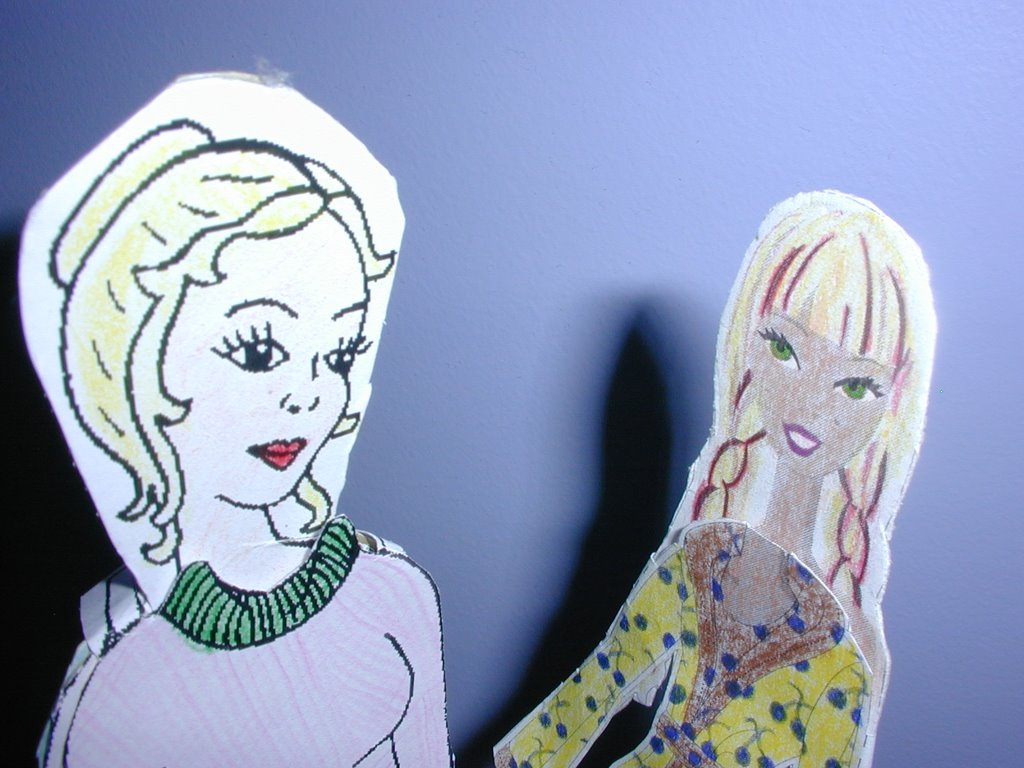
So they made a couple calls.

And all the girls came: Chelsea, Delancey, Christina, Barbie, and Susan.
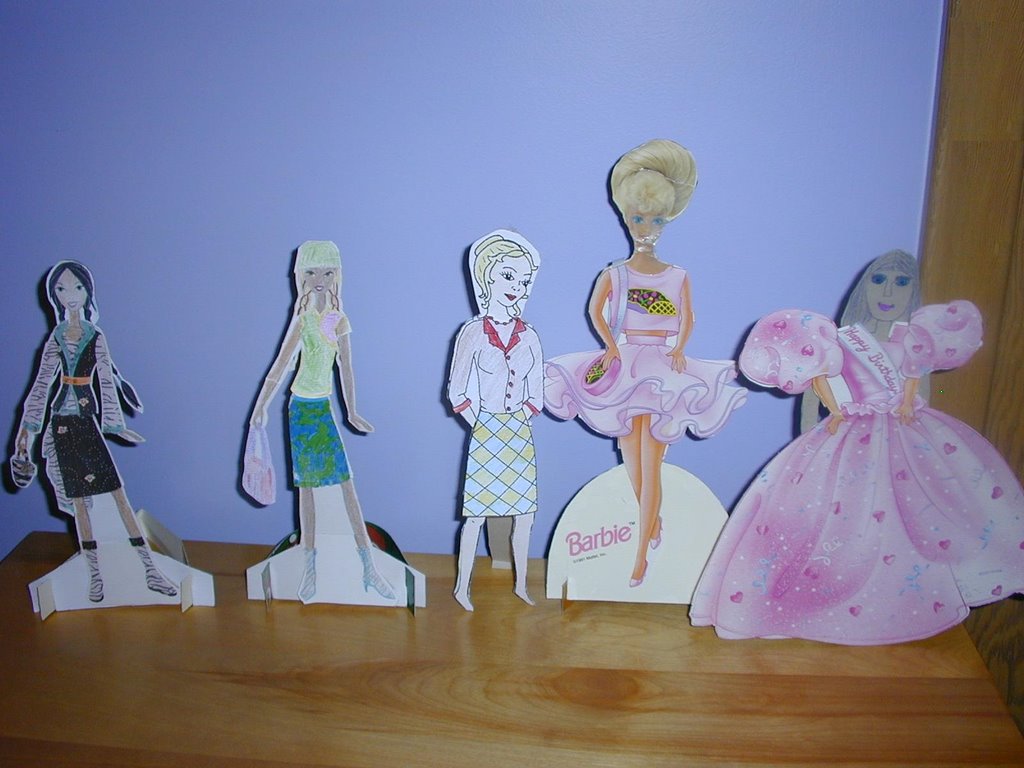
And bowled under blacklights!

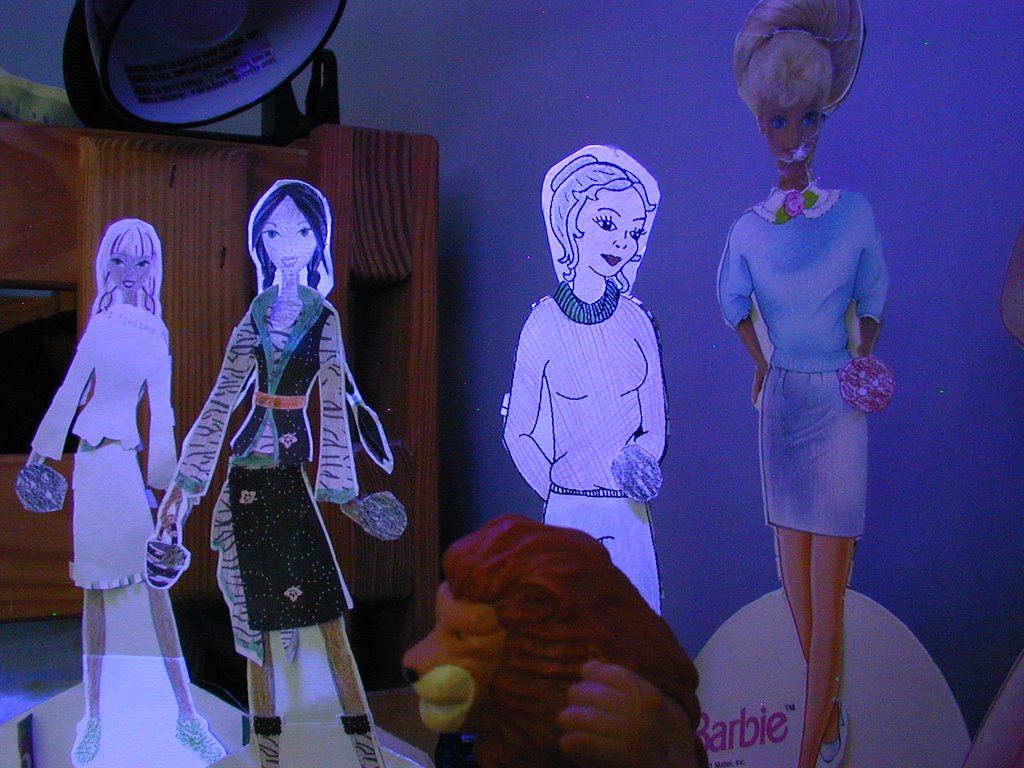
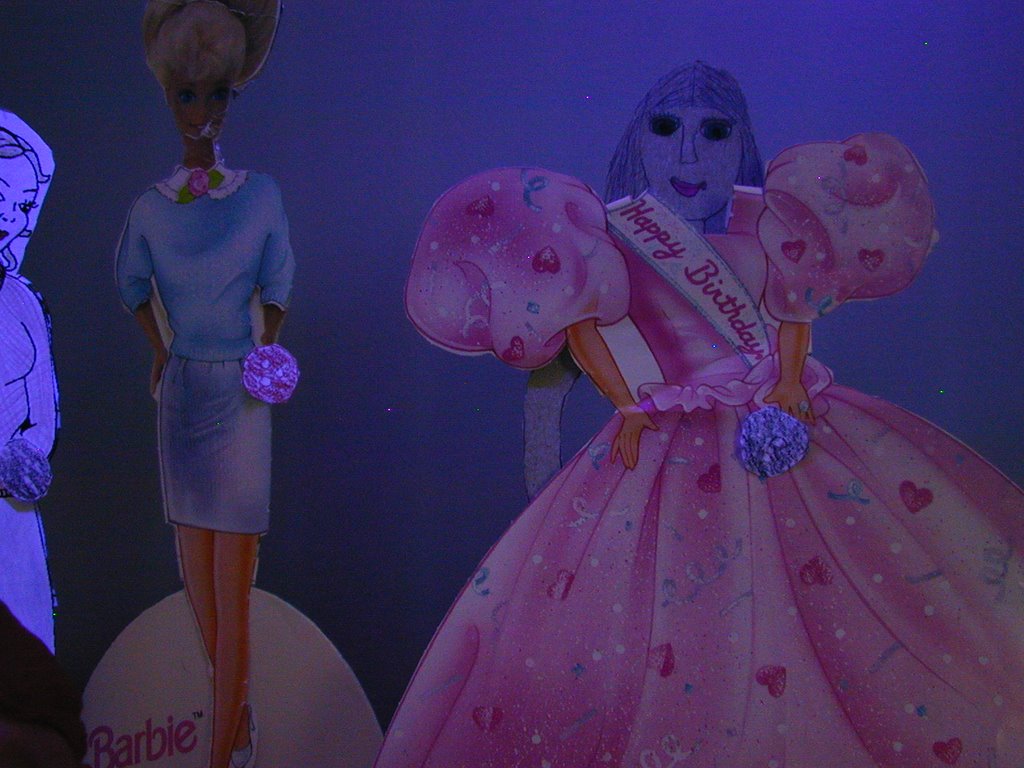
What a groovin' time.
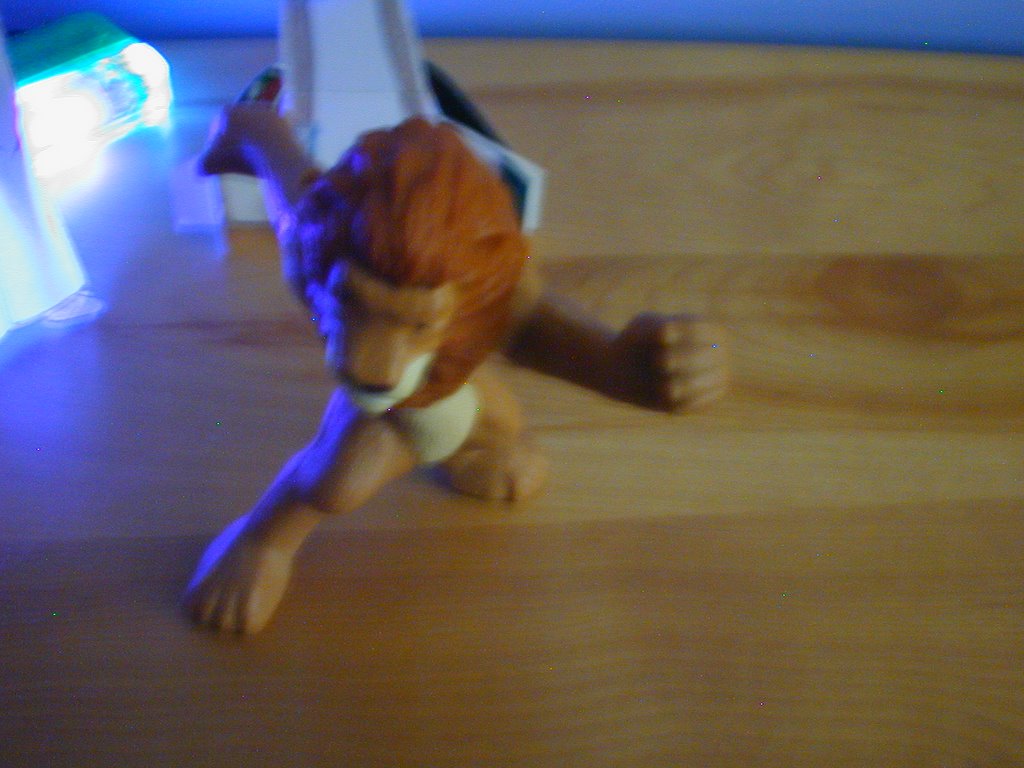
RARRRR!

P.S. Would you like paperdolls like mine? Here's Christina, Chelsea, and Delancey. I made Susan, and Barbie is an old punch-out paperdoll. I looked for pictures of her on Google, but she wasn't there. Pretty sure she was a Golden Book though!
Wednesday, May 17, 2006
Math stuff
Maria at The Homeschool Math Blog pointed out this post: Number Bonds = Better Understanding, by Denise in IL at A Home for Homeschoolers. [Update: Denise's blog has moved; that post is now here.]
This is the way we teach math too! Kids find it easier to see relationships between numbers when you show that a whole can be separated into two or more parts--and you can demonstrate that with a group of things (like a pile of blocks, as Denise's post describes), or a whole thing split into pieces (there we might get into fractions). The post and comments refer to Singapore Math, but we do much the same thing with Miquon Math and Cuisenaire Rods (picture here). [OK, that's changed too. Try this one instead--scroll down a bit to see the photo.] If an orange rod is understood to be ten units long (assuming a white rod is the basic unit), then you can make a "train" just as long as the orange rod by grouping two yellow rods (each 5 cm long), or a light green plus a black (3, 7), or a white plus a blue (1, 9) and so on. You reverse that by showing a white plus a blue and asking what rod will be just as long as that "train"--that's addition. Then you get even more complicated by showing the orange rod with a white rod underneath it, and ask for the missing piece that completes the "train." That's the beginning of subtraction. (Update: If you still can't get the idea of this, you can play with some virtual Cuisenaire Rods here--click on "Start the Integer Bars Applet." This site (www.archytech.org) calls the rods Integer Bars, and the only real disadvantage to them is that they can slide on top of each other in a way that real 3-D rods can't; so you might accidentally overlap your two yellow rods and think that they were equal in length to a blue rod instead of an orange one. The real thing is definitely better, but these at least can give you the sense of how the rods work.) [2012 UPDATE: the virtual rods are long gone--sorry!]
When Ponytails was in first grade, we got a lot of math ideas from the Miquon First Grade Diary (not a diary you write in--it is a day-by-day description of a first grade math class back in the '60's). Lore Rasmussen (the author) described some hollow wooden tubes she had, each 10 cm long, into which you could insert Cuisenaire rods--any number of them that would fit into the tube. The idea was to play a guessing game. If I put a white and a blue rod into the tube, and cover up the blue end so that you can see only the white end--and I tell you that there are only two rods in the tube--then you can guess that the other rod must be blue. The game can get more complicated when three rods are used--if you can see the colours of the two ends, what is the hidden rod in the middle?
And where do you buy these tubes? I have no idea, but I made my own out of 3 x 5 inch file cards. I cut several cards to a 10 cm length (how do you like that for mixing measurements?), folded each one several times around an orange rod, and taped them shut. Instant rod tubes. When they wear out, you can make new ones in a couple of minutes.
We played other games too that develop the idea of whole/parts, particularly relating to the number 10. One game The Apprentice played in kindergarten came (I think) from Peggy Kaye's book Games for Learning. You need a bowl or other container, and five paperclips (for a young child). The bowl goes a short distance away, and you take turns chucking the five paperclips into the bowl. When you're done with your five, you say something like, "Oh, I got one on the floor and four in the bowl. I get four points." Then the child throws her five, and you say, "Oops, you got just two in the bowl and three on the floor." The point of the game is not to get to be a great paperclip chucker, but to get acquainted with all the "parts" of the number five.
Another whole/parts activity I've done with all the Squirrelings is to take several crayons, or blocks, or any small objects, hide them behind my back, and bring some of them back out--how many are still behind my back? Then they have a turn to hide the objects. Sometimes we just put a few objects on the floor--hide your eyes and somebody takes some away--you have to figure out how many are gone.
The Squirrelings have occasionally run into math blocks in other areas, but understanding addition and subtraction has never been a problem!
P.S. Here's a bonus for reading to the end: how do you say "Cuisenaire rods" in other languages?
French: les réglettes Cuisenaire
German: Cuisenairstäbe
Spanish: las regletas Cuisenaire
Portuguese: as barras Cuisenaire
Italian: I regoli Cuisenaire
Swedish: Cuisenaire-stavar
Polish: klockami Cuisenaire'a (Krakovianka, did I get that one right?)
This is the way we teach math too! Kids find it easier to see relationships between numbers when you show that a whole can be separated into two or more parts--and you can demonstrate that with a group of things (like a pile of blocks, as Denise's post describes), or a whole thing split into pieces (there we might get into fractions). The post and comments refer to Singapore Math, but we do much the same thing with Miquon Math and Cuisenaire Rods (picture here). [OK, that's changed too. Try this one instead--scroll down a bit to see the photo.] If an orange rod is understood to be ten units long (assuming a white rod is the basic unit), then you can make a "train" just as long as the orange rod by grouping two yellow rods (each 5 cm long), or a light green plus a black (3, 7), or a white plus a blue (1, 9) and so on. You reverse that by showing a white plus a blue and asking what rod will be just as long as that "train"--that's addition. Then you get even more complicated by showing the orange rod with a white rod underneath it, and ask for the missing piece that completes the "train." That's the beginning of subtraction. (Update: If you still can't get the idea of this, you can play with some virtual Cuisenaire Rods here--click on "Start the Integer Bars Applet." This site (www.archytech.org) calls the rods Integer Bars, and the only real disadvantage to them is that they can slide on top of each other in a way that real 3-D rods can't; so you might accidentally overlap your two yellow rods and think that they were equal in length to a blue rod instead of an orange one. The real thing is definitely better, but these at least can give you the sense of how the rods work.) [2012 UPDATE: the virtual rods are long gone--sorry!]
When Ponytails was in first grade, we got a lot of math ideas from the Miquon First Grade Diary (not a diary you write in--it is a day-by-day description of a first grade math class back in the '60's). Lore Rasmussen (the author) described some hollow wooden tubes she had, each 10 cm long, into which you could insert Cuisenaire rods--any number of them that would fit into the tube. The idea was to play a guessing game. If I put a white and a blue rod into the tube, and cover up the blue end so that you can see only the white end--and I tell you that there are only two rods in the tube--then you can guess that the other rod must be blue. The game can get more complicated when three rods are used--if you can see the colours of the two ends, what is the hidden rod in the middle?
And where do you buy these tubes? I have no idea, but I made my own out of 3 x 5 inch file cards. I cut several cards to a 10 cm length (how do you like that for mixing measurements?), folded each one several times around an orange rod, and taped them shut. Instant rod tubes. When they wear out, you can make new ones in a couple of minutes.
We played other games too that develop the idea of whole/parts, particularly relating to the number 10. One game The Apprentice played in kindergarten came (I think) from Peggy Kaye's book Games for Learning. You need a bowl or other container, and five paperclips (for a young child). The bowl goes a short distance away, and you take turns chucking the five paperclips into the bowl. When you're done with your five, you say something like, "Oh, I got one on the floor and four in the bowl. I get four points." Then the child throws her five, and you say, "Oops, you got just two in the bowl and three on the floor." The point of the game is not to get to be a great paperclip chucker, but to get acquainted with all the "parts" of the number five.
Another whole/parts activity I've done with all the Squirrelings is to take several crayons, or blocks, or any small objects, hide them behind my back, and bring some of them back out--how many are still behind my back? Then they have a turn to hide the objects. Sometimes we just put a few objects on the floor--hide your eyes and somebody takes some away--you have to figure out how many are gone.
The Squirrelings have occasionally run into math blocks in other areas, but understanding addition and subtraction has never been a problem!
P.S. Here's a bonus for reading to the end: how do you say "Cuisenaire rods" in other languages?
French: les réglettes Cuisenaire
German: Cuisenairstäbe
Spanish: las regletas Cuisenaire
Portuguese: as barras Cuisenaire
Italian: I regoli Cuisenaire
Swedish: Cuisenaire-stavar
Polish: klockami Cuisenaire'a (Krakovianka, did I get that one right?)
Tuesday, May 16, 2006
Rhubarb, Year Two
What I'm eating: Coffeemamma's Rhubarb Muffins, made out of the skinny little fresh rhubarb stalks from our garden. We put the plant in last year (actually more than one, but this is the survivor), but it produced nothing all last summer. This spring it started getting leaves very early, and I managed to get enough from it today to make a double batch of the muffins that we never got to try last year. (See Coffeemamma's comment on last year's post; the comments in the recipe are hers as well.) (Update: Coffeemamma has been taking a break from blogging, for various very good reasons, but she's posted a Blue Castle Update today.)
Sour Cream Rhubarb Muffins
Blend these together in a small bowl:
1/2 cup sour cream
1/4 cup vegetable oil
1 large egg
Stir these ingredients together:
1 1/3 cup flour (I have successfully substituted 1 cup unbleached, 1/3 cup whole wheat)
1 cup diced rhubarb
2/3 cup brown sugar (or raw cane sugar)
1/2 tsp. baking soda
1/4 tsp. salt
Stir in sour cream mixture until moistened (batter will be thick).
Drop large spoonful into 12 greased muffin cups or paper-lined muffin cups.
In small bowl, combine these ingredients:
1/4 cup brown sugar
1/2 tsp. cinnamon
2 tsp. melted butter
Spoon this over batter (or lightly brush muffins with melted butter and sprinkle with sugar-cinnamon if you have a jar on hand). Bake muffins at 350 degrees for 20 - 25 minutes. (A note from the Treehouse: you might want to put a cookie sheet under your muffin pans just in case of drips--the sugar mixture bubbles a bit.)
I always double this recipe, and they are still gone the same day they are made ;-) Enjoy!
Sour Cream Rhubarb Muffins
Blend these together in a small bowl:
1/2 cup sour cream
1/4 cup vegetable oil
1 large egg
Stir these ingredients together:
1 1/3 cup flour (I have successfully substituted 1 cup unbleached, 1/3 cup whole wheat)
1 cup diced rhubarb
2/3 cup brown sugar (or raw cane sugar)
1/2 tsp. baking soda
1/4 tsp. salt
Stir in sour cream mixture until moistened (batter will be thick).
Drop large spoonful into 12 greased muffin cups or paper-lined muffin cups.
In small bowl, combine these ingredients:
1/4 cup brown sugar
1/2 tsp. cinnamon
2 tsp. melted butter
Spoon this over batter (or lightly brush muffins with melted butter and sprinkle with sugar-cinnamon if you have a jar on hand). Bake muffins at 350 degrees for 20 - 25 minutes. (A note from the Treehouse: you might want to put a cookie sheet under your muffin pans just in case of drips--the sugar mixture bubbles a bit.)
I always double this recipe, and they are still gone the same day they are made ;-) Enjoy!
Friday, May 05, 2006
Big math, big ideas
Another culling from the Toronto Star Ideas section...The Curious Side of Big Math, by Siobhan Roberts, special to The Star from Atlanta (April 30/06).
One interesting thing about this story is the reason that Siobhan Roberts was in Atlanta to start with: G4G7, the seventh gathering of mathematicians in honour of Martin Gardner. (Get it?--Gathering 4 Gardner, number 7.) It's "all about invoking Gardner's abiding love for the play and fun in math." In other words, if you're a Lewis Carroll type of person, this is your place. It's a "four-day curiosity cabinet of....brainteasers." But there's a catch: you have to be invited. You have to be smart. And you have to be a mathematician.
That doesn't mean you have to be old. One of the invitees was Robert Barrington Leigh, a 19-year-old math student at the University of Toronto. This is a guy who's won a lot of math contests and is majoring in math...but think about this:
Couldn't they just give somebody like that a degree and then let him go off and do "big math?"
And if that's the case for our best math students, how much more should we be concerned for those who aren't as highly motivated in math to begin with?
P.S. Oh yes--the other neat thing (if you didn't read the article) was this:
One interesting thing about this story is the reason that Siobhan Roberts was in Atlanta to start with: G4G7, the seventh gathering of mathematicians in honour of Martin Gardner. (Get it?--Gathering 4 Gardner, number 7.) It's "all about invoking Gardner's abiding love for the play and fun in math." In other words, if you're a Lewis Carroll type of person, this is your place. It's a "four-day curiosity cabinet of....brainteasers." But there's a catch: you have to be invited. You have to be smart. And you have to be a mathematician.
That doesn't mean you have to be old. One of the invitees was Robert Barrington Leigh, a 19-year-old math student at the University of Toronto. This is a guy who's won a lot of math contests and is majoring in math...but think about this:
"[Barrington Leigh's mentor, Professor Andy Liu of the University of Alberta in Edmonton] said that Barrington Leigh was able to maintain his mathematical curiosity through his first two years at university....[but] his university syllabus of mathematical study doesn't allow him time [now] to do playful math. And finding himself [at the conference] among those who do have the time to indulge makes him a bit apprehensive, at first. 'I used to be more [into playful math] when I was younger,' said Barrington Leigh. 'It helps keep you sharp. But right now my work is more about remembering than being creative.' [Liu] noted that therein lies the value of G4G7, and the weakness in typical mathematics education. 'The worst thing the education system does is take away students' natural curiosity,' said Liu...."Wow--even for math majors who get invited to G4G7.
Couldn't they just give somebody like that a degree and then let him go off and do "big math?"
And if that's the case for our best math students, how much more should we be concerned for those who aren't as highly motivated in math to begin with?
P.S. Oh yes--the other neat thing (if you didn't read the article) was this:
Gardner, now 91, lives in Norman, Okla. He did not attend his namesake conference; he has never liked travel (he spent the weekend at home, writing his umpteenth book, this one on the works of the "prince of paradox," G.K. Chesterton).
Thursday, May 04, 2006
We still like Frye
Grandpa Squirrel made his usual weekend Toronto Star/Globe and Mail drop Sunday night, but I haven't had a chance till now to blog about one of the Really Interesting articles in the papers.
Between April and June of last year, I posted several times (here, here, here) about the Canadian literary critic Northrop Frye. The last time was here. Since then I've gotten a couple more of his books, become slightly more confused about his theology (was he ever really clear on it himself?) but even more interested in his ideas on literature.
Last Sunday's Toronto Star had this article by Philip Marchand, called "McLuhan, Frye and the falling towers." Marshall McLuhan, for Americans or others who don't know, was another professor of Frye's vintage, and as Marchand says, he's best known for the phrases he coined: "the global village" and "the medium is the message." As Marchand also points out, Frye and McLuhan were rivals and each "thought the other was on the wrong track."
And neither of them, according to Marchand, is exactly on key with today's academic thinking. Frye in particular is "a distinct minority taste in an age when literary studies are heavily influenced by radical politics and the philosophy of deconstruction--twin wrecking balls sworn to destroy any literary cathedral in sight."
Yep, I know. Frye doesn't have enough duende. He's not hip. And neither is McLuhan, although you would think, of the two, that somebody so interested in the media would have held up better.
However, we at the Treehouse are not too much into hip anyway, and we still like Frye. So, apparently, does B.W. Powe, a York University professor who has "written brilliantly about both Frye and McLuhan in his books A Climate Charged and The Solitary Outlaw....". Powe recently got one of his classes to stage a debate about how Frye and McLuhan would have viewed events such as 9/11. Actually the class is about Frye and McLuhan, which sounds very cool. (Powe was a pretty cool professor anyway. How do I know? I was in one of his senior writing classes in my last year at York.)
It's amazing that there is a Frye-McLuhan class offered these days. It's amazing that anybody takes it. It's amazing that this debate sounds (from the description in the article) like at least some of the students peered out of their millennium-sized boxes long enough to get a handle on what these pre-deconstructionist geezers (dead white guys and all that) were saying. I would have liked to have been there.
Between April and June of last year, I posted several times (here, here, here) about the Canadian literary critic Northrop Frye. The last time was here. Since then I've gotten a couple more of his books, become slightly more confused about his theology (was he ever really clear on it himself?) but even more interested in his ideas on literature.
Last Sunday's Toronto Star had this article by Philip Marchand, called "McLuhan, Frye and the falling towers." Marshall McLuhan, for Americans or others who don't know, was another professor of Frye's vintage, and as Marchand says, he's best known for the phrases he coined: "the global village" and "the medium is the message." As Marchand also points out, Frye and McLuhan were rivals and each "thought the other was on the wrong track."
And neither of them, according to Marchand, is exactly on key with today's academic thinking. Frye in particular is "a distinct minority taste in an age when literary studies are heavily influenced by radical politics and the philosophy of deconstruction--twin wrecking balls sworn to destroy any literary cathedral in sight."
Yep, I know. Frye doesn't have enough duende. He's not hip. And neither is McLuhan, although you would think, of the two, that somebody so interested in the media would have held up better.
However, we at the Treehouse are not too much into hip anyway, and we still like Frye. So, apparently, does B.W. Powe, a York University professor who has "written brilliantly about both Frye and McLuhan in his books A Climate Charged and The Solitary Outlaw....". Powe recently got one of his classes to stage a debate about how Frye and McLuhan would have viewed events such as 9/11. Actually the class is about Frye and McLuhan, which sounds very cool. (Powe was a pretty cool professor anyway. How do I know? I was in one of his senior writing classes in my last year at York.)
It's amazing that there is a Frye-McLuhan class offered these days. It's amazing that anybody takes it. It's amazing that this debate sounds (from the description in the article) like at least some of the students peered out of their millennium-sized boxes long enough to get a handle on what these pre-deconstructionist geezers (dead white guys and all that) were saying. I would have liked to have been there.
Saturday, April 29, 2006
Cookin' with math

Because the name's unfamiliar, people often misspell it. I've seen information online about Cuisinaire Rods, Cuisanaire, Quisenaire, Cuisonaire, Cuisinnaire, Cuisenarie, Cuisenare, Cuisennaire, Cuisenair, and just about every other spelling. (Even Ruth Beechick got it wrong once!) But this one (from the transcript of a legal proceeding involving mentally handicapped students) was new to me.
Mr. RHODES: ....We believe that to do this they've got to get a little messy, maybe, and from that mess we think something good comes. By way of example, I'm sure you're familiar with cuisinart sticks?Not only that, they julienne and shred salad too.
Mr. DICKEY. No. I'm from Arkansas.
Mr. RHODES. They're small sticks that are used to teach mathematics.
Mr. DICKEY. Are you saying cuisinart?
Mr. RHODES. Yes, cuisinart. They are small sticks that are generally in units of one to ten, and they are used to teach mathematics to preschool children. And that activity, that hands-on nature, is what seems to work. I know it did wonders for my daughter when she was three.
(The quote was found here.)
Friday, April 28, 2006
Monday, April 24, 2006
A funny from Crayons
New readers can unintentionally provide a lot of humor.
At lunch, Mr. Fixit was looking at something that came in the mail, and Crayons was looking over his shoulder. "Real...Easter...Update," she read. A real Easter update?
Oh, a real estate update.
I think I preferred Crayons' version!
At lunch, Mr. Fixit was looking at something that came in the mail, and Crayons was looking over his shoulder. "Real...Easter...Update," she read. A real Easter update?
Oh, a real estate update.
I think I preferred Crayons' version!
This is too hard, too boring, irrelevant...
Mom makes us work too hard. Not another book! School is hard. If my children were talking Barbies, they might echo that unfortunate doll (who had her conversation chip yanked for saying that math is too hard). Yes, the Apprentice and Ponytails do complain about school, lest you think that these Shakespeare-reading progeny do everything excellently without ever needing to be prodded (that's only true of other peoples' children, right?). After all, The Apprentice isn't planning on going to university anyway...she alternates between interests in hairdressing/cosmetics, photography, and computer information systems (maybe she'll figure out a way to do all of them). Why does this stuff matter?
So I have some alternatives. I could buy a fill-in-the-blanks homeschool curriculum instead of boring them with Thomas More or Winston Churchill. (Jane Austen and Charles Dickens don't get the "boring" face, for some reason.) I could let them follow their own interests completely. I could buy some of those prepared novel studies, comprehension workbooks, language textbooks, and spend a lot more time teaching them to write five-sentence paragraphs. (Squirrelings, that's not meant to be a threat--some homeschoolers spend a lot of time on those things because that's just the way they do school, and it works for them.)
I could send them to public school, so that they could develop the the following characteristics of current university students. (This list comes from Barbara Aggerholm's story "Educating the next wave" in The Record, April 24, 2006. I'm only including some of them.)
Or we can keep on reading writers who are much wiser and better educated than we are, taking what we can from their thoughts, and making our responses to their books a central part of Treehouse homeschooling.
In spite of the grousing, there are those moments when I know that what we're doing is what we're supposed to be doing. Like when Ponytails asked for a James Whitcomb Riley poetry book at a booksale last year, or The Apprentice kindly found me a volume of Tennyson at this year's sale. Or when I found The Apprentice reading her Canadian history book without being reminded, or saw Ponytails poring over a map of Narnia. Or when The Apprentice found a creative way to make her science experiment work even though somebody discarded the plastic pop bottle she was hoarding. (Sorry.) Or when Ponytails was genuinely sad at finishing a biography of Galileo. Or when Crayons read me back part of the Charlotte's Web chapter we'd just finished together (I had to work her into this post somehow).
We'll try to understand that delays happen...there are disappointments...and that not everything's fun (though something can be enjoyable in its own way without being fun). Maybe the Squirrelings will be strange enough to think that knowing something is even more valuable than knowing where to look it up (or where to copy it from the Internet). Maybe when we've read Utopia and How to Read a Book and Whatever Happened to Justice, there won't be so many blurry lines. Maybe they will be subversive enough to think that they can be producers as well as consumers of knowledge.
If they turned out like that, I wouldn't mind at all.
So I have some alternatives. I could buy a fill-in-the-blanks homeschool curriculum instead of boring them with Thomas More or Winston Churchill. (Jane Austen and Charles Dickens don't get the "boring" face, for some reason.) I could let them follow their own interests completely. I could buy some of those prepared novel studies, comprehension workbooks, language textbooks, and spend a lot more time teaching them to write five-sentence paragraphs. (Squirrelings, that's not meant to be a threat--some homeschoolers spend a lot of time on those things because that's just the way they do school, and it works for them.)
I could send them to public school, so that they could develop the the following characteristics of current university students. (This list comes from Barbara Aggerholm's story "Educating the next wave" in The Record, April 24, 2006. I'm only including some of them.)
* "Doing" is more important than "knowing." In other words, what you know is less important than knowing where to get the answer. "You don't have to master the subject anymore," Sharpe said. [Associate Professor Bob Sharpe of Wilfrid Laurier University, who led a seminar about preparing for the next generation of students.](That last one, in particular, intrigues me. It sounds like one of those creative report card comments that really means "He cheated on his term paper.")
* They have zero tolerance for delays. When they send an e-mail to a professor, they want an answer immediately.
* They're consumers rather than producers of knowledge.
* They blur the lines between consumer and creator by sampling information on the Internet and producing new forms of expression.
Or we can keep on reading writers who are much wiser and better educated than we are, taking what we can from their thoughts, and making our responses to their books a central part of Treehouse homeschooling.
In spite of the grousing, there are those moments when I know that what we're doing is what we're supposed to be doing. Like when Ponytails asked for a James Whitcomb Riley poetry book at a booksale last year, or The Apprentice kindly found me a volume of Tennyson at this year's sale. Or when I found The Apprentice reading her Canadian history book without being reminded, or saw Ponytails poring over a map of Narnia. Or when The Apprentice found a creative way to make her science experiment work even though somebody discarded the plastic pop bottle she was hoarding. (Sorry.) Or when Ponytails was genuinely sad at finishing a biography of Galileo. Or when Crayons read me back part of the Charlotte's Web chapter we'd just finished together (I had to work her into this post somehow).
We'll try to understand that delays happen...there are disappointments...and that not everything's fun (though something can be enjoyable in its own way without being fun). Maybe the Squirrelings will be strange enough to think that knowing something is even more valuable than knowing where to look it up (or where to copy it from the Internet). Maybe when we've read Utopia and How to Read a Book and Whatever Happened to Justice, there won't be so many blurry lines. Maybe they will be subversive enough to think that they can be producers as well as consumers of knowledge.
If they turned out like that, I wouldn't mind at all.
Wednesday, April 19, 2006
Four homeschool days with Ponytails
This is a four-day school week for us (we took Monday off), so these lessons cover what Ponytails did over the last two days and what's planned for the rest of the week. This week also marked the start of our spring term, although a lot of what she's doing is just continuing from the winter.
Tuesday:
Bible: listen to part of Proverbs 1. Start keeping a new illustrated copybook for Proverbs (one verse and one drawing for each chapter).
Copywork: one verse from Proverbs, see above.
Grammar and spelling: Ruth Beechick-style exercises based on The Enchanted Forest (a fairytale in chapters that Ponytails is reading to herself)--looking for synonyms, spelling patterns, word meanings, etc.
Miquon Math: Division concepts.
French: short lesson about "Je sens avec le nez."
Canadian History: Canada's Story, chapter 7, about Champlain and Captain Kirke (really).
Wednesday:
Pilgrim's Progress, Book II--about four pages (part of this section)
Copywork/handwriting: worked on capital G in cursive.
Miquon Math: Reviewed division lesson; did five adding/subtracting word problems.
Shakespeare (with Mom and The Apprentice): read two scenes from Two Gentlemen of Verona.
British History: An Island Story chapter 84: King Monmouth. Marked her timeline.
Minn of the Mississippi, chapter 14 (and an online jigsaw puzzle about the Mississippi)
Thursday:
Bible: Proverbs 2.
Copywork: verse from Proverbs.
Read poems with Mom.
Language work: same. Read some of The Enchanted Forest alone.
French: short lesson.
Natural History: Secrets of the Woods--finish the Tookhees chapter.
Canadian History: Canada's Story, chapter 8 (the death of Champlain). Timeline.
Read Children of the New Forest with Mom and The Apprentice.
Friday:
Bible: Proverbs 3.
Copywork: verse from Proverbs.
Language work: dictation from The Enchanted Forest.
Miquon Math.
The Heroes, by Charles Kingsley: Theseus, part 1.
Science: The Story of Inventions, pages 271-280, about Alexander Graham Bell. Do some experiments with sound.
Other things Ponytails is doing:
Reading The Magician's Nephew with Mom
Listening to Chitty-Chitty-Bang-Bang read on CD
Making clothes for a felt doll
Playing outside
Eating Easter candy
Loving her "pet bird" that drinks water
Watching everybody's beans sprout (a science experiment)
Tuesday:
Bible: listen to part of Proverbs 1. Start keeping a new illustrated copybook for Proverbs (one verse and one drawing for each chapter).
Copywork: one verse from Proverbs, see above.
Grammar and spelling: Ruth Beechick-style exercises based on The Enchanted Forest (a fairytale in chapters that Ponytails is reading to herself)--looking for synonyms, spelling patterns, word meanings, etc.
Miquon Math: Division concepts.
French: short lesson about "Je sens avec le nez."
Canadian History: Canada's Story, chapter 7, about Champlain and Captain Kirke (really).
Wednesday:
Pilgrim's Progress, Book II--about four pages (part of this section)
Copywork/handwriting: worked on capital G in cursive.
Miquon Math: Reviewed division lesson; did five adding/subtracting word problems.
Shakespeare (with Mom and The Apprentice): read two scenes from Two Gentlemen of Verona.
British History: An Island Story chapter 84: King Monmouth. Marked her timeline.
Minn of the Mississippi, chapter 14 (and an online jigsaw puzzle about the Mississippi)
Thursday:
Bible: Proverbs 2.
Copywork: verse from Proverbs.
Read poems with Mom.
Language work: same. Read some of The Enchanted Forest alone.
French: short lesson.
Natural History: Secrets of the Woods--finish the Tookhees chapter.
Canadian History: Canada's Story, chapter 8 (the death of Champlain). Timeline.
Read Children of the New Forest with Mom and The Apprentice.
Friday:
Bible: Proverbs 3.
Copywork: verse from Proverbs.
Language work: dictation from The Enchanted Forest.
Miquon Math.
The Heroes, by Charles Kingsley: Theseus, part 1.
Science: The Story of Inventions, pages 271-280, about Alexander Graham Bell. Do some experiments with sound.
Other things Ponytails is doing:
Reading The Magician's Nephew with Mom
Listening to Chitty-Chitty-Bang-Bang read on CD
Making clothes for a felt doll
Playing outside
Eating Easter candy
Loving her "pet bird" that drinks water
Watching everybody's beans sprout (a science experiment)
Tuesday, April 18, 2006
Well-mannered
The Squirrelings are not always well behaved. (!)
Crayons' account of a fracas she got into with Ponytails:
"I was just colouring nicely, and she hit me. And after that we took turns hitting each other."
Well, at least they were polite about it.
Crayons' account of a fracas she got into with Ponytails:
"I was just colouring nicely, and she hit me. And after that we took turns hitting each other."
Well, at least they were polite about it.
Monday, April 17, 2006
Stuff and nonsense
My friend the DHM at The Common Room quoted Charlotte Mason today:
"There is absolutely no avenue to knowledge but knowledge itself, and the schools must begin, not by qualifying the mind to deal with knowledge, but by affording all the best books."--Towards a Philosophy of Education (Vol. 6), pg. 347
Did she mean the most serious books? The hardest books? The longest books?
Just before Miss Mason gets to that point in the chapter, she has been describing the sad case of two young men who had a half-baked education (in her view), who "laboured indefatigably" at making sense of the books they picked up as young adults, but who admitted themselves that "You and I go at a subject all wrong!"
What was one of the books they couldn't make sense of? Alice in Wonderland.
I found this posted on the Catholic Culture blog:
"There is absolutely no avenue to knowledge but knowledge itself, and the schools must begin, not by qualifying the mind to deal with knowledge, but by affording all the best books."--Towards a Philosophy of Education (Vol. 6), pg. 347
Did she mean the most serious books? The hardest books? The longest books?
Just before Miss Mason gets to that point in the chapter, she has been describing the sad case of two young men who had a half-baked education (in her view), who "laboured indefatigably" at making sense of the books they picked up as young adults, but who admitted themselves that "You and I go at a subject all wrong!"
What was one of the books they couldn't make sense of? Alice in Wonderland.
Deeply impressed he bought the book as soon as he returned to London and read it earnestly. To his horror he saw no sense in it. Then it struck him that it might be meant as nonsense and he had another try, then he concluded that it was rather funny but he remained disappointed.So we have to give our children more than facts, more than vocabulary drills. Knowledge, yes...the DHM's post points that out well, along with the sad fact of our culture's anti-knowledge bent. But also another kind of knowing...an understanding of laughter and nonsense that goes beyond the usual nose-picking humor found in childrens' books. They need to meet characters like my aged Uncle Arly, sitting on a heap of barley...and the Humbug...and the White Knight, one of my favourite characters in any book. They need some silliness, some furry squirrel puppets (I promise we'll do a post about Dewey soon), some knock-knock jokes, some James Thurber, and eventually some Wodehouse and Chesterton. They need to let their brains learn to play and dance and jump around with all the wonderful connections that a sense of nonsense allows. They need some nonsense so they can understand inventiveness...and a mandatory credit in inventiveness and creativity will not substitute.
Here, again, is another evidence of the limitations attending an utter absence of education. A cultivated sense of humour is a great factor in a joyous life, but these young men are without it. Perhaps the youth addicted to sports usually fails to appreciate delicate nonsense; sports are too strenuous to admit of a subtler, more airy kind of play....
I found this posted on the Catholic Culture blog:
A friend said all this reminded him of the scene in The Chronicles of Narnia where Aslan (God) creates Narnia, including an odd little bird which, like all the animals, can talk. The bird says something ridiculous and all the other creatures laugh. Turning to Aslan, the bird says, “Oh, Aslan, have I made the first joke?” “No,” Aslan replies, “you are the first joke.” My friend says there is a moral here.I think he's right.

Friday, April 14, 2006
She knows what she likes
Crayons' comment about today's lunch:
"I could eat a hundred grilled cheese sandwiches. And a hundred macaroni and cheese (that wasn't on the menu). And a hundred kiffle. And a hundred of my favourite beans."
What more could you ask for?
"I could eat a hundred grilled cheese sandwiches. And a hundred macaroni and cheese (that wasn't on the menu). And a hundred kiffle. And a hundred of my favourite beans."
What more could you ask for?
Good Friday Thought
After an emergency or a crisis, there is always the time when you come back and look around at the place that you left in such a hurry.
About ten years ago, my grandmother got very sick and was rushed to the hospital. I went to my parents’ house and found a crockpot full of chili sitting on the counter that had been there since suppertime the night before. You don’t always stop to clean things up when you’re in a hurry.
I was wondering who cleaned up after the last supper. Were some of the disciples intending to come back after their after-dinner walk with Jesus? Then everything was interrupted. Was it hours later, even the next day, that anyone came back into that upstairs room where Jesus had washed their feet and talked about the bread and the cup?
What did they see? Was there maybe the bowl and a still-damp towel, sitting on the floor? Maybe there was a cup that someone had knocked over, with the wine spilling out. Maybe some of the bread was left on the plate, leftovers broken in pieces. Maybe there were candles burned down to stubs, or empty oil lamps that they had used to light the room during their last meal with Jesus. Had they expected to come back to a room that felt so empty and yet that held so many things that reminded them of their Lord?
What did they do with the things? Did someone get busy then and wash the dishes? Did they pack everything away as it was, not wanting to have to deal with such things at such a time? Did they call some women in and ask them to wipe everything up?
Or did someone else come in and clear everything away, not knowing anything about what had happened there that night? Did the disciples come back to a room that was empty, cleaned out? Maybe the whole thing seemed like a dream that had never happened.
What do you think?
About ten years ago, my grandmother got very sick and was rushed to the hospital. I went to my parents’ house and found a crockpot full of chili sitting on the counter that had been there since suppertime the night before. You don’t always stop to clean things up when you’re in a hurry.
I was wondering who cleaned up after the last supper. Were some of the disciples intending to come back after their after-dinner walk with Jesus? Then everything was interrupted. Was it hours later, even the next day, that anyone came back into that upstairs room where Jesus had washed their feet and talked about the bread and the cup?
What did they see? Was there maybe the bowl and a still-damp towel, sitting on the floor? Maybe there was a cup that someone had knocked over, with the wine spilling out. Maybe some of the bread was left on the plate, leftovers broken in pieces. Maybe there were candles burned down to stubs, or empty oil lamps that they had used to light the room during their last meal with Jesus. Had they expected to come back to a room that felt so empty and yet that held so many things that reminded them of their Lord?
What did they do with the things? Did someone get busy then and wash the dishes? Did they pack everything away as it was, not wanting to have to deal with such things at such a time? Did they call some women in and ask them to wipe everything up?
Or did someone else come in and clear everything away, not knowing anything about what had happened there that night? Did the disciples come back to a room that was empty, cleaned out? Maybe the whole thing seemed like a dream that had never happened.
What do you think?
Good Friday
And all three stood and wept. Even the Lion wept: great Lion-tears, each tear more precious than the Earth would be if it was a single solid diamond....
"Son of Adam," said Aslan, "go into that thicket and pluck the thorn that you will find there, and bring it to me."
Eustace obeyed. The thorn was a foot long and sharp as a rapier.
"Drive it into my paw, son of Adam," said Aslan, holding up his right fore-paw and spreading out the great pad toward Eustace.
"Must I?" said Eustace.
"Yes," said Aslan.
Then Eustace set his teeth and drove the thorn into the Lion's pad. And there came out a great drop of blood, redder than all redness that you have ever seen or imagined. And it splashed into the stream over the dead body of the King.
--C.S. Lewis, The Silver Chair
"Son of Adam," said Aslan, "go into that thicket and pluck the thorn that you will find there, and bring it to me."
Eustace obeyed. The thorn was a foot long and sharp as a rapier.
"Drive it into my paw, son of Adam," said Aslan, holding up his right fore-paw and spreading out the great pad toward Eustace.
"Must I?" said Eustace.
"Yes," said Aslan.
Then Eustace set his teeth and drove the thorn into the Lion's pad. And there came out a great drop of blood, redder than all redness that you have ever seen or imagined. And it splashed into the stream over the dead body of the King.
--C.S. Lewis, The Silver Chair
Thursday, April 13, 2006
Thinking outside the package
Several years ago, I went to a post-Christmas sale at a craft store. In the final-clearance, nobody-wants-this bin, I found a couple of Christmas-themed cross-stitch kits that came with some kind of square plastic frames, and bought them for about 75 cents apiece. When I got home, I realized that floss was not included in the kits. I didn't have much floss and definitely not in the right colours, and I don't get to the craft store much. The kits sat. And sat. I kept thinking "someday when they've got floss on sale, I should go and match up all the right colours, and get what I need, and make up those kits." But it wasn't really high on the list of priorities. I'm not even a very good cross-stitcher.
I tried to give the kits away to a crafty friend, but she didn't want them. So they sat.
Finally I was about to put them in a thrift-shop box. And then I took another look at the packages, and a light went on. Those things in my hands were meant to be coasters: nice, heavy-duty clear plastic coasters that you could insert your needlework into. Or anything else! Aha! (You mean I'm allowed to throw out those cross-stitch patterns I've never used? Sigh of relief.)
Since it was close to Father's Day, I found a couple of colourful family pictures that we'd taken at a mini-golf course; stuck them on some printed origami paper (because the pictures were smaller than the coasters); got the kids to sign their names below the pictures; and inserted the whole works into the coasters. One for Mr. Fixit, one for Grandpa Squirrel. Mr. Fixit now uses his coaster every night for his bedtime tea.
Now I'm not expecting that you're going to run out and raid the bargain bins looking for useless needlework kits. But it does illustrate a basic frugal principle. As the DHM at the Common Room likes to say, what do you have in your hand? And if you can't use something in the way it was intended, could you use part of it for something else? Sometimes you'll come up with something even nicer than what it was really meant for.
I tried to give the kits away to a crafty friend, but she didn't want them. So they sat.
Finally I was about to put them in a thrift-shop box. And then I took another look at the packages, and a light went on. Those things in my hands were meant to be coasters: nice, heavy-duty clear plastic coasters that you could insert your needlework into. Or anything else! Aha! (You mean I'm allowed to throw out those cross-stitch patterns I've never used? Sigh of relief.)
Since it was close to Father's Day, I found a couple of colourful family pictures that we'd taken at a mini-golf course; stuck them on some printed origami paper (because the pictures were smaller than the coasters); got the kids to sign their names below the pictures; and inserted the whole works into the coasters. One for Mr. Fixit, one for Grandpa Squirrel. Mr. Fixit now uses his coaster every night for his bedtime tea.
Now I'm not expecting that you're going to run out and raid the bargain bins looking for useless needlework kits. But it does illustrate a basic frugal principle. As the DHM at the Common Room likes to say, what do you have in your hand? And if you can't use something in the way it was intended, could you use part of it for something else? Sometimes you'll come up with something even nicer than what it was really meant for.
Wednesday, April 12, 2006
Money habits...and promises
LRJohnson's Savings Blog posted recently about Habits, Habits (linked through the 18th Festival of Frugality). She points out:
The Squirrels can identify with this. We have often had people ask exactly how we have managed to stay out of debt, have Mama Squirrel stay home with the Squirrelings, etc.; and it is often difficult to answer; or, to be more exact, any honest answer makes it sound more difficult than it has been. At the time we got married, we agreed to keep a running journal of our joint budget and expenses for the year, and to stick as close as possible to the amounts we had agreed on for things like clothes and groceries. We also treated Mama Squirrel's rather paltry wages as extra money but not something to be counted on--which was a good thing, because the Squirrelings started coming along very soon after that. (We still keep a budget binder--it really helps with each year's planning.)
Like LRJohnson, we acquired different habits of saving at different times--or changed them as we went along. There are things we do better now than we did fifteen years ago--those are the habits we've learned. Some things we figured out ourselves or from reading; I think some of the rest are ideas we picked up from watching what our parents and other relatives did. We might not have acted on them until we got married, but they were absorbed!
Some of the habits don't seem money-related; they just involve taking care of things so that they don't have to be replaced as fast or cleaned as often. (We rarely eat meals or have drinks in the car; we don't wear shoes in the house.) We buy store brand groceries, eat leftovers, pass down clothes, go to yard sales, and use/wear/drive things until they won't work/fit/run anymore. (And we try to replace parts before tossing things--that's getting harder to do all the time, though. Most things now are made to be tossed, not fixed, and the parts cost more than the original gizmo.) There are other things we stopped doing...at one time I attempted to keep Mr. Fixit's work socks darned, but his workboots kept putting so many holes into them that I gave up. And anyway, he no longer wears workboots.
But there's one other factor that comes into it for us. Along with habits, we needed faithfulness--and we had to be committed to that from the start. Before we knew each other, and even during the year that we dated, we each had different spending patterns than we did post-wedding. We went out for more meals (and fancier ones), we bought more new clothes, we just seemed to go through more cash in general. But somehow, along with the promises we made to be faithful to each other in other ways, we both came into marriage with a feeling of "this money we have now takes care of both of us--so we have to be responsible to each other with it." No spending sprees, no "I worked for this so I should have more of it", no demands for things that the budget wouldn't allow (brand new furniture or vacation cruises), no tossing the toothpaste tube before we'd squished the last squish. I don't know that we ever even sat down and spelled all that out (definitely not the toothpaste part); it was just understood. We also knew that we weren't accountable only to each other: we were responsible to God for what he'd entrusted us with.
And that--as much as frugal habits--is what's kept us solvent.
I did not start buying oatmeal at the same time that I stopped buying pre-made cartons of juice. Powdered milk came into my life at a different time than the concept of having a max price I’d pay for an item. (For me that’s an In My Head Price Book.) I didn’t start putting leftovers in salsa tub Tupperware at the same time I decided to buy generic or store brand for everything. TVP and bulghur and beans entered my life at different times. But all of these thrifty skills and habits accumulated, over the years, to become a low grocery bill. I incorporate a new habit every now and then, and add it to the routine.And so on.
The Squirrels can identify with this. We have often had people ask exactly how we have managed to stay out of debt, have Mama Squirrel stay home with the Squirrelings, etc.; and it is often difficult to answer; or, to be more exact, any honest answer makes it sound more difficult than it has been. At the time we got married, we agreed to keep a running journal of our joint budget and expenses for the year, and to stick as close as possible to the amounts we had agreed on for things like clothes and groceries. We also treated Mama Squirrel's rather paltry wages as extra money but not something to be counted on--which was a good thing, because the Squirrelings started coming along very soon after that. (We still keep a budget binder--it really helps with each year's planning.)
Like LRJohnson, we acquired different habits of saving at different times--or changed them as we went along. There are things we do better now than we did fifteen years ago--those are the habits we've learned. Some things we figured out ourselves or from reading; I think some of the rest are ideas we picked up from watching what our parents and other relatives did. We might not have acted on them until we got married, but they were absorbed!
Some of the habits don't seem money-related; they just involve taking care of things so that they don't have to be replaced as fast or cleaned as often. (We rarely eat meals or have drinks in the car; we don't wear shoes in the house.) We buy store brand groceries, eat leftovers, pass down clothes, go to yard sales, and use/wear/drive things until they won't work/fit/run anymore. (And we try to replace parts before tossing things--that's getting harder to do all the time, though. Most things now are made to be tossed, not fixed, and the parts cost more than the original gizmo.) There are other things we stopped doing...at one time I attempted to keep Mr. Fixit's work socks darned, but his workboots kept putting so many holes into them that I gave up. And anyway, he no longer wears workboots.
But there's one other factor that comes into it for us. Along with habits, we needed faithfulness--and we had to be committed to that from the start. Before we knew each other, and even during the year that we dated, we each had different spending patterns than we did post-wedding. We went out for more meals (and fancier ones), we bought more new clothes, we just seemed to go through more cash in general. But somehow, along with the promises we made to be faithful to each other in other ways, we both came into marriage with a feeling of "this money we have now takes care of both of us--so we have to be responsible to each other with it." No spending sprees, no "I worked for this so I should have more of it", no demands for things that the budget wouldn't allow (brand new furniture or vacation cruises), no tossing the toothpaste tube before we'd squished the last squish. I don't know that we ever even sat down and spelled all that out (definitely not the toothpaste part); it was just understood. We also knew that we weren't accountable only to each other: we were responsible to God for what he'd entrusted us with.
And that--as much as frugal habits--is what's kept us solvent.
Sunday, April 09, 2006
Only in Canada
Tonight I was reading our family favourite Little Tim and The Brave Sea Captain to Crayons. Then she read some of it back to me. In the story, Tim stows away on a ship and is made to work as a cabin boy. And then the weather gets rough. Crayons read,
"But alas, Tim soon began to feel sick, and when he went down to the galley he could not eat any of the titbits that the cook gave him."
Only she read it "any of the Timbits."
Well, it WAS a Little Tim story.
Postscript: Crayons now says that she wants to be a sailor too.
"But alas, Tim soon began to feel sick, and when he went down to the galley he could not eat any of the titbits that the cook gave him."
Only she read it "any of the Timbits."
Well, it WAS a Little Tim story.
Postscript: Crayons now says that she wants to be a sailor too.
Subscribe to:
Posts (Atom)