Saturday, December 02, 2006

A Holiday Meme, by Dewey Squirrel

This is my blog but I nevver get to rite anything bekuz Mama Squirrel is always hogging it. So today I am taking kontrol of the keeboard and I get to anser all the questions.

1. Egg Nog or Hot Chocolate? Neither, I like root beer flotes.

2. Does Santa wrap presents or just sit them under the tree? I am not suposed to tell.

3. Colored lights on tree/house or white? On my tree/house? All cullers and as many as Snoopy's doghous.

4. Do you hang mistletoe? No, I like it for an apetizer.

5. When do you put your decorations up? Mr. Fixit puts them up for Dewey when he should be resting his tired bones in front of the television Hey wait a minit, this is my meem and I get to rite...Well, I did put up my own reeth on the door.

6. What is your favorite holiday dish? Pizza.

7. Favorite Holiday memory as a child: Curling up in a warm attic with my fourtteen brothers and sisters.

8. When and how did you learn the truth about Santa? I pwomised I would never never tell that he cheets at cards--oops.

9. Do you open a gift on Christmas Eve? I open EVERYBODY'S gifts on Christmas Eve becuz I cant stand the susspens. But don't tell them.

10. How do you decorate your Christmas Tree? I don't have one, I just share with the hummans.

11. Snow! Love it or Dread it? I like it becuz it's eazier to see the cats' footprints and go the uther way.

12. Can you ice skate? I am a very talented squirrel. I can do a lot of things. I have even been on staje at church. But I cant ice skate because I don't aktualy have feet.

13. Do you remember your favorite gift? The Chipmunks' Christmas Album.

14. What's the most important thing about the Holidays for you? Keeping away from Uncle Louie for another year. [Uncle Louie is always after Dewey for that fifty bucks Dewey owes him...]

15. What is your favorite Holiday Dessert? Boosh Butch Bûche de Noël (thank you Mama Squirrel). You no...Yool Log. Something about being a Squirrel, we have a thing for desserts made out of wood.

16. What is your favorite holiday tradition? Riding along in the car and waving at people out the window. Sometimes they wave back.

17. What tops your tree? Well, I tried climbing up there once becuz I wanted to talk to that pwetty angel that the Apwentice made. But she wouldn't even say halo to me.

18. Which do you prefer giving or receiving? Giving. One year I rode along with Santa and helped him give out all the presents. I am very good at going up and down chimnies.

19. What is your favorite Christmas Song? Chesnuts, Akorns and Walnuts Roasting on an Open Fire But It Wasnt My Fault!

20. Candy Canes! Yuck or Yum? They make my fur too stikky.

I made you a game

[Updated to add some hints, since some of my most obsessive-compulsive reading friends still don't recognize more than one or two titles. Don't read the comments before you've tried it, since some people guessed the answers (although nobody got all of them). The complete answers are posted here.]

Christmas book trivia! Actually most of these quotes aren't from Christmas books at all, just from books with good Christmas scenes in them. Virtual gingerbread men to anyone who can get 7 out of 10 (some of these are hard!). Maybe just put down the numbers of the quotes you recognize, rather than naming them, so that you don't give the answers away.

Here we go...

1. “Some Christmas,” remarked [] in a satisfied tone at the end of the day. He was playing []’s Funeral March for her, very quietly in the dusk. “I bet we’re just about the only kids in the county, maybe even the whole state, that got such a big live alligator for a Christmas present.”

HINT: Aw, c'mon, how many books have somebody getting an alligator for a Christmas present? Copyright 1942, the second book of a trilogy.

2. “Breakfast seems so commonplace at such an exciting moment. I’d rather feast my eyes on that dress….I feel that I ought to be a very good girl indeed. It’s at times like this I’m sorry I’m not a model little girl; and I always resolve that I will be in future. But somehow it’s hard to carry out your resolutions when irresistible temptations come. Still, I really will make an extra effort after this.”

3. “That was a wonderful day. It was a treasure, and no mistake! I never saw such heaps and heaps of presents, like things out of a fairy-tale—and even Eliza had a shawl. Perhaps she deserved it, for she did cook the rabbit and the pudding; and [] says it is not her fault if her nose turns up and she does not brush her hair. I do not think Eliza likes brushing things. It is the same with the carpets. But [] tries to make allowances even for people who do not wash their ears.”

Hint: also part of a trilogy. Look on the first page of The Magician's Nephew for another hint.

4. “For ere one half of the night was gone,
Sudden a star has led us on,
Raining bliss and benison—
Bliss tomorrow and more anon,
Joy for every morning!”

5. “And next day they rounded up the mice with the loudest voices. They spent the whole morning practicing their scales and the whole afternoon sorting out the pronunciation of Wenceslas, and by the time it was dark, they were ready.”

Hints: Mice. Vestry. Cat. If you can at least get the right series, you get the gingerbread cookie.

6. (a Christmas list): “Tony—a jack-knife (his has only one blade.) Mr. Gilligan—a clay pipe and tobacco. Mrs. Gilligan—a tomato pin-cushion. Mr. Night-Owl—a cake of soap.”

Hint: 1937 Newbery Medal. New York City.

7. “Don’t you have any tree?” Joey asked.
“Oh, it isn’t worth while just for me,” Mrs. Verduz said. “I don’t usually make any fuss over Christmas. But when I heard you singing I thought it was really awfully dull staying down there in my room all by myself. And you see, I’ve brought a few things with me.”

Hint: Only Amblesiders who have done Year 6 will probably get this one.

8. “'A hand-knit muffler! How warm it looks. I must try it on right now,' said Mr. Bear. He wrapped it around his neck…There was rather a lot left over.”

Hint: Children's picture book illustrated with photographs.

9. “There had never been such a Christmas as this. It was such a large, rich Christmas, the whole church full of Christmas. There were so many lamps, so many people, so much noise and laughter, and so many happinesses in it. [] felt full and bursting, as if that whole big rich Christmas were inside her, and her mittens and her beautiful jewel-box with the wee gold cup-and-saucer and teapot, and her candy and her popcorn ball.”

Hint: I figured most people would get this one pretty fast. Part of a series. Think about being amazed and astounded by mittens and a popcorn ball...

10. “She did not even hug to her heart that moment when, finally, she had become Mama’s ‘dearest, dearest child'. In her heart it was Christmas, and she was busy singing.”

Hint: the author is Jean Little.

Bonus Quote:
"All the ponies are at the war."

Hint: World War I.

Thursday, November 30, 2006

A small chocolate cake that's not so wacky

When I was young, my mom used to make that chocolate "wacky cake" recipe where you make the three holes in the top and pour different things in the holes. This is even faster (no need to dig holes), makes a cake just the right size for a small celebration, can be made dairy-free, and is so idiot-proof that it would make history out of all those jokes about inept newlyweds and other kitchen-phobes baking burned and fallen cakes. Somebody should have given a copy to Arthur too when he was trying to make a cake for his grandma. ("It says put in 1 lb. flour. What's a lub?")

2011 Update: In case anybody wonders if you can bake this recipe as cupcakes...yes! you can! This recipe makes about ten medium-sized cupcakes; you can double it to make more. Bake about 15 minutes at 350 degrees; test with toothpick.

Small Chocolate Cake, from The Kissing Bridge Cookbook by Marcella Wittig Calarco

Ingredients

1 egg
1 cup brown sugar or Demarara sugar
1/4 cup cocoa
3 tablespoons butter or margarine
1 cup flour [You might need a little more flour, as much as 1/2 cup more]
1 teaspoon baking soda
1 teaspoon baking powder
1 cup boiling water
1 teaspoon vanilla

Method

In a large bowl, beat the egg, and beat in the sugar, cocoa and butter until smooth. Add the flour, soda and baking powder and mix well. Pour in the boiling water and vanilla and mix. Pour the batter into a greased and floured 8 inch square pan. Bake at 350°F, 20 to 25 minutes or until it tests done. Leave it in the pan and frost with your favorite frosting.

This cake has had many incarnations at the Treehouse. It was used for Mr. Fixit's Brown Dirt Birthday Cake, frosted with chocolate icing and covered with chocolate cookie crumbs for dirt. Last December it was our Dance Recital and Starting Advent Cake. I was making chocolate chip icing for it (on the stove) but it was kind of thin, so I stirred in some mini marshmallows, thinking they'd melt, but they didn't really. I spread the icing on the cake with all the marshmallows sticking out of it, and it got oohs and ahs from the Squirrelings. ("Like a hot chocolate cake!")

And now you have the recipe too, so there's no reason to go wacky if you have to make a cake.

Book Reviews, Part 6

365 Days of Celebration and Praise: Daily Devotions and Activities for Homeschooling Families, by Julie Lavender

Homeschooling the Challenging Child: A Practical Guide, by Christine M. Field

Homeschooling Methods: Seasoned Advice on Learning Styles, with contributions by Ruth Beechick, Clay & Sally Clarkson, Christine Field, Diana Waring and others. General Editors, Paul & Gena Suarez. Published by The Old Schoolhouse.

With titles like those, you almost don't need reviews. But here are some of my thoughts anyway.

365 Days of Praise: It's not unusual to see almanacs of days; there are places online with lists of odd holidays and anniversaries, and there are books for teachers that suggest activities for Pickle Week or whatever. But two things set this one apart: it's aimed at Christian homeschooling families, and it's set up to be used as a devotional resource. Each day has a short introduction (sometimes with related Bible reading), discussion questions, a related activity, a "curriculum connection", a Bible verse to memorize, and a prayer suggestion. The introduction has some suggestions for using the book; you can pick and choose which days to celebrate (and some of them are weeks or months, such as National Book Month), and you could adapt the suggested activities depending on the ages of your children.

I think the book might work well for a weekly family night or Sunday afternoon time, since some of the activities (such as crafts and outings) will take more time out of a homeschool morning than you might want for devotions. The suggestions remind me of the kinds of things we do during Advent. There are a few things here and there that are a bit strange or seem to be stretching the theme, such as praying for hatmakers on Hat Day. But overall the activities sound like fun, and for those whose homeschool style is mostly rabbit-trail-based, the celebrations might even be the jumping-off point for a whole day's learning (or more).

I even picked up one easy snack idea that would work well for our own advent calendar: December 12th has a peace theme, and Julie's Goose Day activity (for August 29th) is a bagel-and-cream-cheese dove. You slice a bagel across, cut one piece in half (into C shapes), put the two "wings" on a plate facing out from the "body", cover the whole thing with cream cheese, and put a doughnut hole/Timbit where the head would be. We've made Butterfly Sandwiches before, but never bagel doves.


Homeschooling the Challenging Child: This is the book to read "if your kids isn't like all the other kids on the block." The author notes that the book is about learning issues, not physical disabilities; but it does cover a wide range of learning disabilities and differences, discipline issues, and parent/child clashes in personality and learning styles. There are also helpful followup chapters on "Mom, Marriage and Siblings" (families with "difficult children" need support too), on planning a program, and on when and how to seek professional help. The book is about finding creative solutions and getting perspective on problems (which can sometimes be gifts, not problems), whether your child has an official disability or not. (One of Christine Field's children is an energetic boy who might be labelled ADHD in a classroom, but she feels that's just our culture's negative view of energetic boys.) As the subtitle says, there are practical tips all the way through the book, such as ideas for teaching distractible children (if a child is very bothered by the noise of others working in the room, you might consider using industrial-grade ear protectors).

Christine Field says, "The longer I live with challenging children, the more I truly believe they are a privilege because we are all growing more than we would without the challenges. Our spiritual 'muscles' are strengthened and our creativity is heightened as we find the best way to bring out the best in these children." (page 64) She's done a good job of helping others to do that with this book.


Homeschooling Methods: Many people have tried to do a complete rundown of the major homeschooling approaches, in articles, in books, and at homeschool meetings. They usually fail because a) they don't really know enough about all those different approaches, b) they don't know how the "in practice" side of each approach differs from the philosophical side (what do "real" unschoolers or Charlotte Mason-ites do every day?), and c) of course they're biased towards their own approach, even if they're trying to cover things fairly. I have seen innumerable awful descriptions of CM homeschooling, for example; but if I tried to write a positive description of a popular fill-in-the-blank curriculum, I guess I'd be just as unfair since I've never used it myself.

Anyway, Paul and Gena Suarez have gotten around this by calling on people recognized in ten different homeschooling methods and approaches (if you can count a section on special needs and one on carschooling as approaches). Their choices of methods and contributors are slanted toward Christian homeschoolers: there are no radical unschoolers or homeschoolers of other faiths included here.

You will laugh about this if you know us, but if I was disappointed by one section, it was the Traditional Textbook chapter. If I were a new homeschooler weighing my options, I'm not sure I would be convinced by the reasons given to use that method: mainly familiarity and the fact that you don't have to create curriculum from the ground up. One of my local homeschooling friends, a devoted A Beka user, has given more convincing presentations than that to explain her choices; I wish they'd asked her for her opinion! (Although I know they were going for the "big names" here.) I was also slightly puzzled by the mention of Sonlight Curriculum within the Traditional Textbook section, although I think the writer meant to include it as an example of a curriculum where everything is provided for you, rather than as an equivalent to A Beka or Bob Jones. (Sonlight would probably be more of a literature-based or eclectic curriculum.)

What about the CM chapter? It's written by Catherine Levison and sounds pretty much like everything else she's written about CM (well researched and well written), so there were no real surprises there. The only thing I might wish for there (if there were a little more space) might be just a bit of description about what CM educators are up to these days: the online community has contributed a great deal to CM's continued popularity with homeschoolers, and there are also private schools that use CM methods. There is also at least one annual conference for CM educators, in North Carolina (scroll down through the list of events to see the information for 2007).

The thing I liked best about this book was that it seems to be pretty fair in its coverage of different approaches: the writers contribute from their own perspectives, but they don't bash other methods. As Diana Waring writes (on page 180), "Not everyone is like me."

(Proceeds from Homeschooling Methods are going to NATHHAN, the organization that supports homeschoolers with disabilities and their families.)


(Other book reviews on this blog: Part 1, Part 2, Part 3, Part 4, Part 5)

Monday, November 27, 2006

Our Advent Calendar

Every year I find myself looking for Advent ideas. We like having a family gathering time each evening during Advent, and I often provide some kind of related activities for our Squirrelings to do during the days as well. Although I'd like to try Ann Voskamp's new Glorious Coming study, we've done the Jesse Tree-type Old Testament symbols several times over the past few years; we've also done the Names of Jesus and so on. One year we did a four-week look at the Gospels: one week each for Matthew, Mark, Luke and John. (Maybe next year we'll get a copy of Ann's book.)

Anyway, a church bulletin insert last weekend pointed me to the Mennonite Central Committee's printable Advent Calendar (click on the Advent calendar link there). [UPDATE September 2007: last year's calendar is gone, and this year's isn't posted yet. Sorry!] It's a two-page PDF document with brief notes for each day in Advent. Several of the days have notes about MCC projects going on in different countries. It's too sparse for our family to use just as it is, but I'm working on some ways to expand the ideas. When I get my plans together, I'll post them for anyone else who can use them. [Update: our plan for Advent is here.]

Here's a link to last year's post about our family's Advent traditions.

Sunday, November 26, 2006

Frugal is good

Dawn at Frugal for Life is hosting a contest, but the deadline is December 1 so you'll have to hurry. She has five questions about frugality that you need to answer in an email (not in her comments section), and then there will be a draw for the winners.

What can you win? 3 names will be drawn, and each person will receive the following:
~$25 Prepaid Gift Card or Gift Certificate
~ The Complete Tightwad Gazette Book
~ A Frugal for Life T-shirt

Good luck!

Saturday, November 25, 2006

Rather Retro Recipe

Tonight is a rare occasion in the Treehouse: a church potluck dinner. Due to a combination of food preferences, intolerances and food poisoning experiences (not at this church, just in general), we usually beg off from these things. However, this is a starting-the-holidays celebration, and Ponytails is reading a poem after the meal, so it's important to go. And I needed to come up with a dessert.

A plain cake would probably have done fine, but I was looking through some recipes and thinking about all the potlucks I went to when I was younger, at another church. I loved those dinners, even the strange casseroles (well, not the ones with Veg-All in them). (Grandma Squirrel says that she thinks some people would just put their whole week's leftovers in a casserole dish and poured a can of tomato soup over them.)

In my browsing, I came across this recipe for Lemon Delight--one of those fluffy panfuls-of-stuff that I have hardly ever made myself but which were pretty common at those potlucks. And look at that--we had everything right there in the house for it, even on the day before grocery day. Even a can of evaporated milk, which I hardly ever have around.

So Ponytails and I made it. I had my doubts about whether that 2% milk would whip up stiff in the food processor, but it worked. We left a bit of filling aside just so we could taste it first without cutting into the pan--and the Squirrelings agree that this is very good. Sweet, but good.


Ruby’s Lemon Delight (Schmecks Appeal: More Mennonite Country Cooking, by Edna Staebler)

2 cups graham wafer crumbs
½ cup brown sugar
½ cup butter or margarine
1 box lemon Jell-O powder
½ cup boiling water
1 large can evaporated milk (must be icy cold to whip) [I opened a can of 2% evaporated milk, poured it into a shallow container, and let it sit in the freezer for half an hour. By that time, the edges were starting to get frozen. If you had more time, you could just put it in the fridge.]
½ cup sugar
Juice and rind of 1 lemon

Mix graham wafer crumbs with brown sugar and butter. Pack two-thirds of the mixture in the bottom of an unbuttered 9 x 13” pan. Dissolve Jell-O in boiling water and set aside to cool. [A note on the Jell-O: don't make it too soon. By the time I went to add it right at the end, the Jell-O in the bottom of the bowl had started to set.] Whip chilled evaporated milk until stiff [I used the whip attachment on the food processor, but regular beaters might be quicker. It also might help if you chilled the bowl and the beaters as well.]. Add sugar and lemon juice and rind, then beat in the Jell-O. Pour the mixture over the crumbs in the pan. Sprinkle remaining crumbs over top and chill in refrigerator for 3 hours, or in freezer for 1 hour. Cut into squares to serve.

This post is linked from Potluck Saturday at The Common Room.

Friday, November 24, 2006

Answers to the Mama Squirrel quiz

The Answers to "Five Things--tag, you're it"

1. Which part-time/summer job did Mama Squirrel NEVER have?

a) counter help in a fast-food restaurant

2. How many wisdom teeth has Mama Squirrel had pulled?

d) none of them because they never came in

3. Which of these once-trendy haircuts did Mama Squirrel NEVER have?

Both c) Mohawk and e) Ed Grimley

4. Which of these albums did Mama Squirrel NEVER own?

c) Meatloaf, Bat Out of Hell

5. Which of these things has Mama Squirrel never eaten?

c) oysters

Wednesday, November 22, 2006

Book Reviews, Part 3

When Homeschooling Gets Tough!, by Diana Johnson

Shepherding a Child's Heart , by Tedd Tripp

When Homeschooling Gets Tough! is one book I would happily hand out both to new homeschoolers and to veterans feeling like they're "not doing it right", that their kids aren't as talented or as mission-minded as someone else's, or that their husbands aren't following the "homeschool dad" script. Without pushing either one particular theological slant or homeschool philosophy, Diana Johnson graciously and good-humoredly manages to make us all feel welcome. I particularly liked her take on 1 Corinthians 12:
"For, in fact, the homeschool community is not one schooling model, but many. If the textbook user should say, "Because I don't use unit studies, I'm not a good homeschooler," is she therefore not a good homeschooler? And if the living book user should say, "Because I haven't tested my fourth grader at all this year, I am not a good homeschooler," is she therefore not a good homeschooler?....But now God has given us all individual interests and abilities just as He pleased." (When Homeschooling Gets Tough!, page 20)
This isn't just a book for homeschoolers facing discouragement or burnout, though. Drawing on her experience working in the homeschool department of a Christian bookstore (and homeschooling for twenty-plus years), the author also includes chapters on "Providing a Realistic Program" and "Defining the Basics." This is a book I would have liked to have read when we were getting started, but I found some good advice in there even though I have my "10-year homeschool pin."

In the same way, I would like to have read Shepherding a Child's Heart before we ever had children. It manages to be reassuring and challenging at the same time, although some people will disagree with the author's use of "the rod." I think the best thing about it is that it acknowledges that the world has changed, for better or for worse; that children no longer sit in rows in school and listen without question to the teacher; that our culture's view of authority has changed so much that, to paraphrase Susan Schaeffer Macaulay, we might have to go back and think this parenting thing through again. If we're too focused on our childrens' outward behaviour and manners, on what people think, we're missing out on the heart issues. If we take away privileges but don't train our children to walk with God, we're missing out as well. There is a lot in here that echoes Charlotte Mason's parenting advice, particularly on learning to step back and let the Holy Spirit work in our childrens' lives.

Both books are encouraging, and I'm glad we have them for the resource library.

Book Reviews, Part 2

Terri Camp, like many homeschoolers, has taken Yeats' "Education is not the filling of a bucket, but the lighting of a fire" as her favourite educational quote, and her book Ignite the Fire expands on that idea. This is the book I mentioned before with the puzzling cover: a Norman Rockwell/Ideals-type picture of a boy forking up pancakes, obviously ready to leave for school (his coat and his books are nearby), and cramming from a vintage-looking History of America. Is the point that the book is so fascinating that he can't put it down? Or is it that homeschoolers can offer their children something more than a hurried cramming of history dates followed by a cold walk or ride to school?

Terri has collected enough positive reviews of this book that to criticize it seems pointless; obviously a lot of people like it! My only real problem with it is that, like many of the books I've seen lately, it might have used a bit tighter editing. Not that it's long--only about a hundred pages. But I got the feeling that a lot of it had been collected along the way--that some of it had been previously written as separate articles. Not that writing a book that way is a new idea, or that it can't work--in fact, Charlotte Mason's books were largely written as separate talks and articles, and Karen Andreola's CM Companion also contains previously published chapters. It's just that these books sometimes feel a bit choppy, a bit repetitive, even a bit hard to follow. So I am going to be forward enough to say that with a bit more editing, it might have been even more useful.

Most useful for: new homeschoolers, and those interested in the homeschool approach that emphasizes an individualized, God-directed education for each child.

How the book stack challenge is going

(Update from this post)

I got as far as chapter 9 in The Vicar of Wakefield and then decided that this was too good to read by myself. So yesterday I started back at the beginning of it with The Apprentice. The others will have to wait until I'm done my support group library binge.

Tuesday, November 21, 2006

Monday, November 20, 2006

These books are not my own

I have two boxes in the Treehouse rec room with forty-two books in them, all bought this month for our local homeschool support group library. I get to babysit them because I catalogue and sticker them and then take them to support group meetings. (Most of the library isn't stored here, just the new books.)

So they're not my own.

And, truth be told, I wouldn't want to own all of them. Our group is (for these parts) fairly large: 130 families from different church denominations, using widely different approaches to school, and with widely different needs. Some of them have special-needs children. Some of them have teenagers, some have babies, some have both. Some of them have been in the group for a long time, and some of them are just starting out. So when we buy books, we try to pick a buffet, something for everybody. I can get very enthusiastic about books I know I will personally never use!

We have a lot of how-to-homeschool books and curriculum guides, and also books for different subject areas like science and English; books on Christian family living, guides to Shakespeare, and Canadian history. Including a stack of videos and a few cassettes, we have over a thousand items in the library.

And now we have forty-two more.

Every month I write a what's-new library column for our group's newsletter. So I'm going to start posting reviews of these books on the Treehouse as well, as I munch my way through this buffet. [Update: the reviews are here: Part 1, Part 2, Part 3, Part 4, Part 5, Part 6.]

P.S. I should add that most of the library fund comes from money raised from our yearly conference.

Wednesday, November 15, 2006

Frugal gift baskets, and dollar stores

What's not to like about a blog called Not Made of Money?

Their contribution to last week's Festival of Frugality was a post called 5 Christmas Gift Baskets You Can Put Together For An Inexpensive (but thoughtful) Gift, based on items found at a dollar store.

That's a nice variation on an overused gift idea that (as shown in magazines) often ends up being either very expensive or completely impractical. I think the silliest gift-basket idea I've seen was a cookie-baking kit that included tubes of frozen cookie dough--now how is that supposed to survive under the Christmas tree? If someone does happen to notice that frozen dough in the basket and rescues it before it perishes, then they have to wreck the beautiful arrangement and all the bows and plastic wrapping just to get at it, so what is the point? (If that was your idea, I apologize, but maybe you can explain how you'd handle frozen food mixed in with the other things.)

Anyway, I think Not Made of Money has some good suggestions, if you do shop at dollar stores. Some people don't, on principle. Others of us do, also on principle. I've discussed the reasons we do shop there (mostly for our own Treehouse family members) with online friends, awhile back. Some of it comes down to what we expect of kids at Christmas time, and the fact that not everybody wants to make or get macaroni necklaces year after year. (And, if you've never thought about this, it's harder for homeschoolers to keep homemade gifts secret from each other than it is for most people!) There are few yard sales around here this time of year, so we head for the dollar store. (And try to stay out of each others' way while we're there!)

We've had some amazing successes and a few duds (ballet slippers that fell apart by the end of the day). The youngest Squirreling has been made happy with play food (including pretend canned things that you open with a plastic can opener), pink opera gloves, and paper dolls to cut out (from the scrapbooking section). The older girls have given each other gel pens, stickers, decorative boxes, and other craft and school supplies. The grownups have been given (on different occasions) giant barbecue tongs (very useful), hand lotion (Mr. Fixit really appreciated it), chocolate bars, and various kitchen thises and thatses. The toy section has also been raided to find grownup stocking stuffers (Mr. Fixit still plays with his tiny motorcycle set).

Yes, I know many of these things are made in factories overseas. I understand why that bothers people.

However, so are many of the things you buy at more expensive stores.

And if you noticed--many of the things we've given are edible or otherwise consumable or disposable (pens, lotion, paper). We try to avoid the stuff that ends up being clutter forever.

Not all our gifts come from the dollar store. There are always a few larger things (like a new snow toy or a CD-Rom, or Crayons' pirate snakes-and-ladders game), there are usually books from Mama Squirrel (I'm not giving away any secrets here), sometimes there are handmade things (The Apprentice has made great bead earrings for everyone who has pierced ears, and last year Mama Squirrel crocheted the girls some Christmas-coloured hair scrunchies), and sometimes there are used things (some squirrel-shaped salt-and-peppers once showed up in Mr. Fixit's stocking). And there are a few family squirrels and the lady next door who add to the things under the tree.

But the fun of exchanging the small gifts--the dollar store items and the Sunday School productions and the all-afternoon-in-the-bedroom projects--is one of the best parts of the holiday for us. Not THE best or the biggest part, because it shouldn't be, and that's another reason we keep things small. It's about the hunt and the surprise, the little jokes, and the quest to find something that's truly appreciated for a small amount of cash; it's not about presents getting more extravagant every year. And for us--dollar store or not--those are the thoughts that count.

Friday, November 10, 2006

Great Books, not so scary

The Deputy Headmistress quoted today from The Delight of Great Books, by John Erskine, published in 1928. "He says in his first chapter that too often, 'a book is famous enough to scare off some people who, if they had the courage to open the pages, would find there delight and profit.' The remaining chapters hold his proofs of that statement as applied to speicfic books- Canterbury Tales, The Faerie Queene, Paradise Lost, Moby Dick, Candida, Modern Irish Poetry and The Ordeal of Richard Feverel, for example."

Mortimer J. Adler says in How to Read a Book that "most of us are not aware of the loss we suffer by not making that effort [to read epic poetry]," although "any of these major epics exerts enormous demands on the reader--demands of attention, of involvement, and of imagination."

Katherine Paterson once wrote that she had just finished reading The Odyssey, and she couldn't figure out why nobody had ever told her before what a great book it was! Not a Great Book in the Great Books sense, but just a great book.

I've been thinking the same thing lately, especially since I started into Paradise Lost. (I've been temporarily distracted by re-reading Breathing Lessons, which is less ambitious but which was calling out for another read.) I keep running into all these marvellous quotes and images, and some of it is really funny--even the parts about Satan. The fallen angels in Hell have a big council about whether or not they have any chance of getting revenge on God, and whether if they storm heaven's gates God might punish them. One of them says something like, "Well, what's He going to do? Send us to hell?" Eventually they decide that they don't have any chance of taking over Heaven, so the best thing they can do is get revenge through this new thing God is making--

"some new race, called Man, about this time
To be created like to us, though less
In power and excellence, but favoured more
Of Him who rules above."

So Satan volunteers to try to blast through the frontiers of Hell, and he runs into a particularly monstrous, ugly fiend blocking the way. He says,

"Whence, and what art thou, execrable shape,
That dares, though grim and terrible, advance
Thy miscreated front athwart my way
To yonder gates?...."

The monster snaps back,

"....Back to thy punishment,
False fugitive; and to thy speed add wings,
Lest with a whip of scorpions I pursue
Thy lingering...."

(I think I'm going to use that line next time one of the Squirrelings sneaks out of bed.)

Anyway, this is real storytelling, even if you don't think you like stories about foul fiends and such things. And yes, Milton does do all kinds of rabbit trails not only into Biblical imagery but into classical mythology; and some of them, if you've read enough of the stories, you recognize with delight. Other references you could look up if you wanted to, but you don't have to--I just keep reading if I don't recognize whatever analogy he's making. (That's partly why I said in an earlier post that I think I enjoy this more now than I did in university.)

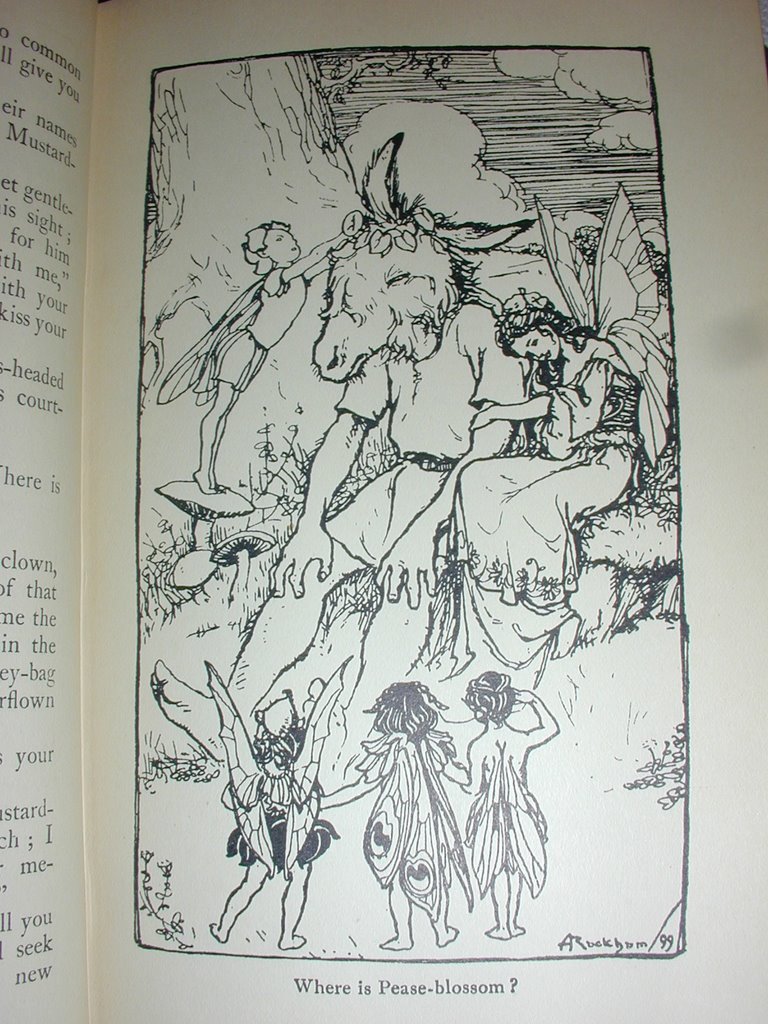
And this is the other thing I've found about enjoying books like Paradise Lost and The Odyssey--find an edition (and, for everything except Paradise Lost) a translation that you enjoy. We were given some Harvard Classics recently, including the volume of Milton, but I don't like reading it out of the HCs: the pages are too crispy and the print's too small. I like my big illustrated hardcover with the nice big print. (Makes you feel like a little kid with a big book.) That doesn't apply just to epic poetry, by the way. One of the two books I brought home from the thrift shop last weekend was a very nice edition of Goldsmith's The Vicar of Wakefield, with illustrations by Arthur Rackham. As in, the illustrator of The Wind in the Willows and other childrens' books. We have an Everyman paperback of The Vicar too, which isn't too exciting to look at; but this one almost yells to be read. It's the same with childrens' books, too; we have an oversized hardcover of Charlotte's Web which is much nicer to read than a cheap paperback edition.

But I digress. The point is that the greatest books of the Western world were never meant to be slow torture by boredom. If you can get beyond being scared off by the foul fiends of English classes past, they make good reading too.

Why is the sky blue?

Because green wouldn't look right in the sky. (Crayons' very good answer.)

Wednesday, November 08, 2006

The Best, bar none

I know maybe three or four things to do with the end of the jar of jam: put it into a peanut butter and jelly sandwich; mix it with a cup of water and a tablespoonful of cornstarch, and cook until slightly thickened--use on pancakes; make Tightwad Gazette jam-and-milk popsicles (I've tried them but I couldn't get the jam really mixed with the milk, so they're not my first choice); or make these bars, which are so accommodating that you can make half the pan one flavour and half the pan another, if your jam jars are really close to the bottom.

Also these have a very nice flavour--I think it's the combination of the almond flavouring and the cloves. They're from the first Harrowsmith Cookbook.

JAM BARS

½ cup shortening
½ cup sugar
½ tsp. vanilla
½ tsp. almond extract
1 egg
1 1/2 cups flour (I use unbleached all-purpose)
1 tsp. baking powder
½ tsp. cinnamon
¼ tsp. ground cloves
½ tsp. salt
Jam, any flavour you like--and the amount is up to your sweet tooth. (Apricot is very good.)

Cream the shortening and sugar with the flavourings, and beat in the egg. Sift the dry ingredients together (I just mix them in another bowl) and add to the creamed mixture. You may need to sprinkle the dough with just a LITTLE water if you find it's too dry.

Spread half the dough in a greased 8" square pan. Cover with jam, which isn't always easy to do without messing up the dough--you just have to spread it out the best you can. Cover with the rest of the dough mixture (it's okay if it doesn't quite cover all the jam) and bake at 400 degrees for 25 minutes. Cool before you cut them in squares. Even then, they can be a bit crumbly for eating out of hand--but they're good.


CHOCOLATE FINGERS

These are a family favourite at Christmas time, and we make only ONE PAN. I linked last year to where somebody had posted the recipe on a message board. Since then that's disappeared, so I decided it was time to post it myself. (We found it in Canadian Living's Family Cookbook.)

1 pkg (400g) digestive biscuits (For those of you who can't get digestive biscuits, you can substitute 1-3/4 cup graham cracker crumbs, or maybe 'Nilla wafer crumbs.)
½ cup finely chopped nuts
½ cup butter
½ cup granulated sugar
½ cup sifted unsweetened cocoa powder

1 Tbsp instant coffee granules
1 Tbsp hot water

2 eggs, beaten
2 tsp vanilla

GLAZE:
1 cup semisweet chocolate chips
2 Tbsp shortening

INSTRUCTIONS

Line 8-inch square pan with waxed or parchment paper, leaving enough paper hanging over the edges for easy removal later.

1. Using food processor or rolling pin, crush biscuits until in fine crumbs (or use a food processor). Transfer to bowl and add nuts.

2. In saucepan or bowl set over simmering water: melt butter; whisk in sugar and cocoa.

3. Dissolve coffee in hot water; add to pan and cook over simmering water, whisking for 1 minute or until thickened and sugar is dissolved.

4. Whisk in eggs and vanilla; cook, whisking, for 4-5 minutes or until thickened slightly. Remove from heat.

5. With fork, stir in crumb mixture. Mix well.

6. Press firmly into prepared pan (lined with wax paper). Cover and refrigerate until cool, about 1 hour.

GLAZE: (don’t prepare this until base is cooled and ready)

1. In saucepan over simmering water, stir chocolate with shortening until melted and smooth.

2. Pour over base, spreading evenly.

3. Cover and refrigerate until set.

4. Using waxed paper as handles, lift square from pan. Cut into small squares or fingers.

5. Keep covered in refrigerator. These will keep for several days.

Tuesday, November 07, 2006

Why we have bean seeds taped to the window

Our current Botany chapter is online here at Home Training Tools. Good thing we had so many bean seeds left from our garden this year.

Monday, November 06, 2006

"I don't know anything. I never did know anything. But now I know that I don't know...."

Maria at the Homeschool Math Blog discusses that recent study that says "that countries in which kids report enjoying mathematics and feeling confident in it do worse in math than kids who report they don't like math and are not feeling confident in it." According to the report, "American students are much more confident about their math abilities than Singapore students, yet they do far worse: Even the least confident students in Singapore outscore the most confident students in America!"

Maria points out:
"This effect in the U.S. may be due to the fact that by and large, mathematics instruction is delivered as easy, small, bite-size chunks that are easy for students to swallow.....[so] they will obviously be confident of their mathematical abilities and think that they do well in mathematics.

"In contrast, their peers in Singapore probably encounter challenging problems and frustration over those.

"In the long run, those students don't feel so confident about math because they have gotten a glimpse about the fact there is a lot they don't know."
To sum up and mix movie quotes: having confidence in confidence alone may not be what students need, if we're hoping to see future Marie Curies and Galileos.

Saturday, November 04, 2006

The mind of Crayons

After drinking a glass of cran-apple cocktail: "Mommy, can I have some more of that cottontail juice?"

Thoroughly Modern Priscilla

The DHM has been chatting about old cookbooks, and I mentioned that I own my great-aunt's copy of The Modern Priscilla Cookbook from the 1920's. Other than the fact that it has strange-sounding recipes (meant for those 1920's gas cookers, undoubtedly), I didn't know anything about it or its origins, including the name. I always assumed that maybe The Modern Priscilla Cookbook was an update of something else, like maybe The Old Out-of-date Priscilla Cookbook.

Now it turns out that Modern Priscilla was a magazine, and the cookbook was published as a subscription gift. Who knew?

I'll post more about the book when I get a chance. (Today we're running out for groceries and probably going to check out a brand-new monster thrift shop near here.)

P.S. If you catch this Ebay listing before it runs out, there's a whole table of contents for an issue of Modern Priscilla. Here are some samples:

"The ways of the draped hat- No 11 of a series of articles on hat making"

"A Paris frock copied in every charming detail, Ready to wear after you do the embroidery"

"Quaint patchwork landscapes to grace your walls" Four Cape Cod pictures.

"Shall we have a Breakfast room"

"Women and the need for more money"

"High school: the breaking point" Medical director for Mental Hygiene, Boston

"Readers recipes" Bean and Ham Loaf, Asparagus Salad, Cheese Sandwich filling, Cornflake Apple Dessert, Pineapple Pikelets, Graham Muffins, Green pepper Salad.

"A Valentine Luncheon party with Menu and Recipes"

"Silver Resist designs for China"

"Designs of dresses for 1925"

Thursday, November 02, 2006

"Pizza with the works" curriculum

There has been much written, and much of it wise or at least well intended, about the value of simplifying young childrens' schoolwork, and about not trying to teach them physics before they've mastered phonics. A recent post to that effect on another blog got many positive comments from veteran homeschoolers. They agreed: take it easy on yourself and your kids; don't try to do too many subjects too early; stick to the "3 R's" until the junior grades. And if you do teach science or history in the primary grades, don't expect the children to remember much of it.

This isn't so much a rebuttal as just another way to look at things.

In Ruth Beechick's booklet A Home Start in Reading (part of her 3-R's series, but we won't hold that against her), she describes the following experiment carried out by a school district:
"Some kindergartners in the district received extensive instruction in reading. Others spent the same amount learning science. They melted ice. They observed thermometers in hot and cold places. They played with magnets, grew plants, learned about animal life, and so on. Books and pictures were available for these children if they wanted them, but no formal lessons in reading were held.

"And what did the school district learn? By third grade the ‘science’ children were far ahead of the ‘reading’ children in their reading scores. The reason? Their vocabularies and thinking skills were more advanced. They could read on more topics and understand higher level materials. The ‘reading’ children, by starting earlier, used up a lot of learning time on the skills of reading, while the ‘science’ children spent the time learning real stuff. And when they did begin reading, they were older and knew more and learned in a fraction of the time that the others took.”
(Ruth Beechick unfortunately doesn't provide any footnotes or verification for this study, so we'll just have to take her word for it.)

Now this may sound like an argument for the don't-teach-them-to-read-early camp, and in fact that is the context in which Dr. Beechick was writing: not to pressure children to read until they're ready. However, all the Squirrelings have happened to be early readers. By kindergarten age, they have all been reading fairly fluently, which, ironically, gives us the same curriculum problem we would have if we didn't want to teach them reading early: what else to do during school time if much reading instruction isn't needed or wanted?

Well, we read books. Out loud, silently, together and alone. Narration of one kind or another often follows.

We do copywork and work on handwriting skills; Crayons practices making her numbers right way round.

And, like the kindergarten experimenters, we "do." Especially this year, with a fourth grader (with a late-in-the-year birthday) and a kindergarten-age child at home during most of the day, I'm trying hard to keep a balance between reading and "doing." Some days feel like we're eating a curriculum pizza with the works (and the kids are helping make it).

We have a big map of the world on the kitchen wall (which Crayons loves to look at and find places she knows, like Poland), and an edible-ingredients model of the atmosphere on the kitchen counter. (We may have to borrow back some of the Thermosphere if we run short.) Already this fall we have had leaf lessons on the back porch (with samples all around us); have acted out (more than once) a favourite story about King David; have made file-folder pictures of the characters from "As You Like It"; and listened to Leonard Bernstein's orchestra demonstrating how Haydn added humor to music.

We've played domino concentration and Pico Fermi Bagels, looked forward to the next chapter of Peter Pan, and memorized Emily Dickinson's poems. (Crayons liked Michael Bedard's picture book Emily, and also the poem that starts "I started early, took my dog and visited the sea; The mermaids in the basement came out to look at me.") We make up new verses to songs, and try to answer Ponytails' Big Questions about everything. The girls mess around with a keyboard and a lap harp. They make up ongoing doll stories, radio shows, and hospital dramas. When the Apprentice comes home from school, she teaches them games she's learned in drama class. Mr. Fixit also lets Ponytails help (as the Apprentice did) when there's a tape recorder or some other piece of electronic stuff to be refurbished.

Now this may not be very different from the daily experience of homeschoolers who say "stick to reading, writing and math for the first few years." Maybe when people say that, they're not including all the things they do with their children and which their children do spontaneously. (I'm typing this while listening to a Squirreling who chooses not to be identified vocalizing at the top of her lungs while playing under a card table tent. They've been opera divas singing "The Voices of Spring" all day after watching The Three Stooges' "Microphonies.") When they put together a very short list for first-grade curriculum, maybe they're not including the books already on the shelf and the games and puzzles they pull out of the closet, and all the other resources they have in their kitchens and workshops.

At the same time, it worries me that "cutting out all those extras" could also mean subjecting primary-age children to an (unnecessary) hour daily of math and the same amount of time spent on phonics AND spelling AND language. No wonder some people can't even imagine adding more to a young child's schedule.

Was it a waste of time for the kindergarten classes to melt ice and play with magnets? According to Dr. Beechick, no; the "real stuff" stirred their imaginations and gave their minds something to work on. (Charlotte Mason would say that they were learning from Things and Ideas.)

Is it a waste of time to do botany and geography and poetry with kids who still play with Polly Pockets? Will they remember everything? No. Will they learn something about their world, that it's a much bigger and more interesting place than the tiny corner of space and time that we inhabit, and yet that even our tiny corner has enough to keep us going for a long time? I hope so.

Wednesday, November 01, 2006

All Saints' Day

In some countries and in some churches, November 1 is a day to remember the dead.

In our house, All Saints' Day is a day to celebrate eternal life, and those people who have been part of the "cloud of witnesses" in Christian history. Every year we choose one person to be our dinner "guest," and plan table decorations, a devotion and maybe the food around that person. We've had Noah, with a toy Noah's Ark on the table; C.S. Lewis, with a stuffed lion and some books; and Queen Margaret of Scotland, with tartan trimmings and a fancy medieval-looking covered book.

Tonight's guest is going to be George Washington Carver. Not every Christian hero is a missionary or a pastor; God uses us, if you'll excuse the expression, "where we're planted."

I liked this quote from an Amazon review (of George Washington Carver: His Life & Faith in His Own Words):
In 1921, Carver addressed the U.S. House Ways and Means Committee regarding the endless uses of the peanut. At the end of his address, the chairman asked:

"Dr. Carver how did you learn all of these things?"

Carver answered, "From an old book."

"What book?" asked the chairman.

Carver replied, "The Bible."

The chairman inquired, "Does the Bible tell about peanuts?"

"No, sir" Dr. Carver replied, "But it tells me about the God who made the peanut. I asked Him to show me what to do with the peanut, and He did."
Now, what are we going to serve tonight? Unfortunately, Mr. Fixit can't eat peanuts, so we can't try Carver's original peanut recipes (check out #59--Peanut Butter Sandwiches). Don't have any cowpeas, either. Sweet potatoes? Soybeans? Durn, I was going to pick up some tofu at the supermarket last Saturday, but one of the packages had leaked all over the others so I passed on it.

Well, some kind of beans or nuts, anyway. We do have some cashews...

[Update: well, our Carver meal wasn't too authentic. I did make Bean Balls with a can of romano beans; I thought that was somewhat in the spirit of Carver's leguminousness. So we had pasta with spaghetti sauce (or blood sauce, nod to Coffeemamma) and Bean Balls, and the Hillbilly Housewife's Garlic Breadsticks which we haven't made for quite awhile, and raw veggies, and chocolate pudding. Ponytails was a big help getting all this ready, and vacuuming, and even helping get some extra dishes done before the meal--blowing kisses your way.]

We Celebrate the Saints, no matter what's on the menu.

[Update: We played a couple of peanut party games after the meal, except that we didn't have any peanuts so we used other things. Everybody got a drinking straw and a dish of big dried squash seeds, and you had to suck on the straw to pick up a seed and move it to another dish. Mama Squirrel thinks she holds the record for sucking the most seeds in thirty seconds. The other game was a peanut rubber ball race--you had to put a straw in your mouth and push a small rubber ball to the finish line.

I hope the Saints were laughing.]

Tuesday, October 31, 2006

School with Ponytails and Crayons (and a math game)

News from the homeschool front:

In Bible lessons, we have just killed off King Saul (and ended the book of 1 Samuel). We are studying seeds in Botany (we've been cutting apart some of the dried beans from our garden), and continents in Geography. Since Ponytails just read a chapter of Hillyer's History about the Trojan War and Homer, we also read the story of Circe's Palace from Hawthorne's Tanglewood Tales. That took us three readings, but it's a great story (Ponytails and Crayons both liked the pigs). [Update: Ponytails says she liked the bird, and sort of the pigs. Crayons doesn't want to be quoted at all.] I remember reading it with The Apprentice too, maybe six years ago.

There's a fun connection there with Crystal Mountain (which we just finished), because the governess in the book, Miss Dunbar, carries a copy of The Odyssey around with her in her pocket, and she tells the children a bit about Ulysses too.

We also just finished watching "As You Like It," a 1978 BBC video with Helen Mirren. We read Lamb's story earlier in the fall, and since we were at a library last week that has good videos of Shakespeare's plays, I brought it home to watch. It's filmed mostly outdoors (Ponytails was amused to see Rosalind having to deal with occasional insects flying in her face). Thumbs-up.

Ponytails is reviewing addition and subtraction in math, and Crayons and I are trying some new math things. Here's a game we found in Ruth Beechick's Arithmetic booklet:

"The Greatest Number"

You need cards numbered from 1 to 9. We used Dutch Blitz cards, but found it was too easy to cheat if you remembered what colour backs the different numbers have, so we played a different way: instead of each person just having nine cards, we each took a whole pile of cards. It doesn't make any difference to the game--it just makes it harder to cheat!

Anyway, you put all your cards face down in a pile, and take three (or two or four) cards out. You each make the biggest number you can from them, so if you take out a three, a four and a six, you can make 643. Whoever has the biggest number gets a point (we award a checker). We play that the first one to get ten points (or checkers) wins the game.

Crayons was uncertain about reading 3-digit numbers, so we played for awhile just taking two cards out at a time. Later on, though, we tried it with three, and she caught on to that as well. So this seems like a fairly painless way to learn to read large numbers! Ponytails wants to play too, so for her I think we'll take out four cards at a time.

School Days with the Apprentice, Fall 2006 Edition

Just to stay caught up on school...

The Apprentice and I are reading How to Read a Book (for the third year!); Are You Liberal, Conservative, Confused? (from the Uncle Eric series on law and government); and parts of Writer's Inc. (for composition). She's also working through Jacobs' textbook Math: A Human Endeavor, and reading Walk Across America for geography and Sophie's World for literature and worldview. Sophie's World is a book I might have saved for a couple of years because it has some fast-forward parts in it as well as some fairly heavy philosophy topics. I will have to ask The Apprentice to post her thoughts about that one.

Besides that, she's taking grade 9 science and drama at our local high school, and even drama has a fair amount of homework: monologues and dialogues to write and memorize, and now a major assignment on playwrights (including an oral report, NO NOTES) that has to be completed within the next couple of weeks. The Apprentice and her partner have to report on Molière and also act out something from one of his plays. Gee, and you thought homeschool was hard...but better Molière than Neil Simon, I guess.

But tomorrow is Take-Our-Kids-to-Work Day, so The Apprentice will be spending the day with Mr. Fixit. Just like old times.

In the spirit of the day

The Treehouse Squirrels have taken a middle ground on October 31st celebrations. We have never gone all out with decorations, but the Squirrelings do dress up and visit a few neighbours and Grandpa Squirrel's house, and we have been known to screen a slightly-scary movie or two during this week. October 31st is the Baptism Birthday of two of the Squirrelings, and also Reformation Day in parts of the Christian world, and we have been as likely to stick up pictures of Martin Luther on the door as we have had pumpkin pictures. (What's on the door is mostly for our own entertainment anyway, since we get very few trick-or-treaters where we live. Last year we had one kid come to the door, besides the Squirrelings.)

But since the serious stuff sometimes gets forgotten in the fun of putting on makeup, we usually have a kind of double celebration: fun pumpkin stuff on October 31st, and an All Saint's Day dinner (the kind with a tablecloth) on November 1st. I'll post about the tablecloth dinner tomorrow.

But for today, I have a puzzle for Treehouse readers who enjoy this sort of thing (and apologies to the rest of you, because it's not meant to offend anybody). This is tonight's dinner menu, which we will eat by the light of an oil lamp flanked by two large pumpkins. Can you figure out what we're really going to eat?

Intestines with Sour Cabbage
Ears Stuffed With Mashed Potatoes
Green Warts


Dessert: Mooshy orange stuff baked until congealed in an old crusty pan

Friday, October 27, 2006

Get me some more of them pork rinds, Bubba

Another ick story about how homeschoolers are a bunch of well-meaning but misguided amateurs. (Thanks again to www.HomeschoolBuzz.com.) From the article:
Critics of homeschooling say it is impossible for a parent to know how to teach a wide array of subjects without training.

"We are professionals," Dianne Birdwell, a high school history teacher, said.

She responds to the idea that public schools do not teach enough about faith or religion by saying that parents need to teach their children about those subjects after school.

"We know how to teach and you need to be their parents," she said.
Well, then I guess that there schoolmarm must know what she's talkin' 'bout. 'Scuse me while we get back to our story from the Odyssey. And our bag of pork rinds.

Wednesday, October 25, 2006

What's your favourite homeschool tool?

The kitchen walls.

Really.

I mean, where else are you going to put the timeline and the contact-paper-posterboard-leaf constructions and the map of Israel and the memory work? Not to mention the calendar.

Open concept? No way, I need my walls!

Two pumpkin recipes (yes, The Pie Recipe)

First, Pumpkin Cake. Or Pumpkin Loaf. Or Pumpkin Muffins, if you're so inclined.

This appeared, with an appetizing-looking photograph, on our newspaper's food page today. When I looked at the recipe, it was the same Canadian Living recipe I've been making forever. So feeling inspired (and having a can of pumpkin), Ponytails and I made a batch. This is the recipe as originally written, with my notes in brackets.


PUMPKIN GINGERBREAD SNACKING CAKE

1 1/2 cups (375 ml) granulated sugar [2009 update: we have been cutting back on the sugar in this, down to 1 cup, and it still tastes fine]
2 eggs
1 cup (250 ml) pumpkin purée
1/2 cup (125 ml) vegetable oil
1/2 cup (125 ml) buttermilk (or sour milk or thinned yogurt)
1 3/4 cups (425 ml) all-purpose flour (we used part whole-wheat today)
1 teaspoon (5 ml) baking soda
1 teaspoon (5 ml) ground ginger
1/2 teaspoon (2 ml) salt
1/2 teaspoon (2 ml) each ground cinnamon, nutmeg, cloves and allspice (We use only 1/4 tsp. of cloves and allspice)
1/4 teaspoon (1 ml) baking powder

Icing sugar (optional--we skip it)

1 In a large bowl, beat together sugar, eggs, pumpkin, oil and buttermilk until smooth. In a medium bowl, stir together flour, baking soda, ginger, salt, cinnamon, nutmeg, cloves, allspice and baking powder. Stir dry ingredients into pumpkin mixture until blended.

2 Pour batter into lightly greased nine-by-nine-inch (2.5-litre) square baking pan. (Or an 8-inch square pan. Or a casserole dish if all your other pans are dirty. Mama Squirrel did not mean to imply that she has a kitchen full of dirty dishes, only that some of her pans are currently holding food in the fridge.)

3 Bake in a preheated 350 F (180 C) oven until top springs back when lightly touched, about 35 minutes (or longer--test to see if it's done). Let cool in pan on rack. Dust with icing sugar.

Makes a nine-by-nine-inch (2.5-litre) cake.

SOURCE: CANADIAN LIVING'S BEST MUFFINS & MORE, BY TELEMEDIA COMMUNICATIONS INC., ADISON PRESS BOOKS


Okay, now that Wicked Pumpkin Pie. This is not the solid-packed version that everybody makes from the pumpkin can label; this is fluffy and lightly spiced, and we look forward to it every year.

There are very similar recipes for this in two of Edna Staebler's cookbooks (Food that Really Schmecks and Schmecks Appeal: More Mennonite Country Cooking). I've made them both and the only real difference (I think) is in the amount of filling that the recipe makes. So here is the Schmecks Appeal version, and if you happen to want a little more (extra company coming), you can look for one of the reprint copies of Food That Really Schmecks.

"Glorious Golden Pumpkin Pie"

2 cups pureed pumpkin (canned is just fine)
2 egg yolks, beaten
1/2 cup milk
2 tbsp. rum (optional) or 1 tsp. vanilla
1 cup sugar
1/2 tsp. cinnamon
1/2 tsp. nutmeg
1/8 tsp. cloves
1/4 tsp. salt
2 egg whites, beaten stiff (I use the food processor whipping attachment to get them good and stiff)
Pastry for a 9-inch pie (I use pat-in pastry because I'm lazy)
Whipped cream for garnish if you want

Mix the pumpkin, egg yolks, milk and rum or vanilla. (We use vanilla.) Add the sugar, blended with the spices and salt. Fold in the stiffly beaten egg whites. Turn the mixture into the unbaked pie shell and bake at 400 degress for 10 minutes (I start it at 425 degrees instead of 400 though), then at 350 degrees for about 30 minutes longer or until a knife comes out clean.

Mama Squirrel's reading list

Working on:

Paradise Lost. (You didn't think I bought it just to class up the coffee table, did you? I am in Book II and thoroughly ENJOYING IT. I don't think I enjoyed it so much in university; funny what twenty years will do for you, post-pregnancy idiocy aside.)

Breathing Lessons. (Re-reading. Maggie's off-to-college daughter asks her, "Mom, was there a point in your life when you just decided to be ordinary?" Ouch.)

Done:

Erewhon. (Krakovianka, I'm sorry, I dutifully worked my way through this and even read most of the weird boring parts about unborn babies pestering potential parents so that they could get born; but I still don't really get it.)

Peter Pan and Crystal Mountain, with Ponytails and Crayons.

Tales of Little Grey Rabbit, with Crayons.

Red plus white equals green

If you understand this t-shirt, then you must have used Cuisenaire rods.

I've still been waiting for someone to design an "I love Miquon Math" shirt, but that one comes pretty close. The comments below the design are funny too.
"This reminds me of the towers we used to build and then drop the little white ones down the middle. Did someone say you can do maths with these things??"

Tuesday, October 24, 2006

Some things we did today, by Crayons

We went to Peter Pan today. It was funny. It had Tinkerbell and Wendy and John and Michael. Michael was the silliest. He got knocked over by a door because he was near the door and when somebody opened it he got knocked over. It was funny because he was wearing a baby costume! They had some volunteer kids up. One was Wendy, one was Peter Pan, and one was Captain Hook. He was a man! I was surprised because I thought it was only for kids.

We had Big John Subs after the play. But before that we went to the library. We got Hansel and Gretel from the library, and we watched it tonight. It was fun.

For school we went for a walk and got leaves. We made placemats out of them. And I made a tube doll! It's a doll with string hair that's made out of a wrapping paper tube. Her name is Sara and she's three years old. And that's the end of my post.

P.S. I love her!

Sunday, October 15, 2006

Two down

Crayons' second tooth fell out this weekend.

And like the first one, it disappeared. Well, at least she got to hold this one before it got lost...somewhere.

Somewhere there's a tooth fairy with a migraine.

Saturday, October 14, 2006

Of old books and great-grandmothers

(Reposted to include the photos, now that we have a faster connection and can get them uploaded!)

October 1st was a rummage sale at one of those churches that always has good rummage sales, and usually a big book table.

We got there fairly late in the morning, which doesn’t usually matter much. We have odd enough tastes in old things that what we like is usually still there by the time we get moving on Saturdays.

But there didn’t seem to be any books. Strange, but maybe books were too much of a hassle to deal with? So I asked, and they said, “There were lots of books! But someone just came in and bought them all!” Every single book at a church rummage sale? “It’s never happened before! But we couldn’t say no!” Well, it saves repacking all those books that didn’t sell!

But Humph. And I was hoping to post something in response to all those lovely posts of the DHM’s about her library-sale-to-end-all-library-sales. Not the-book-to-end-all-books, of course. Just one or two interesting finds?

Well, I did get an abridged cassette version of David Copperfield. (I guess Mr. Buy-them-out missed that one.)

But since I don’t have else anything brand new (or should I say old) to post about, I’ve employed The Apprentice and her digital photography skills to show you some books that we already had.


I really like the old Everyman’s Library editions “bound in cloth with gilt design and coloured top,” but they don’t photograph well, especially when the covers are a bit faded.


I have my grandma’s childhood copy of Tales from Shakespeare, so that’s my favourite; the rest have mostly been picked out at used book sales.


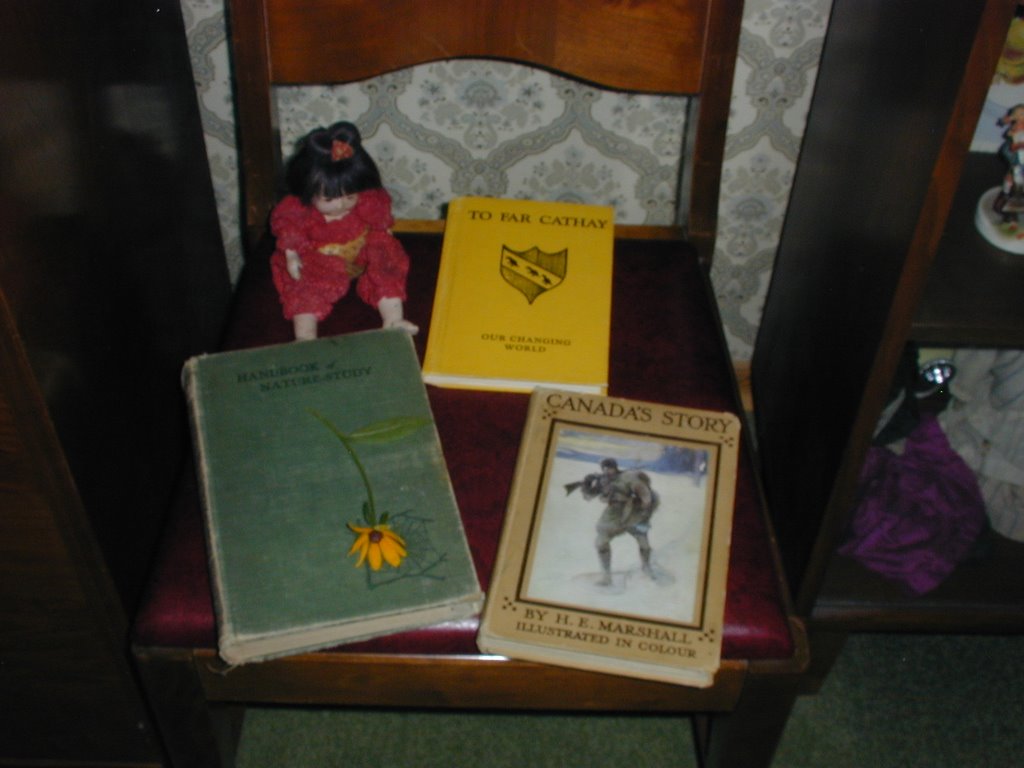
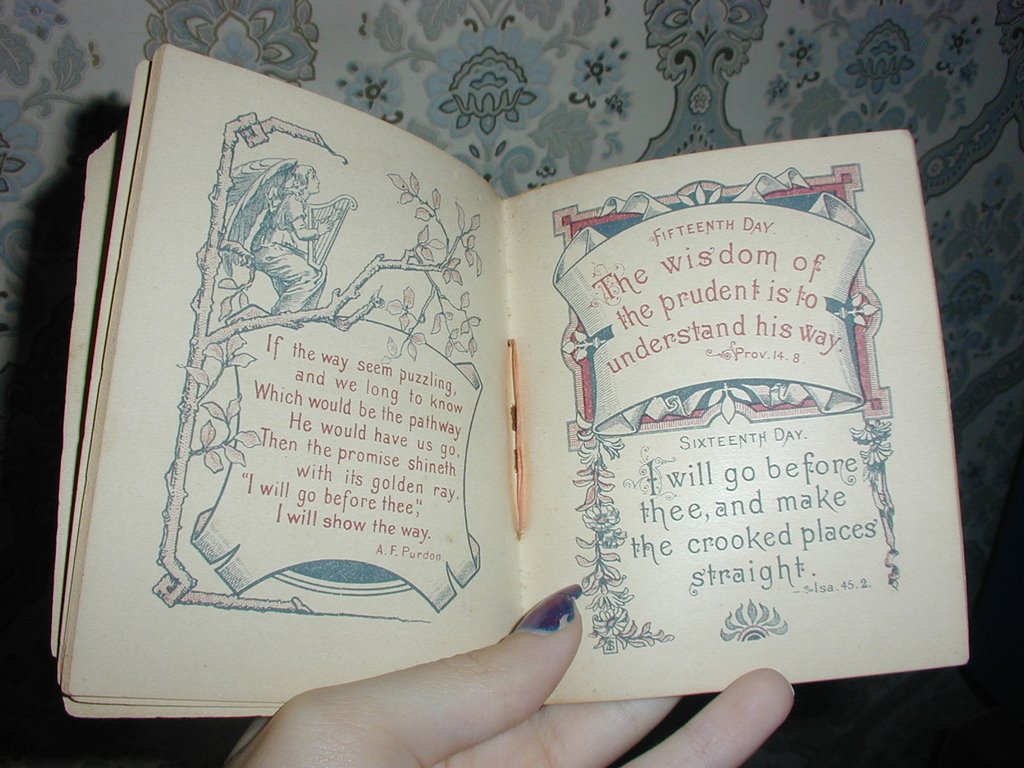
These are some old books that will be familiar to Ambleside Online users. The yellow book is To Far Cathay, by William C. Bagley Jr., a story of Marco Polo (published in 1935). My schoolteacher great-aunt had it on her shelf for forty years and then gave it to me; both The Apprentice and Ponytails have used it for school. The brown book is Canada’s Story, by H.E. Marshall, part of her Empire Story collection. And the green one is Volume 1 of Anna Botsford Comstock’s Handbook of Nature Study (published in two volumes, this printing from 1924). The inscription in it says “Jennie M. Gaskill, Bryn Athyn, Pa.” Jennie Gaskill was an author as well (there are scattered online references to her), and Bryn Athyn is a bastion of the New Church (the Swedenborgians). But how did the book get all the way up to a used bookstore in Ontario? I was browsing in the nature section (this was several years ago) and thought, wouldn't it be amazing if...and there it was. I pulled it off the shelf, not knowing what it was (the spine is unreadable). (I did look for the other volume too, but it wasn't there.)


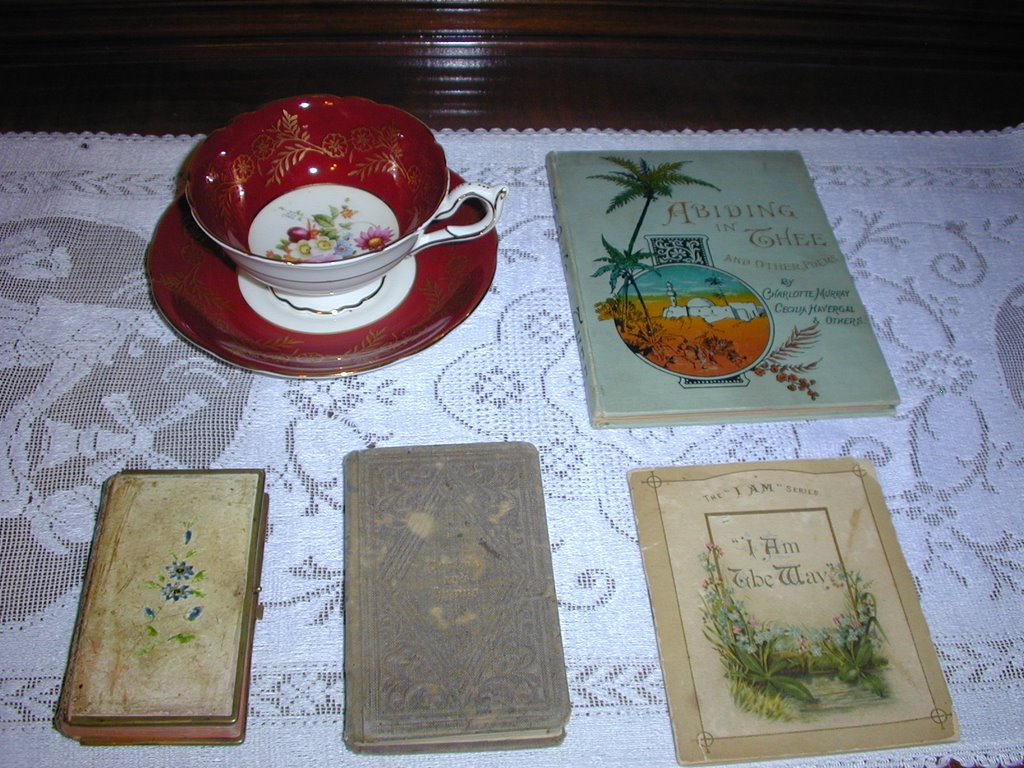
And this is a collection of small books that belonged to the mother and grandmother of that great-aunt. The largest one, Abiding in Thee, is 5 by 6 inches, and the smallest is 2 by almost 4 inches.


Abiding in Thee reminds me of The Country Diary of An Edwardian Lady, except that it’s all Christian verse, illustrated with watercolours of flowers. It was printed in Toronto and has an inscription from 1900 (my great-great-grandmother’s name).


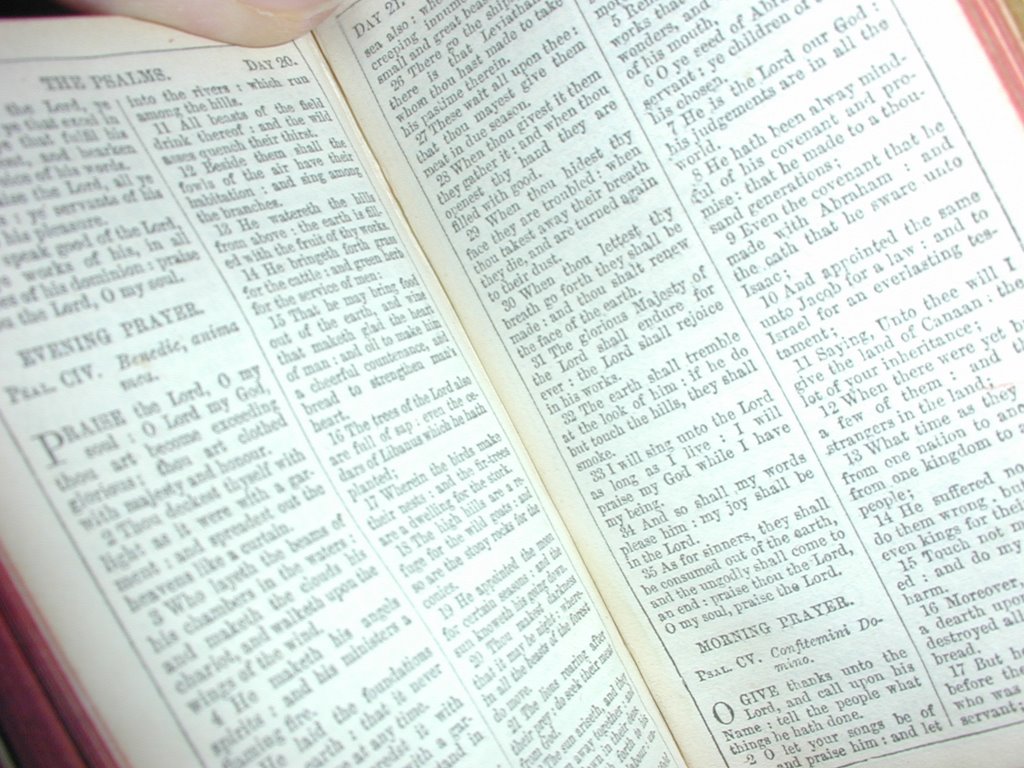
The smallest one is a Book of Common Prayer with metal edges and the findings for a clasp (the clasp is gone though). It was printed in England and it has very small print (I feel sorry for older people trying to make that out in poorly-lit churches!).

The other small book, the dark brown one, is older; it’s A Selection of Psalms, Hymns and Anthems, with a really interesting inscription: the same great-great-grandmother’s maiden name, and then “Pew No. 30, St. Paul’s Church, Yorkville, C.W.” Do you know what C.W. stands for? Canada West; that’s the pre-Confederation name for Ontario. That date’s confirmed by the book itself: it was printed in Toronto in 1861.


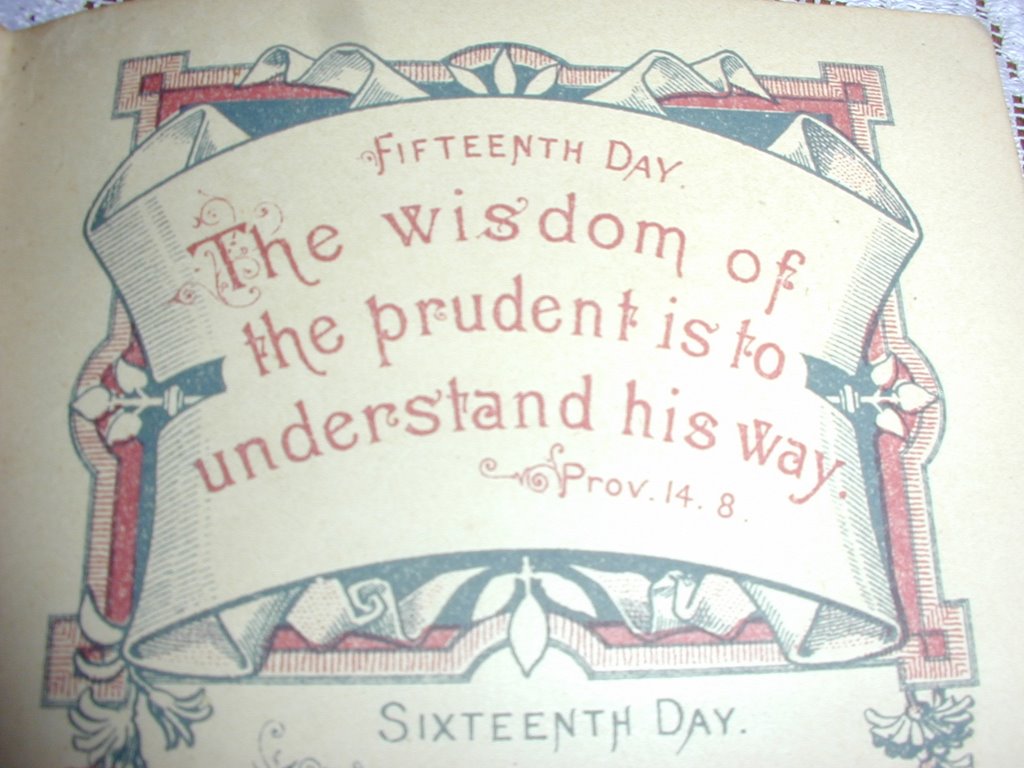
The fourth book is only about sixteen pages long. It’s called “I Am the Way,” from the “I Am Series” published by the Toronto Willard Tract Depository. No date given, although there’s an inscription in the front cover, to my great-grandmother from her cousin Lizzie, so I’m guessing from that and from the style that it’s from around the turn of the last century. It’s meant to be a month-long devotional, almost like a copy-book. Each day’s saying or verse is separated by scrolls and borders that make the verses look like framed mottoes in Victorian parlours. One page says, “Fifteenth Day. The wisdom of the prudent is to understand his way. Prov.14.8. Sixteenth Day. I will go before thee and make the crooked places straight. Isa. 45.2.”

Then on the facing page there’s a verse decorated with drawings and borders:

“If the way seem puzzling,
And we long to know
Which would be the pathway
He would have us go,
Then the promise shineth
With its golden ray,
‘I will go before thee,
I will show the way.’—A.F. Purdon.”

Friday, October 13, 2006

Beatific photography

One of the Beehive inhabitants, Beatrice, has begun a blog of her photographs. I thought that might interest a couple of regular Treehouse visitors. I especially liked the egg photography in this post.

Thursday, October 12, 2006

Chef Earl's Soup (and Ruby Red Rutabagas)

In February 2003, Canadian Living Magazine published a story about chef Earl Johnson's way-better-than-your-average-cafeteria-food at Gordon Bell High School in Winnipeg. They followed up that October (after many requests) with some of his recipes. We've been making his Potage Paysanne ever since, on cold days and when we can manage to get turnip (we use rutabaga), parsnips, leeks and parsley all in our fridge at the same time. (Sometimes we leave one or the other of those things out.)

Now Mama Squirrel must be unflinchingly honest: she hates rutabaga. Rutabaga crumble, rutabaga casserole, rutabaga disguised with apples and spices--it's still rutabaga. Rutabaga raw and sliced is tolerable; and Earl's soup makes it taste...well, about as good as you're going to get a rutabaga to taste. We figured if Earl could convince the teenagers in Winnipeg to eat this, it must have something going for it.

And it gives us one way to eat our ruby-red rutabagas with a smile.

(I'm not posting the recipe, in case you wondered or missed the link; Canadian Living did it nicer than I can, here.)

Wednesday, October 11, 2006

This is really, really good

I found this recipe a long time ago in an ad for Nabisco 100% Bran Cereal (Nabisco's version of All-Bran). The ad called it Coffeeberry Loaf, which makes no sense at all since it contains neither coffee nor coffeeberries. Since I don't usually bake it in a loaf pan either (takes too long), it definitely needs a new name. Cranberry-Apricot Cake isn't imaginative, but it will have to do until we can think of something better.

When you take the cake out of the oven, it will smell like a piece of orange cranberry heaven--especially if you use orange-flavoured dried cranberries. The leftovers are very good for breakfast.

Cranberry-Apricot Cake (or Loaf)

2 eggs
1 cup orange juice
1/3 cup butter, melted (I used soft margarine and I didn't melt it first, just beat it around with the other ingredients)
1 cup Nabisco 100% Bran Cereal (or another brand)
3/4 cup chopped dried apricots (I left them out this time and the cake was still good. I love apricots, but the almost two cups of dried fruit is almost too much for the amount of batter here; too many extras tend to make the cake fall apart. You might try 1/2 to 3/4 cup chopped apricots and the same amount of dried cranberries, if you find that's a problem.)
1 3/4 cups all-purpose flour (I use unbleached)
1/2 cup packed brown sugar
2 tsp. baking powder
1 cup cranberries: fresh, frozen, or dried (I use Craisins)

Whisk together eggs, orange juice and butter. Stir in cereal and apricots; let stand 5 minutes.

Mix flour, brown sugar and baking powder in a large bowl. Add cereal mixture to dry ingredients, stirring just until moistened. You may find you need a little more liquid.

Fold in cranberries (do not over-mix). Spread evenly in a greased 9 by 5 inch loaf pan, OR an 8-inch square pan.

Bake at 350 degrees F for 55 to 60 minutes (in the loaf pan) or less (in the square pan), until a tester comes out clean. (You can bake it in a toaster oven too.) Cool in the pan 10 minutes, and then turn the loaf out onto a rack to cool completely. (If you bake it in a square pan, you probably wouldn't bother turning it out.) If you eat it before it's cooled, it will taste good but be very crumbly.

Homeschooling is an education

Things I’ve learned from homeschooling

1. How to get laundry in and start lunch between math and geography.

2. That there's no such thing as too many bookshelves.

3. That the thermosphere is hot but it's not.

4. That hymns are a good way to start the day.

5. A lot about my kids, my husband, and myself.


Things I’ve learned about homeschooling

1. Trust your instincts and your memories. If your gut reaction to something is “ugh” or “why?” or “I would never inflict this on my kids,” you’re probably right. I’ve felt an instinctive “no” about many things. One was a kindergarten math outline that consisted of making a booklet for One, a booklet for Two, a booklet for Three…a booklet for Seventeen…uh huh. Another was the long vowel-short vowel reading approach—that gave me some BAD flashbacks to a first grade class where we circled pictures of pigs and pails and pins and and pens (always fountain pens, for some unexplained reason). The Squirrelings seemed to approach learning better by getting a good running start and then jumping over as much as they could at a time.

2. But stay open minded, too. A book that a bad teacher ruined for you; something you think is too hard for kids; a subject you never thought you were good at—those things can become real and fascinating when you read or study them with children who come without those prejudices. Sometimes opening the door to a new passion is all it takes; sometimes you need a little more perseverance; but the rewards are great. You may witness the beginnings of the world’s next great artist or scientist or missionary.

3. It's okay if every school day isn't perfectly balanced. Most homeschoolers expect and deal with interruptions; and some days you just get more done than others. But you can also plan things to be a bit unbalanced so that you get other things done. The Hillbilly Housewife touched on this in something about menu planning:
"Monday is a big work day in homeschool, so something relatively easy is in order. Dirty Rice with ground turkey or beef will be nice, but I'll have to use celery instead of green pepper because it's out of season and outside of my budget. Wednesday is a slow day at school and I'll be baking anyway so beans will be good. While I'm at it, I might as well make enough for chili the next day. I have time for making chili on Thursday morning while the kids are doing their independent reading."

4. You are always adjusting and retooling, because your children and learning and changing; because you have more or fewer of them to teach as they grow and graduate; because new books and materials come your way; and because you are learning and changing too.

Saturday, October 07, 2006

A quick trip to the thrift shop

It was one of those quiet, sunny afternoons when nobody wanted Mama Squirrel around...sniff. So she quietly sneaked away and caught the bus downtown to her favourite thrift shop to check out the back book corner.

And came back with a few things. (A bag of books and a pink shirt, all for six dollars.)

(There, now I get to list some finds too.)

Alison Uttley, Tales of Little Grey Rabbit

Cyril Davey, Lady with a Lamp. This is a biography of Florence Nightingale, one of the Stories of Faith and Fame series published by Lutterworth Press, I think in the '50's, although this printing is from the '70's. (I think they must have been common as Sunday School prizes at one time, going by the inscriptions inside them.) We have four others from this series: Elizabeth Fry, Martin Luther, Robert Moffat, and William Carey. The ones we've read are well-written and interesting, and just right for upper-elementary students.

The Magic School Bus Plants Seeds, just because I know we are getting to a seed chapter pretty soon in the botany book.

Donald B. Kraybill, The Upside-Down Kingdom. Our own Sunday School teacher recommended this one.

Meindert De Jong, Shadrach. (Illustrated by Maurice Sendak.) About a boy and a rabbit. "A real, live rabbit! A little black rabbit, if possible. In a week, if possible. And this was in the Netherlands." I thought this might be one that Crayons could read to herself.

Gavin Maxwell, The Otter's Tale.

Janice VanCleave, Math for Every Kid. Lots of stuff here for Ponytails.

Walter Buehr, Knights and Castles and Feudal Life. You can't lose with Walter Buehr.

Two books for Mama Squirrel: My Name is Asher Lev (Chaim Potok) and Breathing Lessons (Anne Tyler). Mama Squirrel has read Breathing Lessons before (and watched the movie), but it has been awhile. Her favourite Anne Tyler novels are still Dinner at the Homesick Restaurant and Celestial Navigation...and Saint Maybe. And Ladder of Years.

Thursday, October 05, 2006

Using Hillyer's History

The Deputy Headmistress posted some lesson plans (here, here) that she wrote for her girls to use with one of the Draw Write Now books. I made up something similar for Ponytails to use this fall along with chapters from V.M. Hillyer's A Child's History of the World. Like the DHM's guide, this is meant only to show what might be done; it includes books that we already had, and there are sure to be others that would be just as good for maps and pictures. (Usborne tends to show a bit more violence and unclothedness than I would sometimes like.)

So when I say "Read these pages in Usborne's Ancient World," it isn't heavy reading at all; the Usborne books are heavily illustrated, with many double-page spreads; one page, for instance, might have a detailed drawing of a group of Egyptians having a party. I've tried to fit those pages in AFTER the reading on that subject in Hillyer's book, except where I thought the picture or map needed to be seen ahead of time.

The lessons here go only from the beginning of Hillyer's section on Mesopotamia. We read the chapters on Egypt too, but I started the "study guide" at about the time we were finishing them. She doesn't have a large timeline book to work in yet, so she is just adding drawings and occasional comments to a blank notebook as she goes along. We have a timeline in the kitchen and we're adding occasional sticky notes to it to mark events; Hillyer's dates for ancient history are sometimes questionable, but we'll stick with them for now.

One other thing is that we are using a reproduction of Hillyer's original book, which means that the pages and chapters in updated editions won't match exactly. The point of posting this is just to show the sort of thing that Ponytails is doing.


Extra books used:

Usborne Book of World History (Update: One of the reviews on Amazon points out that World History is VERY choppy and sparse, and I agree; the reviewer says she prefers the Ancient World book, and I agree with that too! But we are still using this book here and there for pictures and bits of information.)
Usborne Ancient World
History Detectives: Ancient Greece
D’Aulaires’ Book of Greek Myths
The British Museum Timeline of the Ancient World
The Bible, Tanglewood Tales, and poems

MESOPOTAMIA (includes Sumer, Assyria and Babylonia)

Find a map showing the Tigris and Euphrates rivers (see Mom) and the Fertile Crescent.

Read Hillyer p. 42 and 43 (top), looking at the map
Read Ancient World p 6-7
Read World History p 8-9

Learn the ABC of Mesopotamia: Assyria, Babylonia, Chaldea. (Chaldea was part of Babylonia.)

Read the rest of p 43 & 44, and half of p 45.

Talk to Mom about Mesopotamia and the other names from the book.

What is a ziggurat? In your notebook, draw a Babylonian building.

Read the rest of the chapter (pages 45-48).

Read Ancient World p 8-9.
Read World History p 10-11, 12-13, 30-31.

Check the timeline in the kitchen to see how far back Mesopotamia goes.

Add anything else you like to the Mesopotamia and Babylonia page in your notebook.

Find Ur on a map (check with Mom).

Look at Ancient World page 28.

Mark the timeline: “Ur to Canaan, 1900 BC”
Read Hillyer pages 49-51

Divide a notebook page into three sections, and draw or write something about each section of this chapter.

Mark the timeline: “Canaan to Egypt, 1700 BC”

Read Ancient World p 38-39

Read Hillyer from the bottom of p 51 to the bottom of p 54.

What was the Exodus? Talk with Mom about who the Pharaoh was then. (Was it Rameses or someone else?) Talk about when this might have happened.

Mark the timeline: “Egypt back to Canaan.” Use the date that you discussed with Mom.

Finish the chapter (page 55).

Finish the notebook page for this chapter.

SOME STORIES FROM ANCIENT GREECE

Find Greece on the globe.

Read Hillyer chapter 10, pages 56-61, about the names of some Greek gods.

Look up their pictures in the D’Aulaires’ book of Greek stories or in History Detectives pages 14-15.

Find Athens on a map of Greece.

Start a notebook page for this chapter.

Finish reading the chapter (p 61-63)

Finish the notebook page.

Read the chapter “A Fairy-tale War”, up to the bottom of page 67.

Use half a page in your notebook to show the Trojan War (maybe the wooden horse?)

Read the rest of the chapter, about Homer’s poems.

Find the picture of Homer on our timeline.

Read the story of Circe in Tanglewood Tales (with Mom).

Ask Mom for more information about Homer (who was he really?).

Use the other half of the notebook page for Homer.

BIBLE STORIES ARE REAL

Read Hillyer chapter 12, Kings of the Jews.

Ask Mom why the last paragraph of the chapter is no longer true.

Make a notebook page for the Temple, including the date.

PHOENICIANS

Read pages 74 and 75, about the “Phenician alphabet.” Find out how we usually spell “Phenician” now.

Look at the Ancient World, pages 40-41. What were the Phoenicians famous for?
Read World History pages 50-51.
Read the rest of the Hillyer chapter.

Find Tyre and Sidon on a map (Ancient World page 41).
Make a notebook page for the Phoenicians.

ATHENS AND SPARTA

Find Sparta on a map of Greece (Ancient World page 50 or World History page 67).
Read Hillyer chapter 14, pages 79-81.

Write in your notebook some ways that Lycurgus tried to make his people hard and strong. (Use half a page for Sparta.)

Read the rest of the chapter.

Use the other half of the notebook page for Athens.

Read chapter 15, about the first Olympics.

Read History Detectives pages 24-25. Look at the British Museum book, page 24.

Make a notebook page about the Olympics. Include the date.

Monday, October 02, 2006

It's the heart part

This is another of those posts that I’ve been trying to pull together for awhile, and it’s been even harder and slower to write than the frugal post. What’s made it hard is trying not to say exactly the same thing I’ve said so many times in different places: in homeschooling, simpler is better not only because it saves money and space, or because it’s more creative or more flexible, but because of heart.

I could write at length about how you teach with a bagful of yard sale stuff, or about how many math games we can play with a pair of dice and some file cards, but in the end, it comes down to heart. I kept circling around with ideas, trying to figure out what the “heart” of what I was trying to say—and I realized, that’s it. The best part of homeschooling is the heart part, and without that, nothing matters.

That’s why Crayons and I can just be sitting on the floor together finding numbers on a hundred chart and then reading “The Jumblies” for the umpteenth time, and I suddenly realize (for the umpteenth time) that this is exactly the way it should be. It’s about the neighbour we barely knew inviting us into her back yard to see her twenty different kinds of pterophyta (if you missed that one, pterophyta literally means “wing plant”—ferns). It’s about The Apprentice offering to help Ponytails put one of her birthday-present craft kits together. It’s what I wrote last year about coming home from somewhere and seeing dad legs and girl legs sticking out from under the car. It's about sometimes letting lessons go because Crayons is busy with Rhymes for Annie Rose and Ponytails is exploring an old adding machine that was given to us yesterday.

It’s about the Squirrelings’ growing familiarity with the photos on our ancient-history timeline; by the end of the year, Cleopatra and Homer and the Rosetta Stone will have become friends instead of strangers.

It’s about thinking through an education that is based on the knowledge gained from a wide reading of the best minds, in knowledge of God and His world, past and present. It’s about nurturing an educated conscience that is able to make moral decisions, act with wisdom, and show leadership. It’s about growing as good speakers, listeners, writers, thinkers; learning to follow a logical argument and discern a poor one. It’s about gathering all those little practical skills and bits of knowledge that help us function in daily life.

It’s about taking what you know and sharing it with others.

It's about knowing that there are bad days and even bad years and that it's still worthwhile.

And if you think this is on the short side for a post that's been percolating for awhile, let's just say that simpler is better.