Friday, November 10, 2006


Wednesday, November 08, 2006
The Best, bar none
I know maybe three or four things to do with the end of the jar of jam: put it into a peanut butter and jelly sandwich; mix it with a cup of water and a tablespoonful of cornstarch, and cook until slightly thickened--use on pancakes; make Tightwad Gazette jam-and-milk popsicles (I've tried them but I couldn't get the jam really mixed with the milk, so they're not my first choice); or make these bars, which are so accommodating that you can make half the pan one flavour and half the pan another, if your jam jars are really close to the bottom.
Also these have a very nice flavour--I think it's the combination of the almond flavouring and the cloves. They're from the first Harrowsmith Cookbook.
JAM BARS
½ cup shortening
½ cup sugar
½ tsp. vanilla
½ tsp. almond extract
1 egg
1 1/2 cups flour (I use unbleached all-purpose)
1 tsp. baking powder
½ tsp. cinnamon
¼ tsp. ground cloves
½ tsp. salt
Jam, any flavour you like--and the amount is up to your sweet tooth. (Apricot is very good.)
Cream the shortening and sugar with the flavourings, and beat in the egg. Sift the dry ingredients together (I just mix them in another bowl) and add to the creamed mixture. You may need to sprinkle the dough with just a LITTLE water if you find it's too dry.
Spread half the dough in a greased 8" square pan. Cover with jam, which isn't always easy to do without messing up the dough--you just have to spread it out the best you can. Cover with the rest of the dough mixture (it's okay if it doesn't quite cover all the jam) and bake at 400 degrees for 25 minutes. Cool before you cut them in squares. Even then, they can be a bit crumbly for eating out of hand--but they're good.
CHOCOLATE FINGERS
These are a family favourite at Christmas time, and we make only ONE PAN. I linked last year to where somebody had posted the recipe on a message board. Since then that's disappeared, so I decided it was time to post it myself. (We found it in Canadian Living's Family Cookbook.)
1 pkg (400g) digestive biscuits (For those of you who can't get digestive biscuits, you can substitute 1-3/4 cup graham cracker crumbs, or maybe 'Nilla wafer crumbs.)
½ cup finely chopped nuts
½ cup butter
½ cup granulated sugar
½ cup sifted unsweetened cocoa powder
1 Tbsp instant coffee granules
1 Tbsp hot water
2 eggs, beaten
2 tsp vanilla
GLAZE:
1 cup semisweet chocolate chips
2 Tbsp shortening
INSTRUCTIONS
Line 8-inch square pan with waxed or parchment paper, leaving enough paper hanging over the edges for easy removal later.
1. Using food processor or rolling pin, crush biscuits until in fine crumbs (or use a food processor). Transfer to bowl and add nuts.
2. In saucepan or bowl set over simmering water: melt butter; whisk in sugar and cocoa.
3. Dissolve coffee in hot water; add to pan and cook over simmering water, whisking for 1 minute or until thickened and sugar is dissolved.
4. Whisk in eggs and vanilla; cook, whisking, for 4-5 minutes or until thickened slightly. Remove from heat.
5. With fork, stir in crumb mixture. Mix well.
6. Press firmly into prepared pan (lined with wax paper). Cover and refrigerate until cool, about 1 hour.
GLAZE: (don’t prepare this until base is cooled and ready)
1. In saucepan over simmering water, stir chocolate with shortening until melted and smooth.
2. Pour over base, spreading evenly.
3. Cover and refrigerate until set.
4. Using waxed paper as handles, lift square from pan. Cut into small squares or fingers.
5. Keep covered in refrigerator. These will keep for several days.
Also these have a very nice flavour--I think it's the combination of the almond flavouring and the cloves. They're from the first Harrowsmith Cookbook.
JAM BARS
½ cup shortening
½ cup sugar
½ tsp. vanilla
½ tsp. almond extract
1 egg
1 1/2 cups flour (I use unbleached all-purpose)
1 tsp. baking powder
½ tsp. cinnamon
¼ tsp. ground cloves
½ tsp. salt
Jam, any flavour you like--and the amount is up to your sweet tooth. (Apricot is very good.)
Cream the shortening and sugar with the flavourings, and beat in the egg. Sift the dry ingredients together (I just mix them in another bowl) and add to the creamed mixture. You may need to sprinkle the dough with just a LITTLE water if you find it's too dry.
Spread half the dough in a greased 8" square pan. Cover with jam, which isn't always easy to do without messing up the dough--you just have to spread it out the best you can. Cover with the rest of the dough mixture (it's okay if it doesn't quite cover all the jam) and bake at 400 degrees for 25 minutes. Cool before you cut them in squares. Even then, they can be a bit crumbly for eating out of hand--but they're good.
CHOCOLATE FINGERS
These are a family favourite at Christmas time, and we make only ONE PAN. I linked last year to where somebody had posted the recipe on a message board. Since then that's disappeared, so I decided it was time to post it myself. (We found it in Canadian Living's Family Cookbook.)
1 pkg (400g) digestive biscuits (For those of you who can't get digestive biscuits, you can substitute 1-3/4 cup graham cracker crumbs, or maybe 'Nilla wafer crumbs.)
½ cup finely chopped nuts
½ cup butter
½ cup granulated sugar
½ cup sifted unsweetened cocoa powder
1 Tbsp instant coffee granules
1 Tbsp hot water
2 eggs, beaten
2 tsp vanilla
GLAZE:
1 cup semisweet chocolate chips
2 Tbsp shortening
INSTRUCTIONS
Line 8-inch square pan with waxed or parchment paper, leaving enough paper hanging over the edges for easy removal later.
1. Using food processor or rolling pin, crush biscuits until in fine crumbs (or use a food processor). Transfer to bowl and add nuts.
2. In saucepan or bowl set over simmering water: melt butter; whisk in sugar and cocoa.
3. Dissolve coffee in hot water; add to pan and cook over simmering water, whisking for 1 minute or until thickened and sugar is dissolved.
4. Whisk in eggs and vanilla; cook, whisking, for 4-5 minutes or until thickened slightly. Remove from heat.
5. With fork, stir in crumb mixture. Mix well.
6. Press firmly into prepared pan (lined with wax paper). Cover and refrigerate until cool, about 1 hour.
GLAZE: (don’t prepare this until base is cooled and ready)
1. In saucepan over simmering water, stir chocolate with shortening until melted and smooth.
2. Pour over base, spreading evenly.
3. Cover and refrigerate until set.
4. Using waxed paper as handles, lift square from pan. Cut into small squares or fingers.
5. Keep covered in refrigerator. These will keep for several days.
Tuesday, November 07, 2006
Why we have bean seeds taped to the window
Our current Botany chapter is online here at Home Training Tools. Good thing we had so many bean seeds left from our garden this year.
Monday, November 06, 2006
"I don't know anything. I never did know anything. But now I know that I don't know...."
Maria at the Homeschool Math Blog discusses that recent study that says "that countries in which kids report enjoying mathematics and feeling confident in it do worse in math than kids who report they don't like math and are not feeling confident in it." According to the report, "American students are much more confident about their math abilities than Singapore students, yet they do far worse: Even the least confident students in Singapore outscore the most confident students in America!"
Maria points out:
Maria points out:
"This effect in the U.S. may be due to the fact that by and large, mathematics instruction is delivered as easy, small, bite-size chunks that are easy for students to swallow.....[so] they will obviously be confident of their mathematical abilities and think that they do well in mathematics.To sum up and mix movie quotes: having confidence in confidence alone may not be what students need, if we're hoping to see future Marie Curies and Galileos.
"In contrast, their peers in Singapore probably encounter challenging problems and frustration over those.
"In the long run, those students don't feel so confident about math because they have gotten a glimpse about the fact there is a lot they don't know."
Saturday, November 04, 2006
The mind of Crayons
After drinking a glass of cran-apple cocktail: "Mommy, can I have some more of that cottontail juice?"
Thoroughly Modern Priscilla
The DHM has been chatting about old cookbooks, and I mentioned that I own my great-aunt's copy of The Modern Priscilla Cookbook from the 1920's. Other than the fact that it has strange-sounding recipes (meant for those 1920's gas cookers, undoubtedly), I didn't know anything about it or its origins, including the name. I always assumed that maybe The Modern Priscilla Cookbook was an update of something else, like maybe The Old Out-of-date Priscilla Cookbook.
Now it turns out that Modern Priscilla was a magazine, and the cookbook was published as a subscription gift. Who knew?
I'll post more about the book when I get a chance. (Today we're running out for groceries and probably going to check out a brand-new monster thrift shop near here.)
P.S. If you catch this Ebay listing before it runs out, there's a whole table of contents for an issue of Modern Priscilla. Here are some samples:
"The ways of the draped hat- No 11 of a series of articles on hat making"
"A Paris frock copied in every charming detail, Ready to wear after you do the embroidery"
"Quaint patchwork landscapes to grace your walls" Four Cape Cod pictures.
"Shall we have a Breakfast room"
"Women and the need for more money"
"High school: the breaking point" Medical director for Mental Hygiene, Boston
"Readers recipes" Bean and Ham Loaf, Asparagus Salad, Cheese Sandwich filling, Cornflake Apple Dessert, Pineapple Pikelets, Graham Muffins, Green pepper Salad.
"A Valentine Luncheon party with Menu and Recipes"
"Silver Resist designs for China"
"Designs of dresses for 1925"
Now it turns out that Modern Priscilla was a magazine, and the cookbook was published as a subscription gift. Who knew?
I'll post more about the book when I get a chance. (Today we're running out for groceries and probably going to check out a brand-new monster thrift shop near here.)
P.S. If you catch this Ebay listing before it runs out, there's a whole table of contents for an issue of Modern Priscilla. Here are some samples:
"The ways of the draped hat- No 11 of a series of articles on hat making"
"A Paris frock copied in every charming detail, Ready to wear after you do the embroidery"
"Quaint patchwork landscapes to grace your walls" Four Cape Cod pictures.
"Shall we have a Breakfast room"
"Women and the need for more money"
"High school: the breaking point" Medical director for Mental Hygiene, Boston
"Readers recipes" Bean and Ham Loaf, Asparagus Salad, Cheese Sandwich filling, Cornflake Apple Dessert, Pineapple Pikelets, Graham Muffins, Green pepper Salad.
"A Valentine Luncheon party with Menu and Recipes"
"Silver Resist designs for China"
"Designs of dresses for 1925"
Thursday, November 02, 2006
"Pizza with the works" curriculum
There has been much written, and much of it wise or at least well intended, about the value of simplifying young childrens' schoolwork, and about not trying to teach them physics before they've mastered phonics. A recent post to that effect on another blog got many positive comments from veteran homeschoolers. They agreed: take it easy on yourself and your kids; don't try to do too many subjects too early; stick to the "3 R's" until the junior grades. And if you do teach science or history in the primary grades, don't expect the children to remember much of it.
This isn't so much a rebuttal as just another way to look at things.
In Ruth Beechick's booklet A Home Start in Reading (part of her 3-R's series, but we won't hold that against her), she describes the following experiment carried out by a school district:
Now this may sound like an argument for the don't-teach-them-to-read-early camp, and in fact that is the context in which Dr. Beechick was writing: not to pressure children to read until they're ready. However, all the Squirrelings have happened to be early readers. By kindergarten age, they have all been reading fairly fluently, which, ironically, gives us the same curriculum problem we would have if we didn't want to teach them reading early: what else to do during school time if much reading instruction isn't needed or wanted?
Well, we read books. Out loud, silently, together and alone. Narration of one kind or another often follows.
We do copywork and work on handwriting skills; Crayons practices making her numbers right way round.
And, like the kindergarten experimenters, we "do." Especially this year, with a fourth grader (with a late-in-the-year birthday) and a kindergarten-age child at home during most of the day, I'm trying hard to keep a balance between reading and "doing." Some days feel like we're eating a curriculum pizza with the works (and the kids are helping make it).
We have a big map of the world on the kitchen wall (which Crayons loves to look at and find places she knows, like Poland), and an edible-ingredients model of the atmosphere on the kitchen counter. (We may have to borrow back some of the Thermosphere if we run short.) Already this fall we have had leaf lessons on the back porch (with samples all around us); have acted out (more than once) a favourite story about King David; have made file-folder pictures of the characters from "As You Like It"; and listened to Leonard Bernstein's orchestra demonstrating how Haydn added humor to music.
We've played domino concentration and Pico Fermi Bagels, looked forward to the next chapter of Peter Pan, and memorized Emily Dickinson's poems. (Crayons liked Michael Bedard's picture book Emily, and also the poem that starts "I started early, took my dog and visited the sea; The mermaids in the basement came out to look at me.") We make up new verses to songs, and try to answer Ponytails' Big Questions about everything. The girls mess around with a keyboard and a lap harp. They make up ongoing doll stories, radio shows, and hospital dramas. When the Apprentice comes home from school, she teaches them games she's learned in drama class. Mr. Fixit also lets Ponytails help (as the Apprentice did) when there's a tape recorder or some other piece of electronic stuff to be refurbished.
Now this may not be very different from the daily experience of homeschoolers who say "stick to reading, writing and math for the first few years." Maybe when people say that, they're not including all the things they do with their children and which their children do spontaneously. (I'm typing this while listening to a Squirreling who chooses not to be identified vocalizing at the top of her lungs while playing under a card table tent. They've been opera divas singing "The Voices of Spring" all day after watching The Three Stooges' "Microphonies.") When they put together a very short list for first-grade curriculum, maybe they're not including the books already on the shelf and the games and puzzles they pull out of the closet, and all the other resources they have in their kitchens and workshops.
At the same time, it worries me that "cutting out all those extras" could also mean subjecting primary-age children to an (unnecessary) hour daily of math and the same amount of time spent on phonics AND spelling AND language. No wonder some people can't even imagine adding more to a young child's schedule.
Was it a waste of time for the kindergarten classes to melt ice and play with magnets? According to Dr. Beechick, no; the "real stuff" stirred their imaginations and gave their minds something to work on. (Charlotte Mason would say that they were learning from Things and Ideas.)
Is it a waste of time to do botany and geography and poetry with kids who still play with Polly Pockets? Will they remember everything? No. Will they learn something about their world, that it's a much bigger and more interesting place than the tiny corner of space and time that we inhabit, and yet that even our tiny corner has enough to keep us going for a long time? I hope so.
This isn't so much a rebuttal as just another way to look at things.
In Ruth Beechick's booklet A Home Start in Reading (part of her 3-R's series, but we won't hold that against her), she describes the following experiment carried out by a school district:
"Some kindergartners in the district received extensive instruction in reading. Others spent the same amount learning science. They melted ice. They observed thermometers in hot and cold places. They played with magnets, grew plants, learned about animal life, and so on. Books and pictures were available for these children if they wanted them, but no formal lessons in reading were held.(Ruth Beechick unfortunately doesn't provide any footnotes or verification for this study, so we'll just have to take her word for it.)
"And what did the school district learn? By third grade the ‘science’ children were far ahead of the ‘reading’ children in their reading scores. The reason? Their vocabularies and thinking skills were more advanced. They could read on more topics and understand higher level materials. The ‘reading’ children, by starting earlier, used up a lot of learning time on the skills of reading, while the ‘science’ children spent the time learning real stuff. And when they did begin reading, they were older and knew more and learned in a fraction of the time that the others took.”
Now this may sound like an argument for the don't-teach-them-to-read-early camp, and in fact that is the context in which Dr. Beechick was writing: not to pressure children to read until they're ready. However, all the Squirrelings have happened to be early readers. By kindergarten age, they have all been reading fairly fluently, which, ironically, gives us the same curriculum problem we would have if we didn't want to teach them reading early: what else to do during school time if much reading instruction isn't needed or wanted?
Well, we read books. Out loud, silently, together and alone. Narration of one kind or another often follows.
We do copywork and work on handwriting skills; Crayons practices making her numbers right way round.
And, like the kindergarten experimenters, we "do." Especially this year, with a fourth grader (with a late-in-the-year birthday) and a kindergarten-age child at home during most of the day, I'm trying hard to keep a balance between reading and "doing." Some days feel like we're eating a curriculum pizza with the works (and the kids are helping make it).
We have a big map of the world on the kitchen wall (which Crayons loves to look at and find places she knows, like Poland), and an edible-ingredients model of the atmosphere on the kitchen counter. (We may have to borrow back some of the Thermosphere if we run short.) Already this fall we have had leaf lessons on the back porch (with samples all around us); have acted out (more than once) a favourite story about King David; have made file-folder pictures of the characters from "As You Like It"; and listened to Leonard Bernstein's orchestra demonstrating how Haydn added humor to music.
We've played domino concentration and Pico Fermi Bagels, looked forward to the next chapter of Peter Pan, and memorized Emily Dickinson's poems. (Crayons liked Michael Bedard's picture book Emily, and also the poem that starts "I started early, took my dog and visited the sea; The mermaids in the basement came out to look at me.") We make up new verses to songs, and try to answer Ponytails' Big Questions about everything. The girls mess around with a keyboard and a lap harp. They make up ongoing doll stories, radio shows, and hospital dramas. When the Apprentice comes home from school, she teaches them games she's learned in drama class. Mr. Fixit also lets Ponytails help (as the Apprentice did) when there's a tape recorder or some other piece of electronic stuff to be refurbished.
Now this may not be very different from the daily experience of homeschoolers who say "stick to reading, writing and math for the first few years." Maybe when people say that, they're not including all the things they do with their children and which their children do spontaneously. (I'm typing this while listening to a Squirreling who chooses not to be identified vocalizing at the top of her lungs while playing under a card table tent. They've been opera divas singing "The Voices of Spring" all day after watching The Three Stooges' "Microphonies.") When they put together a very short list for first-grade curriculum, maybe they're not including the books already on the shelf and the games and puzzles they pull out of the closet, and all the other resources they have in their kitchens and workshops.
At the same time, it worries me that "cutting out all those extras" could also mean subjecting primary-age children to an (unnecessary) hour daily of math and the same amount of time spent on phonics AND spelling AND language. No wonder some people can't even imagine adding more to a young child's schedule.
Was it a waste of time for the kindergarten classes to melt ice and play with magnets? According to Dr. Beechick, no; the "real stuff" stirred their imaginations and gave their minds something to work on. (Charlotte Mason would say that they were learning from Things and Ideas.)
Is it a waste of time to do botany and geography and poetry with kids who still play with Polly Pockets? Will they remember everything? No. Will they learn something about their world, that it's a much bigger and more interesting place than the tiny corner of space and time that we inhabit, and yet that even our tiny corner has enough to keep us going for a long time? I hope so.
Wednesday, November 01, 2006
All Saints' Day
In some countries and in some churches, November 1 is a day to remember the dead.
In our house, All Saints' Day is a day to celebrate eternal life, and those people who have been part of the "cloud of witnesses" in Christian history. Every year we choose one person to be our dinner "guest," and plan table decorations, a devotion and maybe the food around that person. We've had Noah, with a toy Noah's Ark on the table; C.S. Lewis, with a stuffed lion and some books; and Queen Margaret of Scotland, with tartan trimmings and a fancy medieval-looking covered book.
Tonight's guest is going to be George Washington Carver. Not every Christian hero is a missionary or a pastor; God uses us, if you'll excuse the expression, "where we're planted."
I liked this quote from an Amazon review (of George Washington Carver: His Life & Faith in His Own Words):
Well, some kind of beans or nuts, anyway. We do have some cashews...
[Update: well, our Carver meal wasn't too authentic. I did make Bean Balls with a can of romano beans; I thought that was somewhat in the spirit of Carver's leguminousness. So we had pasta with spaghetti sauce (or blood sauce, nod to Coffeemamma) and Bean Balls, and the Hillbilly Housewife's Garlic Breadsticks which we haven't made for quite awhile, and raw veggies, and chocolate pudding. Ponytails was a big help getting all this ready, and vacuuming, and even helping get some extra dishes done before the meal--blowing kisses your way.]
We Celebrate the Saints, no matter what's on the menu.
[Update: We played a couple of peanut party games after the meal, except that we didn't have any peanuts so we used other things. Everybody got a drinking straw and a dish of big dried squash seeds, and you had to suck on the straw to pick up a seed and move it to another dish. Mama Squirrel thinks she holds the record for sucking the most seeds in thirty seconds. The other game was apeanut rubber ball race--you had to put a straw in your mouth and push a small rubber ball to the finish line.
I hope the Saints were laughing.]
In our house, All Saints' Day is a day to celebrate eternal life, and those people who have been part of the "cloud of witnesses" in Christian history. Every year we choose one person to be our dinner "guest," and plan table decorations, a devotion and maybe the food around that person. We've had Noah, with a toy Noah's Ark on the table; C.S. Lewis, with a stuffed lion and some books; and Queen Margaret of Scotland, with tartan trimmings and a fancy medieval-looking covered book.
Tonight's guest is going to be George Washington Carver. Not every Christian hero is a missionary or a pastor; God uses us, if you'll excuse the expression, "where we're planted."
I liked this quote from an Amazon review (of George Washington Carver: His Life & Faith in His Own Words):
In 1921, Carver addressed the U.S. House Ways and Means Committee regarding the endless uses of the peanut. At the end of his address, the chairman asked:Now, what are we going to serve tonight? Unfortunately, Mr. Fixit can't eat peanuts, so we can't try Carver's original peanut recipes (check out #59--Peanut Butter Sandwiches). Don't have any cowpeas, either. Sweet potatoes? Soybeans? Durn, I was going to pick up some tofu at the supermarket last Saturday, but one of the packages had leaked all over the others so I passed on it.
"Dr. Carver how did you learn all of these things?"
Carver answered, "From an old book."
"What book?" asked the chairman.
Carver replied, "The Bible."
The chairman inquired, "Does the Bible tell about peanuts?"
"No, sir" Dr. Carver replied, "But it tells me about the God who made the peanut. I asked Him to show me what to do with the peanut, and He did."
Well, some kind of beans or nuts, anyway. We do have some cashews...
[Update: well, our Carver meal wasn't too authentic. I did make Bean Balls with a can of romano beans; I thought that was somewhat in the spirit of Carver's leguminousness. So we had pasta with spaghetti sauce (or blood sauce, nod to Coffeemamma) and Bean Balls, and the Hillbilly Housewife's Garlic Breadsticks which we haven't made for quite awhile, and raw veggies, and chocolate pudding. Ponytails was a big help getting all this ready, and vacuuming, and even helping get some extra dishes done before the meal--blowing kisses your way.]
We Celebrate the Saints, no matter what's on the menu.
[Update: We played a couple of peanut party games after the meal, except that we didn't have any peanuts so we used other things. Everybody got a drinking straw and a dish of big dried squash seeds, and you had to suck on the straw to pick up a seed and move it to another dish. Mama Squirrel thinks she holds the record for sucking the most seeds in thirty seconds. The other game was a
I hope the Saints were laughing.]
Tuesday, October 31, 2006
School with Ponytails and Crayons (and a math game)
News from the homeschool front:
In Bible lessons, we have just killed off King Saul (and ended the book of 1 Samuel). We are studying seeds in Botany (we've been cutting apart some of the dried beans from our garden), and continents in Geography. Since Ponytails just read a chapter of Hillyer's History about the Trojan War and Homer, we also read the story of Circe's Palace from Hawthorne's Tanglewood Tales. That took us three readings, but it's a great story (Ponytailsand Crayons both liked the pigs). [Update: Ponytails says she liked the bird, and sort of the pigs. Crayons doesn't want to be quoted at all.] I remember reading it with The Apprentice too, maybe six years ago.
There's a fun connection there with Crystal Mountain (which we just finished), because the governess in the book, Miss Dunbar, carries a copy of The Odyssey around with her in her pocket, and she tells the children a bit about Ulysses too.
We also just finished watching "As You Like It," a 1978 BBC video with Helen Mirren. We read Lamb's story earlier in the fall, and since we were at a library last week that has good videos of Shakespeare's plays, I brought it home to watch. It's filmed mostly outdoors (Ponytails was amused to see Rosalind having to deal with occasional insects flying in her face). Thumbs-up.
Ponytails is reviewing addition and subtraction in math, and Crayons and I are trying some new math things. Here's a game we found in Ruth Beechick's Arithmetic booklet:
"The Greatest Number"
You need cards numbered from 1 to 9. We used Dutch Blitz cards, but found it was too easy to cheat if you remembered what colour backs the different numbers have, so we played a different way: instead of each person just having nine cards, we each took a whole pile of cards. It doesn't make any difference to the game--it just makes it harder to cheat!
Anyway, you put all your cards face down in a pile, and take three (or two or four) cards out. You each make the biggest number you can from them, so if you take out a three, a four and a six, you can make 643. Whoever has the biggest number gets a point (we award a checker). We play that the first one to get ten points (or checkers) wins the game.
Crayons was uncertain about reading 3-digit numbers, so we played for awhile just taking two cards out at a time. Later on, though, we tried it with three, and she caught on to that as well. So this seems like a fairly painless way to learn to read large numbers! Ponytails wants to play too, so for her I think we'll take out four cards at a time.
In Bible lessons, we have just killed off King Saul (and ended the book of 1 Samuel). We are studying seeds in Botany (we've been cutting apart some of the dried beans from our garden), and continents in Geography. Since Ponytails just read a chapter of Hillyer's History about the Trojan War and Homer, we also read the story of Circe's Palace from Hawthorne's Tanglewood Tales. That took us three readings, but it's a great story (Ponytails
There's a fun connection there with Crystal Mountain (which we just finished), because the governess in the book, Miss Dunbar, carries a copy of The Odyssey around with her in her pocket, and she tells the children a bit about Ulysses too.
We also just finished watching "As You Like It," a 1978 BBC video with Helen Mirren. We read Lamb's story earlier in the fall, and since we were at a library last week that has good videos of Shakespeare's plays, I brought it home to watch. It's filmed mostly outdoors (Ponytails was amused to see Rosalind having to deal with occasional insects flying in her face). Thumbs-up.
Ponytails is reviewing addition and subtraction in math, and Crayons and I are trying some new math things. Here's a game we found in Ruth Beechick's Arithmetic booklet:
"The Greatest Number"
You need cards numbered from 1 to 9. We used Dutch Blitz cards, but found it was too easy to cheat if you remembered what colour backs the different numbers have, so we played a different way: instead of each person just having nine cards, we each took a whole pile of cards. It doesn't make any difference to the game--it just makes it harder to cheat!
Anyway, you put all your cards face down in a pile, and take three (or two or four) cards out. You each make the biggest number you can from them, so if you take out a three, a four and a six, you can make 643. Whoever has the biggest number gets a point (we award a checker). We play that the first one to get ten points (or checkers) wins the game.
Crayons was uncertain about reading 3-digit numbers, so we played for awhile just taking two cards out at a time. Later on, though, we tried it with three, and she caught on to that as well. So this seems like a fairly painless way to learn to read large numbers! Ponytails wants to play too, so for her I think we'll take out four cards at a time.
School Days with the Apprentice, Fall 2006 Edition
Just to stay caught up on school...
The Apprentice and I are reading How to Read a Book (for the third year!); Are You Liberal, Conservative, Confused? (from the Uncle Eric series on law and government); and parts of Writer's Inc. (for composition). She's also working through Jacobs' textbook Math: A Human Endeavor, and reading Walk Across America for geography and Sophie's World for literature and worldview. Sophie's World is a book I might have saved for a couple of years because it has some fast-forward parts in it as well as some fairly heavy philosophy topics. I will have to ask The Apprentice to post her thoughts about that one.
Besides that, she's taking grade 9 science and drama at our local high school, and even drama has a fair amount of homework: monologues and dialogues to write and memorize, and now a major assignment on playwrights (including an oral report, NO NOTES) that has to be completed within the next couple of weeks. The Apprentice and her partner have to report on Molière and also act out something from one of his plays. Gee, and you thought homeschool was hard...but better Molière than Neil Simon, I guess.
But tomorrow is Take-Our-Kids-to-Work Day, so The Apprentice will be spending the day with Mr. Fixit. Just like old times.
The Apprentice and I are reading How to Read a Book (for the third year!); Are You Liberal, Conservative, Confused? (from the Uncle Eric series on law and government); and parts of Writer's Inc. (for composition). She's also working through Jacobs' textbook Math: A Human Endeavor, and reading Walk Across America for geography and Sophie's World for literature and worldview. Sophie's World is a book I might have saved for a couple of years because it has some fast-forward parts in it as well as some fairly heavy philosophy topics. I will have to ask The Apprentice to post her thoughts about that one.
Besides that, she's taking grade 9 science and drama at our local high school, and even drama has a fair amount of homework: monologues and dialogues to write and memorize, and now a major assignment on playwrights (including an oral report, NO NOTES) that has to be completed within the next couple of weeks. The Apprentice and her partner have to report on Molière and also act out something from one of his plays. Gee, and you thought homeschool was hard...but better Molière than Neil Simon, I guess.
But tomorrow is Take-Our-Kids-to-Work Day, so The Apprentice will be spending the day with Mr. Fixit. Just like old times.
In the spirit of the day
The Treehouse Squirrels have taken a middle ground on October 31st celebrations. We have never gone all out with decorations, but the Squirrelings do dress up and visit a few neighbours and Grandpa Squirrel's house, and we have been known to screen a slightly-scary movie or two during this week. October 31st is the Baptism Birthday of two of the Squirrelings, and also Reformation Day in parts of the Christian world, and we have been as likely to stick up pictures of Martin Luther on the door as we have had pumpkin pictures. (What's on the door is mostly for our own entertainment anyway, since we get very few trick-or-treaters where we live. Last year we had one kid come to the door, besides the Squirrelings.)
But since the serious stuff sometimes gets forgotten in the fun of putting on makeup, we usually have a kind of double celebration: fun pumpkin stuff on October 31st, and an All Saint's Day dinner (the kind with a tablecloth) on November 1st. I'll post about the tablecloth dinner tomorrow.
But for today, I have a puzzle for Treehouse readers who enjoy this sort of thing (and apologies to the rest of you, because it's not meant to offend anybody). This is tonight's dinner menu, which we will eat by the light of an oil lamp flanked by two large pumpkins. Can you figure out what we're really going to eat?
Intestines with Sour Cabbage
Ears Stuffed With Mashed Potatoes
Green Warts
Dessert: Mooshy orange stuff baked until congealed in an old crusty pan
But since the serious stuff sometimes gets forgotten in the fun of putting on makeup, we usually have a kind of double celebration: fun pumpkin stuff on October 31st, and an All Saint's Day dinner (the kind with a tablecloth) on November 1st. I'll post about the tablecloth dinner tomorrow.
But for today, I have a puzzle for Treehouse readers who enjoy this sort of thing (and apologies to the rest of you, because it's not meant to offend anybody). This is tonight's dinner menu, which we will eat by the light of an oil lamp flanked by two large pumpkins. Can you figure out what we're really going to eat?
Intestines with Sour Cabbage
Ears Stuffed With Mashed Potatoes
Green Warts
Dessert: Mooshy orange stuff baked until congealed in an old crusty pan
Friday, October 27, 2006
Get me some more of them pork rinds, Bubba
Another ick story about how homeschoolers are a bunch of well-meaning but misguided amateurs. (Thanks again to www.HomeschoolBuzz.com.) From the article:
Critics of homeschooling say it is impossible for a parent to know how to teach a wide array of subjects without training.Well, then I guess that there schoolmarm must know what she's talkin' 'bout. 'Scuse me while we get back to our story from the Odyssey. And our bag of pork rinds.
"We are professionals," Dianne Birdwell, a high school history teacher, said.
She responds to the idea that public schools do not teach enough about faith or religion by saying that parents need to teach their children about those subjects after school.
"We know how to teach and you need to be their parents," she said.
Wednesday, October 25, 2006
What's your favourite homeschool tool?
The kitchen walls.
Really.
I mean, where else are you going to put the timeline and the contact-paper-posterboard-leaf constructions and the map of Israel and the memory work? Not to mention the calendar.
Open concept? No way, I need my walls!
Really.
I mean, where else are you going to put the timeline and the contact-paper-posterboard-leaf constructions and the map of Israel and the memory work? Not to mention the calendar.
Open concept? No way, I need my walls!
Two pumpkin recipes (yes, The Pie Recipe)
First, Pumpkin Cake. Or Pumpkin Loaf. Or Pumpkin Muffins, if you're so inclined.
This appeared, with an appetizing-looking photograph, on our newspaper's food page today. When I looked at the recipe, it was the same Canadian Living recipe I've been making forever. So feeling inspired (and having a can of pumpkin), Ponytails and I made a batch. This is the recipe as originally written, with my notes in brackets.
PUMPKIN GINGERBREAD SNACKING CAKE
1 1/2 cups (375 ml) granulated sugar [2009 update: we have been cutting back on the sugar in this, down to 1 cup, and it still tastes fine]
2 eggs
1 cup (250 ml) pumpkin purée
1/2 cup (125 ml) vegetable oil
1/2 cup (125 ml) buttermilk (or sour milk or thinned yogurt)
1 3/4 cups (425 ml) all-purpose flour (we used part whole-wheat today)
1 teaspoon (5 ml) baking soda
1 teaspoon (5 ml) ground ginger
1/2 teaspoon (2 ml) salt
1/2 teaspoon (2 ml) each ground cinnamon, nutmeg, cloves and allspice (We use only 1/4 tsp. of cloves and allspice)
1/4 teaspoon (1 ml) baking powder
Icing sugar (optional--we skip it)
1 In a large bowl, beat together sugar, eggs, pumpkin, oil and buttermilk until smooth. In a medium bowl, stir together flour, baking soda, ginger, salt, cinnamon, nutmeg, cloves, allspice and baking powder. Stir dry ingredients into pumpkin mixture until blended.
2 Pour batter into lightly greased nine-by-nine-inch (2.5-litre) square baking pan. (Or an 8-inch square pan. Or a casserole dishif all your other pans are dirty. Mama Squirrel did not mean to imply that she has a kitchen full of dirty dishes, only that some of her pans are currently holding food in the fridge.)
3 Bake in a preheated 350 F (180 C) oven until top springs back when lightly touched, about 35 minutes (or longer--test to see if it's done). Let cool in pan on rack. Dust with icing sugar.
Makes a nine-by-nine-inch (2.5-litre) cake.
SOURCE: CANADIAN LIVING'S BEST MUFFINS & MORE, BY TELEMEDIA COMMUNICATIONS INC., ADISON PRESS BOOKS
Okay, now that Wicked Pumpkin Pie. This is not the solid-packed version that everybody makes from the pumpkin can label; this is fluffy and lightly spiced, and we look forward to it every year.
There are very similar recipes for this in two of Edna Staebler's cookbooks (Food that Really Schmecks and Schmecks Appeal: More Mennonite Country Cooking). I've made them both and the only real difference (I think) is in the amount of filling that the recipe makes. So here is the Schmecks Appeal version, and if you happen to want a little more (extra company coming), you can look for one of the reprint copies of Food That Really Schmecks.
"Glorious Golden Pumpkin Pie"
2 cups pureed pumpkin (canned is just fine)
2 egg yolks, beaten
1/2 cup milk
2 tbsp. rum (optional) or 1 tsp. vanilla
1 cup sugar
1/2 tsp. cinnamon
1/2 tsp. nutmeg
1/8 tsp. cloves
1/4 tsp. salt
2 egg whites, beaten stiff (I use the food processor whipping attachment to get them good and stiff)
Pastry for a 9-inch pie (I use pat-in pastry because I'm lazy)
Whipped cream for garnish if you want
Mix the pumpkin, egg yolks, milk and rum or vanilla. (We use vanilla.) Add the sugar, blended with the spices and salt. Fold in the stiffly beaten egg whites. Turn the mixture into the unbaked pie shell and bake at 400 degress for 10 minutes (I start it at 425 degrees instead of 400 though), then at 350 degrees for about 30 minutes longer or until a knife comes out clean.
This appeared, with an appetizing-looking photograph, on our newspaper's food page today. When I looked at the recipe, it was the same Canadian Living recipe I've been making forever. So feeling inspired (and having a can of pumpkin), Ponytails and I made a batch. This is the recipe as originally written, with my notes in brackets.
PUMPKIN GINGERBREAD SNACKING CAKE
1 1/2 cups (375 ml) granulated sugar [2009 update: we have been cutting back on the sugar in this, down to 1 cup, and it still tastes fine]
2 eggs
1 cup (250 ml) pumpkin purée
1/2 cup (125 ml) vegetable oil
1/2 cup (125 ml) buttermilk (or sour milk or thinned yogurt)
1 3/4 cups (425 ml) all-purpose flour (we used part whole-wheat today)
1 teaspoon (5 ml) baking soda
1 teaspoon (5 ml) ground ginger
1/2 teaspoon (2 ml) salt
1/2 teaspoon (2 ml) each ground cinnamon, nutmeg, cloves and allspice (We use only 1/4 tsp. of cloves and allspice)
1/4 teaspoon (1 ml) baking powder
Icing sugar (optional--we skip it)
1 In a large bowl, beat together sugar, eggs, pumpkin, oil and buttermilk until smooth. In a medium bowl, stir together flour, baking soda, ginger, salt, cinnamon, nutmeg, cloves, allspice and baking powder. Stir dry ingredients into pumpkin mixture until blended.
2 Pour batter into lightly greased nine-by-nine-inch (2.5-litre) square baking pan. (Or an 8-inch square pan. Or a casserole dish
3 Bake in a preheated 350 F (180 C) oven until top springs back when lightly touched, about 35 minutes (or longer--test to see if it's done). Let cool in pan on rack. Dust with icing sugar.
Makes a nine-by-nine-inch (2.5-litre) cake.
SOURCE: CANADIAN LIVING'S BEST MUFFINS & MORE, BY TELEMEDIA COMMUNICATIONS INC., ADISON PRESS BOOKS
Okay, now that Wicked Pumpkin Pie. This is not the solid-packed version that everybody makes from the pumpkin can label; this is fluffy and lightly spiced, and we look forward to it every year.
There are very similar recipes for this in two of Edna Staebler's cookbooks (Food that Really Schmecks and Schmecks Appeal: More Mennonite Country Cooking). I've made them both and the only real difference (I think) is in the amount of filling that the recipe makes. So here is the Schmecks Appeal version, and if you happen to want a little more (extra company coming), you can look for one of the reprint copies of Food That Really Schmecks.
"Glorious Golden Pumpkin Pie"
2 cups pureed pumpkin (canned is just fine)
2 egg yolks, beaten
1/2 cup milk
2 tbsp. rum (optional) or 1 tsp. vanilla
1 cup sugar
1/2 tsp. cinnamon
1/2 tsp. nutmeg
1/8 tsp. cloves
1/4 tsp. salt
2 egg whites, beaten stiff (I use the food processor whipping attachment to get them good and stiff)
Pastry for a 9-inch pie (I use pat-in pastry because I'm lazy)
Whipped cream for garnish if you want
Mix the pumpkin, egg yolks, milk and rum or vanilla. (We use vanilla.) Add the sugar, blended with the spices and salt. Fold in the stiffly beaten egg whites. Turn the mixture into the unbaked pie shell and bake at 400 degress for 10 minutes (I start it at 425 degrees instead of 400 though), then at 350 degrees for about 30 minutes longer or until a knife comes out clean.
Mama Squirrel's reading list
Working on:
Paradise Lost. (You didn't think I bought it just to class up the coffee table, did you? I am in Book II and thoroughly ENJOYING IT. I don't think I enjoyed it so much in university; funny what twenty years will do for you, post-pregnancy idiocy aside.)
Breathing Lessons. (Re-reading. Maggie's off-to-college daughter asks her, "Mom, was there a point in your life when you just decided to be ordinary?" Ouch.)
Done:
Erewhon. (Krakovianka, I'm sorry, I dutifully worked my way through this and even read most of the weird boring parts about unborn babies pestering potential parents so that they could get born; but I still don't really get it.)
Peter Pan and Crystal Mountain, with Ponytails and Crayons.
Tales of Little Grey Rabbit, with Crayons.
Paradise Lost. (You didn't think I bought it just to class up the coffee table, did you? I am in Book II and thoroughly ENJOYING IT. I don't think I enjoyed it so much in university; funny what twenty years will do for you, post-pregnancy idiocy aside.)
Breathing Lessons. (Re-reading. Maggie's off-to-college daughter asks her, "Mom, was there a point in your life when you just decided to be ordinary?" Ouch.)
Done:
Erewhon. (Krakovianka, I'm sorry, I dutifully worked my way through this and even read most of the weird boring parts about unborn babies pestering potential parents so that they could get born; but I still don't really get it.)
Peter Pan and Crystal Mountain, with Ponytails and Crayons.
Tales of Little Grey Rabbit, with Crayons.
Red plus white equals green
If you understand this t-shirt, then you must have used Cuisenaire rods.
I've still been waiting for someone to design an "I love Miquon Math" shirt, but that one comes pretty close. The comments below the design are funny too.
I've still been waiting for someone to design an "I love Miquon Math" shirt, but that one comes pretty close. The comments below the design are funny too.
"This reminds me of the towers we used to build and then drop the little white ones down the middle. Did someone say you can do maths with these things??"
Tuesday, October 24, 2006
Some things we did today, by Crayons
We went to Peter Pan today. It was funny. It had Tinkerbell and Wendy and John and Michael. Michael was the silliest. He got knocked over by a door because he was near the door and when somebody opened it he got knocked over. It was funny because he was wearing a baby costume! They had some volunteer kids up. One was Wendy, one was Peter Pan, and one was Captain Hook. He was a man! I was surprised because I thought it was only for kids.
We had Big John Subs after the play. But before that we went to the library. We got Hansel and Gretel from the library, and we watched it tonight. It was fun.
For school we went for a walk and got leaves. We made placemats out of them. And I made a tube doll! It's a doll with string hair that's made out of a wrapping paper tube. Her name is Sara and she's three years old. And that's the end of my post.
P.S. I love her!
We had Big John Subs after the play. But before that we went to the library. We got Hansel and Gretel from the library, and we watched it tonight. It was fun.
For school we went for a walk and got leaves. We made placemats out of them. And I made a tube doll! It's a doll with string hair that's made out of a wrapping paper tube. Her name is Sara and she's three years old. And that's the end of my post.
P.S. I love her!
Wednesday, October 18, 2006
Not a hack job
Check out the Carnival of Homeschooling #42--which is, of course, the Answer to Everything.
Sunday, October 15, 2006
Two down
Crayons' second tooth fell out this weekend.
And like the first one, it disappeared. Well, at least she got to hold this one before it got lost...somewhere.
Somewhere there's a tooth fairy with a migraine.
And like the first one, it disappeared. Well, at least she got to hold this one before it got lost...somewhere.
Somewhere there's a tooth fairy with a migraine.
Saturday, October 14, 2006
Of old books and great-grandmothers
(Reposted to include the photos, now that we have a faster connection and can get them uploaded!)
October 1st was a rummage sale at one of those churches that always has good rummage sales, and usually a big book table.
We got there fairly late in the morning, which doesn’t usually matter much. We have odd enough tastes in old things that what we like is usually still there by the time we get moving on Saturdays.
But there didn’t seem to be any books. Strange, but maybe books were too much of a hassle to deal with? So I asked, and they said, “There were lots of books! But someone just came in and bought them all!” Every single book at a church rummage sale? “It’s never happened before! But we couldn’t say no!” Well, it saves repacking all those books that didn’t sell!
But Humph. And I was hoping to post something in response to all those lovely posts of the DHM’s about her library-sale-to-end-all-library-sales. Not the-book-to-end-all-books, of course. Just one or two interesting finds?
Well, I did get an abridged cassette version of David Copperfield. (I guess Mr. Buy-them-out missed that one.)
But since I don’t have else anything brand new (or should I say old) to post about, I’ve employed The Apprentice and her digital photography skills to show you some books that we already had.
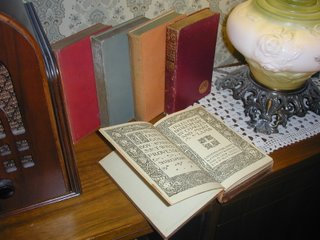
I really like the old Everyman’s Library editions “bound in cloth with gilt design and coloured top,” but they don’t photograph well, especially when the covers are a bit faded.
These are some old books that will be familiar to Ambleside Online users. The yellow book is To Far Cathay, by William C. Bagley Jr., a story of Marco Polo (published in 1935). My schoolteacher great-aunt had it on her shelf for forty years and then gave it to me; both The Apprentice and Ponytails have used it for school. The brown book is Canada’s Story, by H.E.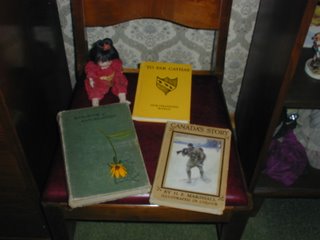 Marshall, part of her Empire Story collection. And the green one is Volume 1 of Anna Botsford Comstock’s Handbook of Nature Study (published in two volumes, this printing from 1924). The inscription in it says “Jennie M. Gaskill, Bryn Athyn, Pa.” Jennie Gaskill was an author as well (there are scattered online references to her), and Bryn Athyn is a bastion of the New Church (the Swedenborgians). But how did the book get all the way up to a used bookstore in Ontario? I was browsing in the nature section (this was several years ago) and thought, wouldn't it be amazing if...and there it was. I pulled it off the shelf, not knowing what it was (the spine is unreadable). (I did look for the other volume too, but it wasn't there.)
Abiding in Thee reminds me of The Country Diary of An Edwardian Lady, except that it’s all Christian verse, illustrated with watercolours of flowers. It was printed in Toronto and has an inscription from 1900 (my great-great-grandmother’s name).
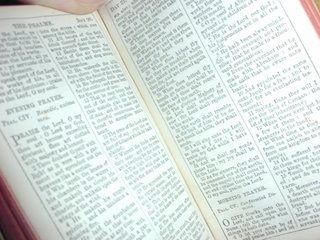
The smallest one is a Book of Common Prayer with metal edges and the findings for a clasp (the clasp is gone though). It was printed in England and it has very small print (I feel sorry for older people trying to make that out in poorly-lit churches!).
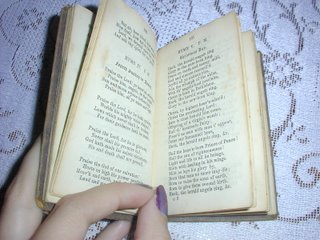
The other small book, the dark brown one, is older; it’s A Selection of Psalms, Hymns and Anthems, with a really interesting inscription: the same great-great-grandmother’s maiden name, and then “Pew No. 30, St. Paul’s Church, Yorkville, C.W.” Do you know what C.W. stands for? Canada West; that’s the pre-Confederation name for Ontario. That date’s confirmed by the book itself: it was printed in Toronto in 1861.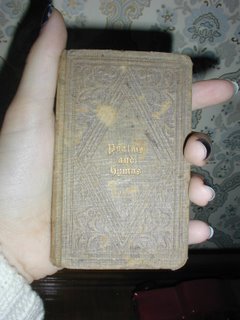
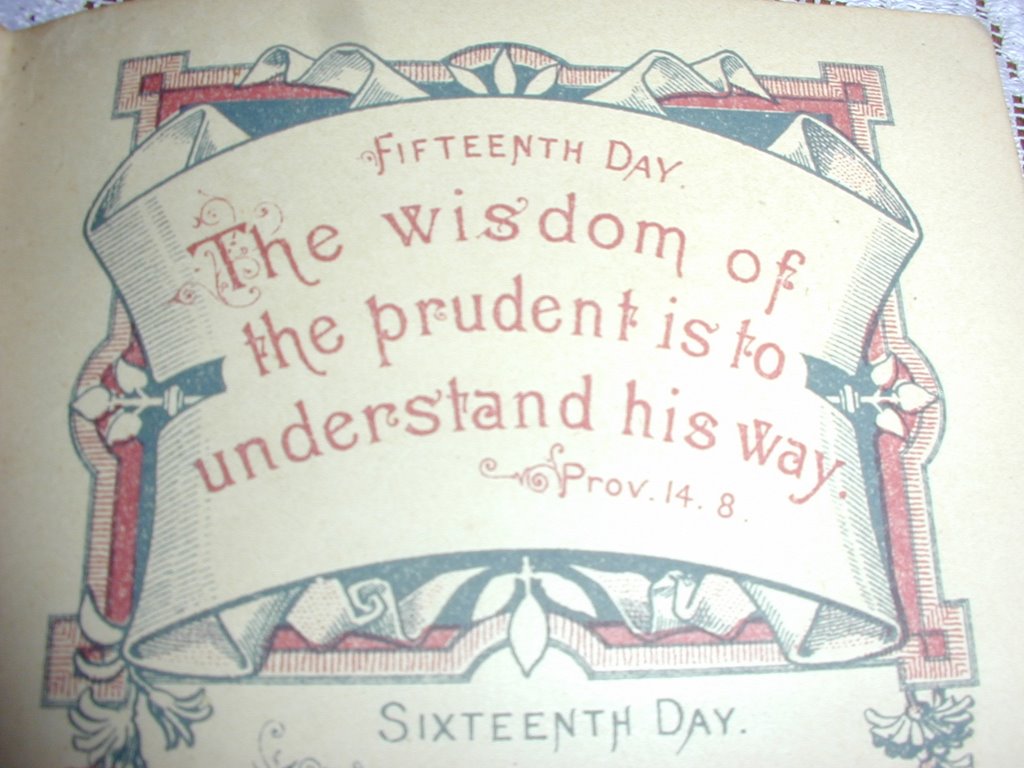
The fourth book is only about sixteen pages long. It’s called “I Am the Way,” from the “I Am Series” published by the Toronto Willard Tract Depository. No date given, although there’s an inscription in the front cover, to my great-grandmother from her cousin Lizzie, so I’m guessing from that and from the style that it’s from around the turn of the last century. It’s meant to be a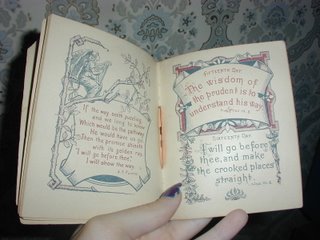 month-long devotional, almost like a copy-book. Each day’s saying or verse is separated by scrolls and borders that make the verses look like framed mottoes in Victorian parlours. One page says, “Fifteenth Day. The wisdom of the prudent is to understand his way. Prov.14.8. Sixteenth Day. I will go before thee and make the crooked places straight. Isa. 45.2.”
Then on the facing page there’s a verse decorated with drawings and borders:
“If the way seem puzzling,
And we long to know
Which would be the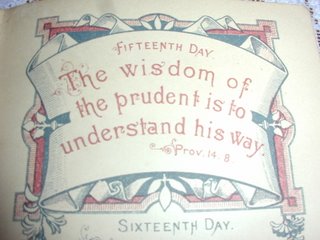 pathway
He would have us go,
Then the promise shineth
With its golden ray,
‘I will go before thee,
I will show the way.’—A.F. Purdon.”
October 1st was a rummage sale at one of those churches that always has good rummage sales, and usually a big book table.
We got there fairly late in the morning, which doesn’t usually matter much. We have odd enough tastes in old things that what we like is usually still there by the time we get moving on Saturdays.
But there didn’t seem to be any books. Strange, but maybe books were too much of a hassle to deal with? So I asked, and they said, “There were lots of books! But someone just came in and bought them all!” Every single book at a church rummage sale? “It’s never happened before! But we couldn’t say no!” Well, it saves repacking all those books that didn’t sell!
But Humph. And I was hoping to post something in response to all those lovely posts of the DHM’s about her library-sale-to-end-all-library-sales. Not the-book-to-end-all-books, of course. Just one or two interesting finds?
Well, I did get an abridged cassette version of David Copperfield. (I guess Mr. Buy-them-out missed that one.)
But since I don’t have else anything brand new (or should I say old) to post about, I’ve employed The Apprentice and her digital photography skills to show you some books that we already had.

I really like the old Everyman’s Library editions “bound in cloth with gilt design and coloured top,” but they don’t photograph well, especially when the covers are a bit faded.
| I have my grandma’s childhood copy of Tales from Shakespeare, so that’s my favourite; the rest have mostly been picked out at used book sales. |  |
These are some old books that will be familiar to Ambleside Online users. The yellow book is To Far Cathay, by William C. Bagley Jr., a story of Marco Polo (published in 1935). My schoolteacher great-aunt had it on her shelf for forty years and then gave it to me; both The Apprentice and Ponytails have used it for school. The brown book is Canada’s Story, by H.E.
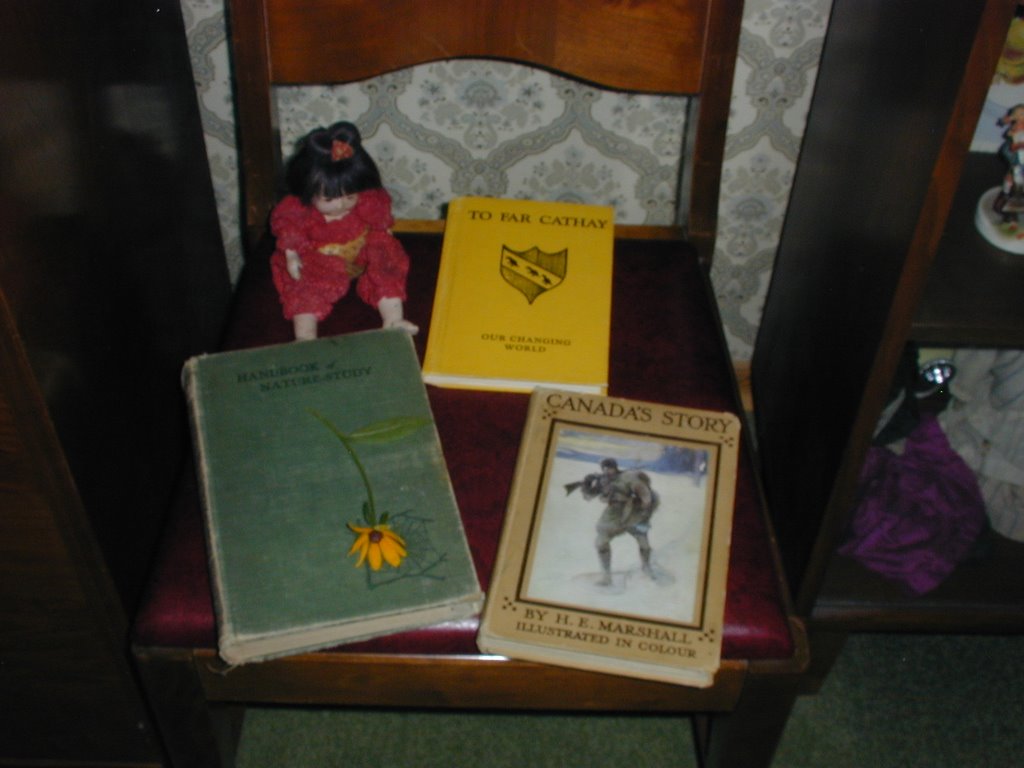 Marshall, part of her Empire Story collection. And the green one is Volume 1 of Anna Botsford Comstock’s Handbook of Nature Study (published in two volumes, this printing from 1924). The inscription in it says “Jennie M. Gaskill, Bryn Athyn, Pa.” Jennie Gaskill was an author as well (there are scattered online references to her), and Bryn Athyn is a bastion of the New Church (the Swedenborgians). But how did the book get all the way up to a used bookstore in Ontario? I was browsing in the nature section (this was several years ago) and thought, wouldn't it be amazing if...and there it was. I pulled it off the shelf, not knowing what it was (the spine is unreadable). (I did look for the other volume too, but it wasn't there.)
| And this is a collection of small books that belonged to the mother and grandmother of that great-aunt. The largest one, Abiding in Thee, is 5 by 6 inches, and the smallest is 2 by almost 4 inches. | 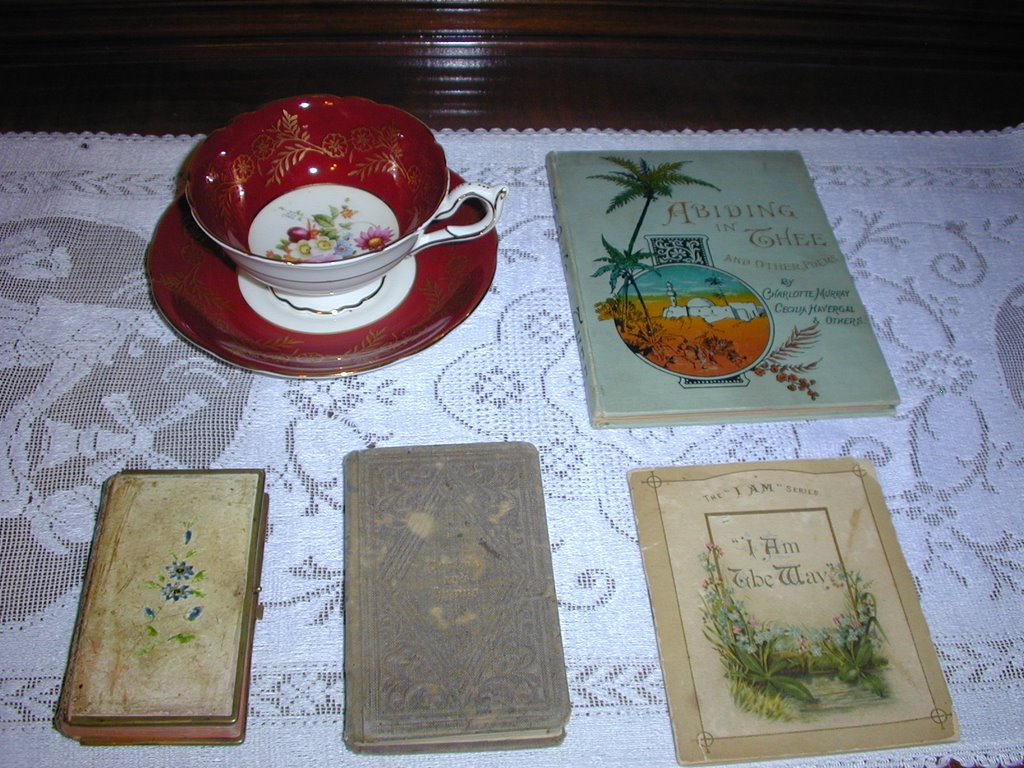 |
Abiding in Thee reminds me of The Country Diary of An Edwardian Lady, except that it’s all Christian verse, illustrated with watercolours of flowers. It was printed in Toronto and has an inscription from 1900 (my great-great-grandmother’s name).
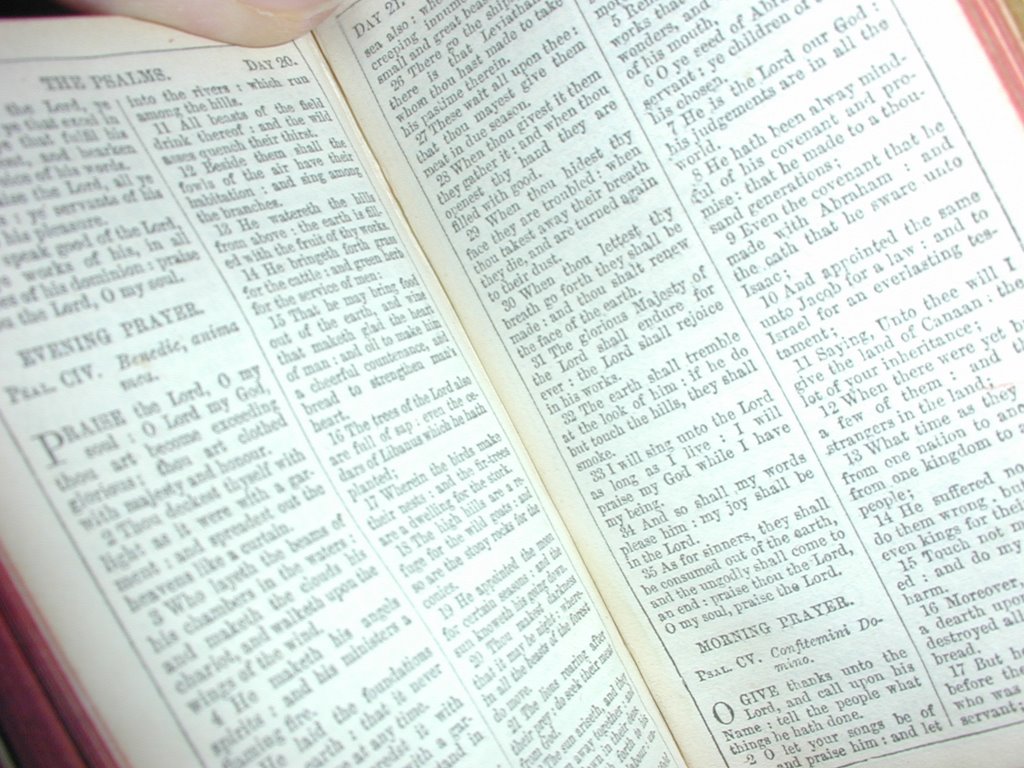
The smallest one is a Book of Common Prayer with metal edges and the findings for a clasp (the clasp is gone though). It was printed in England and it has very small print (I feel sorry for older people trying to make that out in poorly-lit churches!).
The other small book, the dark brown one, is older; it’s A Selection of Psalms, Hymns and Anthems, with a really interesting inscription: the same great-great-grandmother’s maiden name, and then “Pew No. 30, St. Paul’s Church, Yorkville, C.W.” Do you know what C.W. stands for? Canada West; that’s the pre-Confederation name for Ontario. That date’s confirmed by the book itself: it was printed in Toronto in 1861.


The fourth book is only about sixteen pages long. It’s called “I Am the Way,” from the “I Am Series” published by the Toronto Willard Tract Depository. No date given, although there’s an inscription in the front cover, to my great-grandmother from her cousin Lizzie, so I’m guessing from that and from the style that it’s from around the turn of the last century. It’s meant to be a
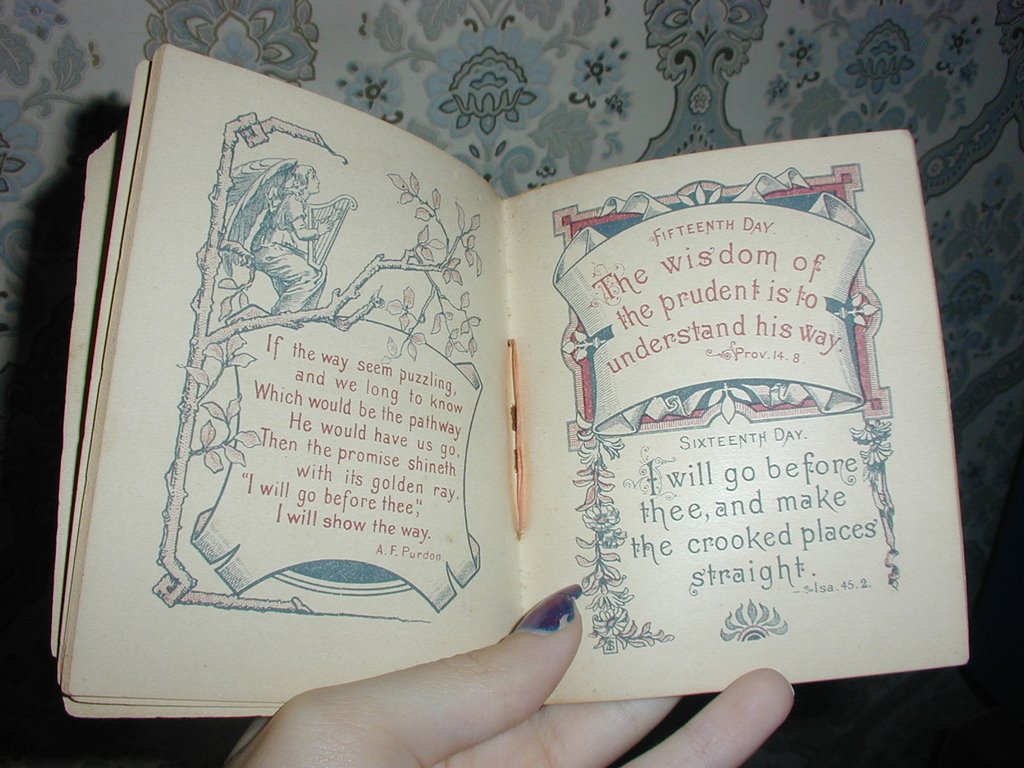 month-long devotional, almost like a copy-book. Each day’s saying or verse is separated by scrolls and borders that make the verses look like framed mottoes in Victorian parlours. One page says, “Fifteenth Day. The wisdom of the prudent is to understand his way. Prov.14.8. Sixteenth Day. I will go before thee and make the crooked places straight. Isa. 45.2.”
Then on the facing page there’s a verse decorated with drawings and borders:
“If the way seem puzzling,
And we long to know
Which would be the
 pathway
He would have us go,
Then the promise shineth
With its golden ray,
‘I will go before thee,
I will show the way.’—A.F. Purdon.”
Subscribe to:
Posts (Atom)