[updated because I forgot to squash the bread]
A long time ago (when the Apprentice was a preschooler), I took some training to be a Community Nutrition Worker. CNWs are “peer support workers” (rather than professionals). They’re usually hired by community centres or other outreach programs to run co-op kitchens or other food-related programs. My career as a CNW was fairly short-lived, but I did learn quite a bit—not so much from the nutritionist who taught the course, but from the other women taking the training. Which is probably the way it should be.
One of the class assignments was to take the contents of an emergency food hamper and explain how it might feed two adults and two children for three or four days. (I think the original assigment was three days, but I wrote menus for four.) There were rules about including three out of four food groups in the breakfasts, and all food groups in the other meals. I don’t remember whether we were allowed to assume that there was any food already on hand or whether there was some cash allowed to buy a few groceries; but I did end up including a few other things which I noted.
I don’t pretend that this is as good as the Hillbilly Housewife’s emergency menu. In some ways, it’s not nearly as good. The food we were given to work with wasn’t particularly economical; it's mostly canned goods and other common food bank items, rather than the bags of flour and dried beans that the HH and the Deputy Headmistress recommend. It reflects a different need: using what you’ve been given, even if that wouldn’t be the smartest way to spend your own money; and (I’m trying to be careful about the way I say this), it also reflects the fact that a lot of food hamper recipients don’t yet have the skills to bake bread or deal with dried beans. Sure, I know those things are not hard to learn; but a lot of people who might be in the situation of getting a food hamper are still a bit intimidated/freaked out/uninterested by the idea of cooking food that doesn’t come in cans. [Update: again, that's not meant to be a condemnation, just an observation. I know there are plenty of very resourceful and savvy people who get into tight spots and need occasional help too.] That was supposed to be the aim of the food programs that CNWs might run at community centres or one-on-one: to gently introduce better economy and nutrition in a supportive environment.
Most of the recipes I used for that assignment came from a 1975 book called The One-Burner Gourmet, by Harriett Barker. I don’t know whether, ten-plus years later, I’d produce the same menus I did then. I wasn’t allowing for what I think of as the “ick factor,” meaning that some people would not care for the idea of mixing things together the way I did. Even in an emergency, I’m not sure I’d be able to eat canned peas straight up, knowing how relatively little nutrition they have for the amount of stomach-clutching it takes to swallow them. But this is what I came up with, plus my notes from then and now. Your comments are welcome.
Contents of a Basic Food Hamper (estimated for 2-3 days use)
[note that this is not a government assistance hamper but something put together by a local charitable organization; the goal would be to have all these things in each box, but that depends on the supply at any time]
Pork and Beans, 2 [cans] per person
Vegetables (Green and Yellow), 2 per person
Mac and cheese, 2 per person
Jam/Honey, 1 per hamper
Soup, 2 (cans?) per person
Juice (48 oz), 1 per hamper
Peanut butter, 1 per hamper (size unspecified)
Cookies, ½ (1/2 of what?) when available
Crackers, ½ (ditto?) when available (I guess they broke open the packages)
Fruit, canned, 1 [can?] per person, (fresh when available)
Potatoes, 5 lb.
Powdered milk, “1 per hamper” (size unspecified, I assume a supermarket-sized bag or box)
Margarine, “1 per hamper” (size unspecified, I assume a pound container)
Pasta/sauce “when available”
Cereal, “1 when available” (size unspecified)
Meat, “3 lunches, 3 suppers, when available” (kind of meat is unspecified—Spam? Tuna? Something not canned?)
Bread, “1 per person” (1 loaf?)
Donuts, when available
Buns, when available
Baby needs on request.
[Just for fun, I priced out the contents of the food hamper using the lowest local prices I could find. It came to approximately $55 Canadian (in the prices of ten years ago), which didn’t seem to be very economical for a weekend’s food.]
Grocery list: peppers or celery, onions (or dried onion), rice or pasta if they weren’t in the box, and tomato sauce if it wasn’t in the box. [Update: I think a dozen eggs would have been a good addition as well, but I was trying for bare necessities.] Food on hand: Mayonnaise or generic white salad dressing, salt and pepper.
We were supposed to suggest snacks, but there wasn’t a lot to work with beyond the obvious bread, crackers and cookies in the box. I said that if honey was provided, they could use it with the dried milk and peanut butter to make peanut butter balls.
Wednesday
Breakfast: 4 oz. juice (per person), cereal with milk, toast and jam or peanut butter
Lunch: Macaroni and cheese (2 or 3 boxes), with 1 can meat (Spam, tuna etc.) chopped in; 2 cans peas. (The One-Burner Gourmet suggests browning the Spam or similar product in margarine first, with fresh or dried onion if you have it, and then adding it to the cooked macaroni.)
Supper: Bean Chowder, made of 2 cans of pork-and-beans, 1 can of tomatoes or tomato sauce, a green pepper or celery, an onion, some margarine (to saute the vegetables first), and salt. Serve with bread (or toast) and milk.
Thursday
Breakfast: 4 oz. juice; toasted peanut butter and jam sandwiches; milk
Lunch: 2 cans soup with crackers; sandwiches made with a can of fish or other meat, plus the mayonnaise or other moistener
Supper: “Lunch Meat and Noodles,” a recipe from the One-Burner Gourmet. You cook these things together: 1 can cream soup, ½ cup milk, 1 can of luncheon meat (cut in strips), ½ a green pepper, chopped (or celery), 1 tsp. dried onion (or some fresh), 1 can peas (use the liquid to add to the dry milk), and 1 tsp. salt. Simmer all this while you cook some noodles or other pasta (you could save out some of the boxed macaroni), and add this to the pot as well. Rice could be substituted. 2 cans of fruit for dessert.
Friday
Breakfast: Fried lunch meat and potatoes; toast; milk
Lunch: 2 cans pork and beans; boiled potatoes; bread, milk, cookies.
Supper: “Soup and Vegetable Chowder,” another One-Burner Gourmet recipe. The success of this would depend on what cans were in the hamper. The recipe calls for 2 cans cream soup, 2 cans chicken soup (like chicken noodle, chicken with rice, etc.), 2 cans corn, 1 can lima beans, 1 can milk (or dry substitute), salt and pepper. You are supposed to add everything together except the milk, simmer for 10-15 minutes, and then add the milk just before serving but don’t boil it. Dessert is something I used to make when I was younger; you cut the crusts off bread, [update: flatten each piece with a rolling pin or something similar], roll them up with jam or peanut butter, secure with a toothpick, and spread a bit of margarine on the outside. Bake them in the oven for a few minutes until they’re toasty. Not fancy, but little kids like them. (Think jam burritos.)
Saturday (the bonus day if the food holds out)
Breakfast: 4 oz. juice; cereal with milk; toast and jam or peanut butter
Lunch: Tuna and Green Bean mixup: A can of cream soup, a can of tuna, a can of vegetables, and enough milk to moisten; doubled if enough food is left in the box. Serve with toast and cookies.
Supper: Whatever’s left: could be potatoes, pork and beans, canned vegetables, and bread. Milk if there’s still some left.
Tuesday, January 30, 2007


Monday, January 29, 2007
Cookie Connections
One of the common themes you hear around homeschoolers is that so many lessons can be taught through real life. One that irritates me is "teach writing by writing thank-you notes." Unless we're getting married or having a baby, most of us just don't have to write that many thank-yous, and I assume that most of our children are in neither position. The other one is fractions-by-cookies. "Make cookies. Look at what they're learning."
Well, yes. But I have an issue with the "just make cookies" idea, besides dental objections. It's true I had my own first exposure to fractions by making cookies with my mother. ("It says put in 1, funny line, 2 cups of peanut butter. What's that mean?") But there's more to math than just recognizing what 3/8 of a cup looks like, or even that if you put two of those together you get 3/4 of a cup. There seem to be an awful lot of excellent cooks out there who still get nervous around fractions. Some of them are homeschooling moms, and that worries me.
One of the most interesting arithmetic concepts--that my teachers somehow forgot to point out in school until we did algebra--is that multiplication, division, and fractions are all interchangeable. Connected. Once you understand this, arithmetic gets so much easier.
Consider 2/3 of 5.
In Miquon Math you learn that the word "of" can be written "x." As in "times." If something doesn't make sense to you with the word "times," try substituting "of." Or the other way around. So 2/3 x 5 is the same as 2/3 of 5, or 5 of 2/3. If you don't know what 2/3 of 5 is, you can figure it out with multiplication. Everybody knows how to multiply fractions, right? (much easier than learning to add them) So 10/3, or 3 1/3. Simple.
Little kids can get "of." You write "1/2 x 10," and they say 5. They've just multiplied fractions.
And then there's that cancelling-out maneuver. When you add this to your arsenal, you have some powerful arithmetic tools going for you. You know what I mean, right?
Like 3/10 x 5/9. Of course you can multiply the tops and the bottoms, and you end up with 15/90. And then you can fool around reducing, and you get 1/6. But sometimes that's a lot of work. So you can cancel out the numbers that criss-cross; and you know why, don't you? Because
3/10 x 5/9 is the same as 3 x 5 over 10 x 9 (I'm not sure how to get those to line up properly).
And you could write that 5 x 3 over 10 x 9; and you could split those back up and write 5/10 x 3/9 . And if you reduced the fractions before you multiplied, you'd have 1/2 x 1/3 = 1/6.
Well, just in case you need a reminder on this--you don't need to go through all that moving around. You can do the same cancelling out by checking the numbers that are criss-cross with each other in the original equation. The 3 and the 9 cancel out, and the 5 and the 10.
The third point I wish my teacher had remembered to pass on is that fractions are also division. The "funny line" is not just a fraction marker, it's a division sign. 2/3 means 2 divided by 3, or how many 3's in 2, or how much pizza do 3 people get if they split 2 pizzas? Obviously they each get 2/3 (you could have figured that out even without doing fractions), but isn't that still kind of mind-boggling? You say 2 divided by 3, you write 2/3, and you already have your answer.
And what's 5/3 of 2? Obviously, still 10/3. 3 1/3.
What's 5 divided by 3? How many 3's in 5? 5/3, or 1 2/3.
What's 10 divided by 3? How many 3's in 10? 10/3, or 3 1/3.
What's 1/3 of 10? 10/3.
Multiply 1/3 x 10/1. 10/3.
Fractions? Division? How come we're doing all this multiplying all of a sudden? Zing: connections.
This is why I like Miquon Math. I like bigger ways of looking at things than the "this year we do multiplication, next year we do division" approach. And that's why I think you do need to go beyond cookies--unless you have an awful lot of them and a very sharp knife.
Sunday, January 28, 2007
An abundance post: Make It Do
Make It Do has always been one of my favourite topics. Except that the phrase Make It Do sounds a bit grim, like Grin and Bear It. I prefer the DHM's question What Do You Have In Your Hand? Or in your cupboard...or on your bookshelf. What DO we have in this camp kitchen to feed the two vegetarians? (I talked the cook into putting some of the soup into another pot before he added meat.) What can we do with all this coloured telephone wire in the craft room? (Braided bracelets for eighty campers.) What would you do with these hypothetical food hamper groceries for four hungry people for three days? (That was for a community nutrition class--and I got a good mark on that one! Nobody else thought of making peanut butter balls...)
What's In Your Hand is Ma Ingalls and blackbird pies. It's popsicle sticks and Cheerios for math, and teaching phonics with a pile of old Highlights magazines. It's all those recipes invented to use up things like rhubarb that really don't taste so good on their own. (OK, I know there are people who chew on raw rhubarb...) It's how Marsha and I once taught Sunday School in a un-child-friendly college classroom: we stuck pictures up with Stick-tack and took them down again every week, brought old couch cushions to sit on and our own toys to play with, and let the kids colour at the adult-sized tables. And they really did manage fine without mini-sized chairs.
It's a dull prairie cabin with sunflowers planted around it. (Virtual sunflower seeds if you can help me remember where that story came from, because I've forgotten.)
Use Your Creativity is about surprise and discovery, instead of just "I suppose I can make do with it." It's Athena's kids retelling stories with Playmobil. It's Ponytails' coloured-pencil drawing to go with Mendelssohn's Fingal's Cave (maybe I can scan that one in). It's Homeschool Radio Shows' Fourth Annual Make-Your-Own-Radio-Show Contest. It's Meredith's closet makeover and tree-frog-painted table. It's two balls of Dollarama yarn that got turned into one pair of slippers (for Crayons), a dolly hat and scarf, and a couple of hair scrunchies. (You couldn't buy all that even at Dollarama for the two dollars the yarn cost.)
Make It Do is combining two or more parts to make something better than a whole. Instead of waiting for the perfect thing to arrive, the perfect homeschool curriculum to be written, or our body to revert to the perfect size, we use what's there. Can we use it a little differently? Do we need to adapt, go faster/slower, make it more challenging, skip the questions or tests, include more hands-on activities? Or should we use just the best part of it? (For Meredith: Every cloud has a cashmere lining.)
We're using a not-perfect curriculum for math; but it doesn't matter that it doesn't cover everything, because there are lots of ways to learn the things that it doesn't include, and it's kind of interesting having a break from the same workbook all the time anyway. Combining resources for homeschool science can make a stronger overall program than trying to pick one perfect textbook or study guide. We just got an Astronomy book for next year's school--but we also have an old Sky Science experiment kit and several books about the solar system, so we'll combine what we have.
And Make It Do is finding new ways to use what you already have. Cutting holes into the bottom edges of a cereal box is one surefire way of getting kids to notice long-neglected marbles (you shoot them at the holes). You can use wooden blocks to build temporary furniture for plastic trolls. You can learn new rules for cards, checkers, or dominoes.
Not what you ordered? Not just what you hoped for? Make it do. And have fun.
Thursday, January 25, 2007
Postscript to Wearing it out: From Complaining to Celebrating
People have been virtually ringing the Treehouse doorbell here all day, thanks to Meredith's mention of this post. We got several comments, too, mostly from people agreeing that a lot of new stuff is poorly made.
But I feel like I did more complaining that celebrating in that post; after all, we are supposed to be celebrating abundance and finding ways to cope.
So here's a list of reasons why we can be thankful even in this age of made-to-break craziness.
1. It encourages us to be thoughtful, careful purchasers; to look for the best quality we can manage, to read consumer guides, to consider what is the best use of our money. It teaches us to appreciate true quality, in everything from produce to clothes to cars. Every year we look forward to our favourite family-run produce market re-opening; it runs only from strawberry time through late fall. We go out there almost every weekend during the growing season, and enjoy bringing home "happy vegetables."
About ten years ago we bought a queensize bed and a loft bed from Crate Designs, and we're still happy with them. They are sturdy, simple, and easy to clean if needed. (The two younger Squirrelings sleep in forty-year-old cream-coloured twin beds that came free with the Treehouse. The only thing I don't like about those is that I'm always banging my thigh on the endposts!)
We bought a quilt for our queensize bed a few years ago, on sale; unfortunately, it turned out to be one of those made-somewhere-in-Asia deals, and the patchwork quickly started coming apart. Now we have a vintage quilt on top instead; not homemade, but still kind of old--and seemingly indestructible.
2. It encourages us to buy simpler styles of things, with a view to having them eventually repaired or re-covered when needed. For instance, we replaced our electronically-controlled toaster oven with a non-computerized model which is easier to fix. (Unfortunately, even the simpler model needed a repair in a sadly very short space of time, but at least we could fix it.) Using the same reasoning, the abundance of here-today fad junk encourages us to buy classic styles and basic colours (in clothing, furniture etc.) so that we don't have to add "out of style" to our other complaints. We just bought a new couch and chair (NOT from one of the super-stores); the couch is a soft medium brown (I can't remember the right name) and the chair (I love it!) is Fudge Brown. What a retro colour--it's perfect in our 1960ish panelled rec room/school room.
3. It encourages us to buy things used--because, compared to what's out there at the store, you're about as far ahead to buy something that's already been through the wash and held up well, or that somebody else has taken good care of and that needs just a small repair.
4. It encourages us to know when to call it quits. Mr. Fixit knows someone who's having extensive body work done on an early '90's car--I won't name the make, but it wasn't exactly a banner year for that car maker. Along with the body work, they're also having cylinder head work done--and it's not the original engine. These repairs are not cheap! The question is, is it worth it to have such extensive work done on a car with such little resale value? Mr. Fixit says that, personally, he would just "drive the car into the ground" without having all the repainting etc. done.
Be encouraged--we just have to be a little bit smarter, and work a little bit harder these days. But we can do it!
Wednesday, January 24, 2007
Abundance post: Wear it Out
[Update: I added some further comments on this here.]
Use it up, wear it out...
There's some debate there about what "wear it out" means. Does wearing something out mean to keep fixing something until there's no place left to patch? Or wear it out as-is, like driving a car full of rust holes and belching smoke out the end? How far do you take this before you give in and replace something that's unsafe, inefficient or just ugly?
I don't think there's one right answer. I do think that "wear it out" includes refinishing, repainting, patching, darning, and replacing parts if you can; it can also just mean squeezing the last out of something. But there's a difference between wearing a sock with a hole in the toe and re-using a worn out baby car seat or a lamp that short-circuits.
Which brings us back to one of Mama Squirrel's favourite rants: how come socks don't last as long as they used to? How come the stroller we bought for Crayons was toast after just one kid (even though it was treated nicely and not dragged through the snow the way The Apprentice's old beast was)? How come the Barbie heads crack off and the new sheets shrink beyond recognition? How come more things aren't user-repairable?
Of course I know why. They're mostly made overseas, as cheaply as possible. The plastic parts snap off at a touch. We're supposed to buy new things, not fix the old ones. Besides, most of us can't be trusted to know how to open the back of something. Or someone thinks we just can't be bothered.
You could say that the joke of "wearing it out" is that most things these days "wear out" without any help, one week past the warranty period. Our stove is on its fourth oven element, and that's not a tribute to our resourcefulness, it's a rant against poor workmanship. (The first time one of the elements broke, it shot sparks out the oven door, made a hole like a cigarette burn in the kitchen floor, and scared me half to death. Since then I keep an eye on the element, and if I ever see any funny red bulges while it's heating up, I know it's time to replace it.)
The challenge now of hanging onto something long enough to wear it out is finding something that's worth wearing out in the first place.
A box of delights
We're already making a good head start on next year's school books; recently I managed to get the next two levels of Making Math Meaningful and Jeannie Fulbright's Astronomy book--both things that were on my list.
Astronomy came in a "box of delights" last week from one of my favourite book-dealing homeschoolers (or is that homeschooling book dealers?), who lives in Western Canada and who's been sending us books now for...I don't know, at least five years, probably more. "I shall always think of her as a benefactress."
This is what was in the box:
MR. PIPES AND PSALMS AND HYMNS OF THE REFORMATION
FATHER MARQUETTE AND THE GREAT RIVERS, by August Derleth.
PLUTARCH'S LIVES. Volume 3 of the Everyman edition. (I had Volume 1, so now Volume 2 is the only one I'll have to keep taking out of the library.)
BOOKS CHILDREN LOVE, A Guide to the Best Children's Literature--the old blue edition, but I'm quite happy with that.
EXPLORING CREATION WITH ASTRONOMY
SEWING MACHINE FUN & MORE SEWING MACHINE FUN. The I'll Teach Myself series, by Nancy Smith & Linda Milligan. (Ponytails really wants to use these.)
FIVE LITTLE PEPPERS AND HOW THEY GREW, by Margaret Sidney. (Remember the crawly thing?)
PARABLES FROM NATURE, by Margaret Gatty.
CHRISTY, by Catherine Marshall.
ARISTOTLE FOR EVERYONE, Difficult Thought Made Easy (I'm tempted to add, For Bears of Very Little Brain). By Mortimer J. Adler. (Wasn't there someone else out there who had this on their lists of books to read, or things they had just read?)
HOW THE HEATHER LOOKS, by Joan Bodger. Yeaaaah!
Monday, January 22, 2007
A book about falling in love
The best book I've read so far this year isn't on my Bookstack Challenge List, but it was on the shelf, so I guess it counts. I'd seen it recommended in one of Terry W. Glaspey's books, and had been meaning to read it for awhile--and one night I just picked it up and started in.
The book is A Severe Mercy, by Sheldon Vanauken, published in 1977. The plot of the story is no secret (just read the back of the book): Van (the husband) meets Davy (the wife); they go sailing; they become Christians; Davy dies; and life goes on.
Oh, and the middle of all that they go to Oxford and become friends with C.S. Lewis.
This is a book about falling in love: intensely, desperately, "intoxicatingly" (to quote Terry Glaspey). With another human being, and with Christ. Van and Davy don't do anything by halves. At the beginning of their relationship, they set up rules that most of us would find extreme: they will do nothing apart, they will have no separate interests or activities that would interfere with or change their love. In their view, that includes having children, since children might cause an imbalance in their two-ness. They are more interested in pursuing both outdoor and intellectual adventures--together, of course.
However, this isn't a brief "Love Story"; the Vanaukens' marriage lasts for about eighteen years, and they become Christians in their thirties. When they start to consider Christianity, naturally they turn to books: the whole Christian literary canon, C.S. Lewis, T.S. Eliot's later poems, Chesterton, Sayers, Newman, the medieval writers. But, interestingly, it's Christians rather than books that help convince them that Christianity might be true. The Christians they meet at Oxford are intelligent, joyful, and not very "Puritan"; they drink wine, spend evenings (often at the Vanaukens' flat) discussing everything in creation, and sing liturgical goodnights to each other at unholy hours. This is community; this is a kind of magic circle that's all the more magical because of the realization that it's both temporary and eternal. Most of the people involved will leave Oxford for whatever comes next; but at the same time there are bonds being formed that will last the rest of this lifetime and into the next. In the same way that Van and Davy first fall in love with each other, the two of them fall in uncontested, unswerving love with Christ; and one of the only points of friction between them is that Davy seems to take her new relationship with the Lord even more seriously than Van does, if that's possible.
One might ask if this love story with Christ is just as much about falling in love with England, Oxford, and stimulating friends, including Lewis, as it is about God. Does that make it less true? Obviously not, because the real test comes when the Vanaukens return to the U.S. (Van gets a college teaching position). Although they are disappointed by mainstream churches and miss England a lot (they drink a lot of tea and find the houses way too warm), God begins to build a growing circle of believers and seekers around them. This part of the story sounds much like the beginnings of L'Abri: a student has questions and comes over to talk; then she brings a friend...I found this fascinating because it proves you don't have to live in the Alps to reach out to people, or even hang a "Knock for Christian inquiry" sign on your door. If God's writing the story, He opens the door at the right time, or at least provides the right person to knock.
All too soon, the partnership comes to an end with Davy's illness and death at the age of forty. In some ways, I found this less interesting (or at least less surprising) than the first part of the story, although it continues to show the Vanaukens' devotion both to each other and to the Lord. (At one point, Van coaxes Davy out of a coma by talking to her for hours on end.) The last part of the book focuses on the period afterwards, especially on Van's continuing correspondence and friendship with C.S. Lewis, through the time of Lewis's marriage and then his death.
Would I want a marriage as intense as the Vanaukens'? Not if it meant forgoing our children--but they made that decision long before they became Christians. (Did they ever reconsider their choice?) Still, there's much to learn from them about love that serves the other person's needs and pushes aside a lot of the small daily irritations, just for the sake of the relationship. The detailed discussions on faith (including C.S. Lewis's letters to Van) are worth reading and re-reading; we are privileged to observe great minds sharpening themselves on each other. Sheldon Vanauken's descriptions of that time at Oxford are so good that we can almost feel like we were there, on one of those unforgettable winter nights with bells ringing out all around.
Blinky-blink Carrot Cake (trying to get it right)
I used to keep a scrapbook-cookbook with cartoons pasted in among the recipes. One of my favourites showed a lady baking something in her kitchen, and a lot of rabbits hopping around the table and more coming through the window. Her husband comes in and says something like, "What the blinky-blink are you making?" She says (of course), "Carrot cake."
The carrot cake recipe I've used for the last while is...okay. It's fairly healthy, if a bit dry and slightly boring; you can eat it for breakfast without guilt. It reminds me a bit of The Hillbilly Housewife's Cinnamon Raisin Bars (which are very tasty), with carrots instead of raisins. But it isn't CARROT CAKE...do you know the kind I mean? The kind you'd make a trip to Mother's Pizza for when you weren't even having pizza; the kind smothered in cream cheese icing; the kind that's moist and carrotty and nutty all at the same time; the kind my mom baked for our wedding.
So I pulled out about five different recipes for carrot cake, from the sweetest, highest-fat '60's version to more recent Betty Crocker and Canadian Living recipes. And I think I have the basics pretty much figured out, along with the reasons why the one we've been making is a bit on the austere side (besides the fact that I don't ice it).
The basics of a "regular" carrot cake seem to be: 2 cups flour; 1 1/2 to 2 cups sugar (can be half brown); either 3 cups grated carrots or 2 cups carrots plus 1 cup drained crushed pineapple; 2 tsp. cinnamon; a bit of salt (anywhere from a pinch to 3/4 tsp.); 3 to 4 eggs; 1 tsp vanilla; around 1 cupful of oil; and something to raise it with (which seems to be a point of debate). Some people add chopped nuts; some add 1/4 to 1/2 teaspoon nutmeg. You mix the dry and wet ingredients separately and bake.
The "something to raise it with" varies from either 1 to 2 tsp. baking soda, alone, to 2 tsp. baking powder plus a tsp. of baking soda; to 2 tsp. of each. Other than making a lot of test batches, I have no way of proving which is the best combination, other than the fact that Canadian Living's "best" recipe calls for 2 tsp. baking powder plus 1 tsp. soda. (Link is broken! Yes, I know. Correction in progress.) Maybe it doesn't matter a whole lot.
The pan sizes given vary a lot too, in spite of the fact that all the recipes I compared were based on 2 cups of flour. I've been baking our less-fat recipe in a 9 x 13 inch pan, but some of the recipes say to use an 8 or 9 inch pan instead (which makes sense, because when I bake a standard batch of muffins in a square pan it comes out right). That might be part of the problem right there--the cake's getting more spread out and a bit dried out.
The recipe we've been using is also from Canadian Living, but it was designed to be lower fat; the oil is cut to 1/3 cup and you add a cupful of applesauce to make up the difference. The flour is increased to 2 1/3 cups (half whole wheat), which might explain why it's a bit dry; but the sweetener is cut to 3/4 cup of brown sugar, and the carrots, for some reason, are cut to 2 cups (without any pineapple). Maybe if you added in the pineapple, it would taste better even without the added fat and sugar. But no guarantees. I think I'm going to try it (in a square pan)with 1 1/2 cups sugar and 3/4 to 1 cup oil, plus the pineapple, and we'll see if we have to beat off the rabbits.
Monday, January 15, 2007
This is A Day That Really Schmecks
 Today's the day! It's also the day that would have been Edna Staebler's 101st birthday. In honour of that, and to celebrate the reissue of her first cookbook, Food That Really Schmecks, Jasmine at Cardamom Addict organized a good-schmecking roundup of recipes. I counted (I think) eleven bloggers who are linked from Jasmine's page, including our Schnitz Pie post.
(It sounds like there might even be a Part Two featuring other bloggers who heard about it and wanted to participate. If you're interested, please read this.)
Happy birthday to Edna. And thanks again to Jasmine and WLU Press for sponsoring this.
Monday, January 08, 2007
Paper and scissors rock
I started a post about some new things I wanted to use this term, things we already had that I wanted to start using or make better use of. A hands-on math book, a set of notecards, an explorer biography, a craft book. And I said there were other things on the list--not books.
I wanted to finish the post, and tried to name those other things that I was going to use to zip up our winter homeschool. The list went something like this: Tape. String. Paper. Bible. Markers.
Not exactly earth-shattering!
But it struck me that sometimes we're looking for poprocks in our school shopping bags, and overlooking things that are less explosive but just as useful.
For instance, we have an ancient history timeline in the kitchen. It's been there all this school year, and it's been looked at (it's agreed that Cleopatra is beautiful and that Nero and Socrates are ugly). But the print on the events is pretty small and I thought the fourth-grader needed a boost in making sense of what's on it. So this term we are going to add construction paper tags, not right on the timeline but above and below it, attached with string. (Tape to hold the strings on the back of the tags, and stick-tack to hold the other ends to the timeline.) And not one but two colours: one colour tags for Bible events (we're reviewing David and Solomon and then going through some of the kings of Judah), and another for the stories from Hillyer's A Child's History of the World (we're moving through the Assyrians, the Babylonians and the Persians and will be getting to the Persian Wars and the golden age of Greece). When the two colours cross over, so much the better!
We have two books of French stories--actually very short English stories that were translated into French. They are useful for teaching vocabulary and a bit of grammar. We've acted out the stories with toys, printed out sentences from them, and made up our own version of worksheets to go with them--usually drawing things from the story or illustrating new sentences we've made up with the story vocabulary. This term we'll probably only get through three stories, two short and one a bit longer, but that's all right. The first one is about a snowbear (not a polar bear, a bear made of snow) and has lots of body-parts vocabulary (She rolled a head. She put on a nose, etc.). So I'm going to dig out the felt board (homemade a long time ago) and make some construction-paper snowbear pieces to help tell the story. (Construction paper works as well as felt does, and it's much easier to cut.) Then on other days I'll ask Ponytails (and maybe Crayons too) to draw her own snowbear and label the parts in French. (Maybe Crayons will do it in English.) One day we'll practice some French phonics from the story (the difference between vit, petit and vite, petite). We'll play Simon dit (Simon says) to help with body parts, and sing the French version of Head and Shoulders, Knees and Toes. And that's it--no CD-Roms in this program, but it seems to work.
I'm going to have Ponytails (the fourth grader) make a Stick Book of Area, Perimeter and Circumference (topics from Janice van Cleave's Math for Every Kid). I'm not sure if Stick Books appear online anywhere; I got the instructions from The Ultimate Lap Book Handbook by Tammy Duby and Cyndy Regeling. Better than stapled books, better than Duotangs: all you need are pages made from cardstock (we have some already from the dollar store), a hole punch, a rubber band, and a popsicle stick. The book is held together by a rubber band threaded through two holes punched in the pages, and that's held down by a popsicle stick. Revolutionary!
Paper. String. Imagination. You can't lose.
Saturday, January 06, 2007
Changing Spaces
The mom-fashion blog Space Between My Peers (I posted about it a few weeks ago) has moved to a new domain here. Check out the new Month of Sundays feature!
Friday, January 05, 2007
The Contest is on.
 Attention all Neopets users: join the firtree20 Signature Contest! What am I contesting? Siggy pets!
Example:
~()*>Mouse
Mouse Face
() ()
 * *
  V
The rules are simple, and the contest is within the Neopets rules...there are no prizes (no, not even a Pile of Sludge!), and it doesn't even have to be original! Details here.
(Chia picture from www.neopets.com. Copyright 2000-2007 Neopets, Inc. All Rights Reserved. Used With Permission.)
Abundance in Homeschooling
The conference workshop I'm going to be doing in March is about using thrift shop finds and other free and inexpensive materials as homeschool curriculum. Here are some things that I'm planning on using [in our own homeschool] in the near future--things that have been on the shelf or that I haven't thought of using for school before this.
1. On Foot to the Arctic, by Ronald Syme: a biography of Arctic explorer Samuel Hearne, the first European to reach the Arctic coast. The cover's old and dull, but how can you not like a biography that starts:
"The English county of Somerset was a good place for any boy to live. The streams which flowed through the fine green meadows were filled with small trout and perch. In forest glades of oak and elm and ash, big cock pheasants made an easy target for anyone expert with a sling and able to dodge the prowling wardens. In the kitchens of the white-walled farmhouses, great joints of beef frizzled gently in copper pans, and the warm air was filled with the aroma of smoked ham, cheese, fresh butter, and sweet West Country honey."
2. Janice Van Cleave, Math for Every Kid. A thrift shop copy! I think Ponytails has had enough of the four operations for awhile, so I'm considering making this a more hands-on math term with lots of measurement. The activities in this book seem pretty do-able, although the vocabulary will be challenging.
3. Beanbag Buddies and Other Stuffed Toys. Also a thrift shop find, although these Kids Can books are readily available. Two patterns in this caught my eye: Baby Chicks made out of fabric and put into felt egg shapes (we will probably do that closer to spring), and "Buttons Bear" made out of old denim--a good way to practice sewing on buttons.
4. A Bisquick cookbook (from the grocery store a long time ago). This would be fun to use with homemade biscuit mix (maybe we could spring for a box of the commercial mix and compare results). We could make cinnamon rolls, muffins, and pizza (recipes from the book).
More coming, this is just a start! (My list isn't all books, but these came up first.)
Why the Book Stack Challenge is going s..l..o..w
I signed up nonchalantly for the Book Stack Reading Challenge, but I haven't finished even one of the books on the list. Parts of several of them, but none of them done. On the other hand, since the challenge started I've finished a Paddington book, Elin's Amerika (about Swedish pioneers), The Thirteen Clocks and The Wonderful O with Ponytails; and read quite a few picture books with Crayons. We've also started Grey Owl's children's book Sajo and the Beaver People.
Not the same thing?
Well, the other problem is that a couple of the books I picked are tough ones. Rewarding, but tough. I'm still on page 20 of Northrop Frye's The Great Code. It's something like his Educated Imagination--some of the same ideas--but not written for a radio audience. Like reading C.S. Lewis's Mere Christianity and then digging into one of his more challenging books. They're both worthwhile, but different experiences.
The Great Code is one of those books that builds up its own vocabulary as it goes, so you have to take it a bit at a time and keep going back to the definitions of things--like reading a Russian novel where people keep coming in who were introduced a hundred pages back.
Here's one of the ideas that you kind of have to stop and chew on in the first chapter. Is "God" a noun or a verb?
"In Exodus 3:14, though God also gives himself a name, he defines himself (according to the AV) as 'I am that I am,' which scholars say is more accurately rendered 'I will be what I will be.' That is, we might come closer to what is meant in the Bible by the word 'God' if we understood it as a verb, and not a verb of simple asserted existence but a verb implying a process accomplishing itself. This would involve trying to think our way back to a conception of language in which words were words of power, conveying primarily the sense of forces and energies rather than analogues of physical bodies. To some extent this would be a reversion to the metaphorical language of primitive communities....But it would also be oddly contemporary with post-Einsteinian physics, where atoms and electrons are no longer thought of as things but rather as traces of processes. [In contemporary culture and language] God may have lost his function as the subject or object of a predicate, but may not be so much dead as entombed in a dead language."--Frye, p. 18So I don't know if I'll get through this challenge. Maybe I can get through just this book, "call it Sam and be done with it," as the Hillbilly Housewife says.
Thursday, January 04, 2007
Abundance
[Followup posts on this topic are Bring on the Marching Band (Use It Up,) Wear It Out, a postscript to Wear It Out, Make It Do, and Do Without.]
Meredith's post on Frugal Storage Solutions pointed me towards Sallie's new focus on Abundance for 2007 at A Gracious Home, and her first post this year about that. (Sallie's blog is sometimes a bit slow to load for me, but it's really beautiful. If you have trouble accessing the "focus on Abundance" page, you can click on it from her second post.)
"Abundance." What a good way to balance the more negative word "frugality," to celebrate what we have rather than searching for more, for something else. Yes, it's easy for me to say that this week, after what feels like a very "abundant" couple of months here. This week we got some much-needed (yes, it was needed!), brand-new furniture for our recroom/schoolroom, after years of sitting on something that was sagging closer and closer towards the floor. Cards still stuck to the doorframes remind me of our abundance of friends. There's pumpkin cake on the counter and a roast in the freezer. I have a warm coat (if it ever snows here again) and a watch that works (even if it needs a new strap).
We also have daily reminders of God's true abundance that transcends the perishable blessings. Couches eventually sag, food is eaten up, and our physical bodies betray us, but there is more beyond those things. We get updates from an in-real-life friend battling cancer, and from another homeschooler I know only online but whose struggles with illness are no less real and distressing to read about. The updates from both families continually speak of God's goodness and the blessings He shows during times of adversity.
Ann's ongoing list of gifts from God was a good reminder of how we celebrate God's abundance in everything from bananas and nylons to eternal life. I don't know if Ann's thankfulness "that hair grows again" was meant in response to a bad haircut, but someone at church last Sunday happened to mention her own thankfulness for that very thing--because she went through chemotherapy (and a time without any hair) several years ago.
So I'm in on this "Year of Abundance" too. Sallie says her aim this year, rather than not buying anything, is to make do and use what she has; for instance, enjoying the games in the closet and the books on the shelf rather than looking for outside entertainment. Meredith's post reminds us that, even in organizing what we have, we can use other things already around (a purse, a clay saucer, a nail) rather than buying more plastic containers. (Side note: Mr. Fixit went out yesterday looking for plastic shoeboxes and couldn't find any good quality ones anyway. What's happening out there?) I'll continue to post when I can on this theme, and Sallie is organizing a system of links from her website to other bloggers.
Let's celebrate abundance--and live abundantly this year.
[A postscript: A blog that always reminds me of enjoying life through adversity is Momma's Corner. Momma is a 70+ blogging grandmother, and she tells it like it is.]
Wednesday, January 03, 2007
A Pie That Really Schmecks
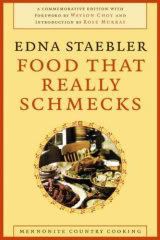
(This post is part of the Day that Really Schmecks blog round-up, in honour of the late author Edna Staebler and the reprinting of her first cookbook, Food That Really Schmecks, by Wilfrid Laurier University Press. The round-up is hosted by Jasmine at the Cardamom Addict blog, and will officially take place on January 15th. Thank you very much, Jasmine and WLU Press!)
I first saw Food That Really Schmecks in our school library when I was twelve or thirteen. I’m not sure what relevance the librarian thought it had for seventh and eighth graders, but I found it on the shelf and wanted a copy of my own. Like Edna’s, my own background was a hodgepodge of Waterloo County (Ontario) cultures. Like Edna, I had some pioneering Mennonite great-something-great-grandparents. And I grew up in a community that reflected not only the historical side of Edna’s cooking (the bean salads and elderberry pies) but what I think of as the Church Lady side of her food: potluck suppers; bazaar baking and fudge-making, and tables of chili sauce and rhubarb jam for sale; church card parties and strawberry socials.
I did get a copy of the book, along with More Food That Really Schmecks which came out right about then as well. And I cooked and baked a lot of those recipes over the years: cookies, breads, pies, even a few of the oddities like Wieners and Buttons.
Edna and my grandma were about the same age, and much of the food in that 1968 book could have come right out of Grandma’s kitchen. I’d never seen a recipe written down for noodle potpie (Edna called it Hingle Potpie), which Grandma passed on to us as a kind of kitchen art form, showing us how to drop the noodle dough in just where the chicken broth was boiling, and lamenting that her noodles weren’t thin enough to have passed muster with her own grandmother. (Mr. Fixit’s Schwabian grandmother made a similar chicken dish with homemade noodles she called Flekele.)
 Grandma also made pies—strawberry, elderberry, and Dutch Apple. I’m still trying to define what makes a Waterloo County Dutch Apple or Schnitz pie different from any other recipe (and it’s not the same as the Dutch Apple pie Wikipedia describes). Edna includes at least three different recipes for Schnitz Pie in her book, plus another simply called “Dutch Apple Pie.” Our Dutch Apple is a single-crust pie, and I think it’s richer than “regular” (double-crust, all-American) apple pie. Grandma’s version is pretty close to Edna’s “Cream Schnitz Pie,” although I don’t have exact amounts, just my mom’s description of how to make it. The version that I make myself (usually when I can get really good apples in the fall) is her “Cream and Crumb Schnitz Pie.” Both recipes are included here with permission from the publisher, as part of this blogging event.
[The recipes are typed as they appear in Food That Really Schmecks, including the WOW! at the end. I’ve include a couple of family notes in the Cream Schnitz version.]
Cream Schnitz Pie
Pastry for one-crust, 9-inch pie
5 or 7 apples—depending on size
3 tbsp. flour
1/8 tsp. salt
1 cup thick cream—sweet, sour, or on the turn [my mother says that Grandma preferred “rich milk or light cream”]
¾ tsp. cinnamon
1 cup sugar
Combine ¾ cup of the sugar, flour, salt and the cream and beat until smooth. Peel and core the apples, cut them in schnitz [slices] and arrange prettily and closely in the pastry shell. Pour the cream mixture over the apples. [Grandma's method was slightly different; she mixed the dry ingredients and sprinkled most of them in the bottom of the crust; added the apples; and then said to “pour just enough milk so you can see it coming up over the apples.”] Mix the remaining ¼ cup sugar with the cinnamon and sprinkle over the top. Bake at 425 degrees for 10 minutes, turn heat to 350 degress and bake half an hour till the apples are soft and the filling is set. Watch it. [I assume Edna meant to watch it in case it burns, but my mom reminded me that you should also watch this kind of pie because it has a tendency to bubble over a bit and make a sticky mess in the oven. She recommends putting a cookie pan or foil underneath to catch any drips.]
Cream-and-Crumb Schnitz Pie
“If you want to have it both ways [cream and crumbs], try this one.”
Pastry for one-crust, 9-inch pie
Enough apples to fill up the pie shell
1 cup brown sugar
3 tbsp. butter
1/3 cup flour
2/3 cup cream—sweet, sour, or turning
¾ tsp. cinnamon
Mix butter, sugar and flour into crumbs. Sprinkle half in the bottom of the shell. Peel and core the apples, cut them in schnitz and arrange them on top of the crumbs. Mix half the remaining crumbs with the cream and pour the mixture over the apples. Finally, mix the cinnamon with the rest of the crumbs and sprinkle these over the top. Bake at 425 degrees for 10 minutes, then at 350 degrees for about half an hour. WOW!
----*----*----*----*----*----*----
I met Edna Staebler once or twice at book signings, but it wasn’t until 2002 that I wrote to let her know how much her cookbooks had meant to me. I was delighted when she wrote back, in a note that sounded like she was still very much herself—“at almost 97.”
“3:44 a.m., Nov. 22. Thanks for your wonderful letter about my Schmecks books—it is so enthusiastic and well expressed. Twelve hours ago I had a molar extracted, it is very painful and I can’t sleep—your mention of hingle potpie and all the other things you enjoy makes me hungry. I’ll be sipping nothing but soup for awhile—Fortunately I have friends who kindly bring me some they have made & frozen.
“Keep eating well as long as you can. At almost 97 I must be more cautious—but I’m lucky and [grateful?], & will eat heartily when the tooth heals.
“Sorry to tell you all this.
I just read your letter over again, it makes me feel better to think of all those good things to eat. Maybe in a few days----Edna Staebler.”
Tuesday, January 02, 2007
Carnival of Homeschooling is up
That's the one-year anniversary edition! Congratulations!
And Binary Dollar hosts the New Year's Festival of Frugality.
And Binary Dollar hosts the New Year's Festival of Frugality.
Monday, January 01, 2007

Things I gotta do
I'm not making a list of resolutions, but I do have a list of projects, big and small, that need attention. Some of them are fun, some of them are just things to do!
Here are a few of them:
Work on the Plutarch notes for this term; we're doing Themistocles. (I'm caught up! Last term's notes are done! Hurray!)
Get ready for a special kind of blog carnival coming up soon: A Day That Really Schmecks, in honour of Food That Really Schmecks author Edna Staebler.
Use these Constable notecards I bought to do picture study this term with the Squirrelings.
Get ready to do a workshop at a spring homeschooling conference. Okay, I know it's three months away, but I'm already looking forward to it!
Make dentist appointments for everybody. Clean out the cupboards. Sort out the school supplies. Send a note to my Secret Sister at church. Play ping pong with Mr. Fixit.
Have the Blue Castle inhabitants over for an afternoon.
And there are so many books I want to read: my Book Stack list (I really don't know if I can keep up with this challenge), Paradise Lost, and Coffeemamma loaned me a volume of the Miss Read books.
Big and little things, tomorrow and three months from now--they will all form part of the pattern that's shaping into 2007. I hope at least the really important ones get done, and the rest...well, I'll try to make time for cleaning the cupboards too.
You know Christmas is over...
...when all your plastic containers are suddenly empty.
...when all the Scotch tape (what's left of it) is suddenly back in the tape and scissors drawer.
...when all the Scotch tape (what's left of it) is suddenly back in the tape and scissors drawer.
Welcome to 2007
We don't usually go out to parties or church services on New Year's Eve; we usually have a just-us party here. Often it's a theme; last year we had a Narnia party. This year there was no real theme, but we did have a fun menu of things that we usually walk right by at the grocery store. Frozen fried rice and eggrolls, frozen chicken wings, pretzels, fishie crackers, carrot sticks, banana chips, sparkly cranberry juice in wine glasses, and Vachon Jos. Louis cakes. Then we lit our Christmas candle, finished reading Henry Van Dyke's story The Other Wiseman (it took us four nights), and read the last chapter of Revelation and the 150th Psalm. Grandpa Squirrel arrived for ping pong (we are lucky enough to have a table in the garage), and the younger Squirrelings and I watched some of It's a Wonderful Life before they want off to bed. Mr. Fixit, the Apprentice and I stayed up till midnight talking about budgets (Mr. Fixit always does a family accounting at year's end) and watching The Musgrave Ritual, and then a few minutes of Happy New Year's, pouring rain and fireworks from Niagara Falls.
Sunday, December 31, 2006
Treehouse Recipe Index for 2006
[Reposted and updated]
Here's a roundup of the recipes we posted this year on Dewey's Treehouse. I didn't include the ones that were only given as a link. And I should note that most of these aren't original: they came from Food that Really Schmecks, Whole Foods for the Whole Family, The Harrowsmith Cookbook, Vegetarian Times, Canadian Living, and friends who like to cook.
[Update note: one might THINK, especially after viewing the November and December recipes, that we eat nothing in the Treehouse but chocolate. Mama Squirrel thinks that would be nice, but it isn't true. As our New Year's Resolution, we promise to provide a few slightly more healthful recipes in 2007.]
January
Kitchener Special
Kasha-Vegetable Pilaf
Sugar-free Banana Prune Bread
February
Subversive Tuna Recipe (Tuna Wrap-Up)
Raisin Sesame Cookies
March
Cocoa-Ricotta Cream
Beef and Green Bean Stir Fry
Dulcie's Macaroni Meal in a Skillet
April
Good Friday Kiffle (or Kolacky or Kolache)--one of our most-Googled recipes
May
Coffeemamma's Sour Cream Rhubarb Muffins
July
No-Bake Brownies
August
Hungarian Stew
Swiss-Cashew Salad, Our Version
Serendipity and the DHM's Chicken Recipe
September
Tofu Chocolate Pie
October
Cranberry-Apricot Loaf
Pumpkin Gingerbread Snacking Cake
Edna Staebler's Glorious Golden Pumpkin Pie
November
Small Chocolate Cake
Rather Retro Recipe (Lemon Dessert)
Jam Bars
Chocolate Fingers
December
Christmas Day Lunch (Jiggle Bells and Star of the East Salad Plate)
Chocolate-Apricot Confections
Chocolate-Hazelnut Slices or Crescents
Our 2005 Recipe Index
Saturday, December 30, 2006
Of Smarties and Lune Moons, and things that are no good for you
If you're outside of Canada, here's a site offering favourite Canadian groceries shipped wherever you happen to be! Although I didn't think that Cheerios and Kraft Dinner were uniquely Canadian.
If you're looking for the Smarties, you'll have to look under Chocolate Bars, for some reason, not candy.
I liked this page of Vachon Snack Cakes--Canada's answer to Little Debbies. They were pretty common lunchbox currency when I was growing up: Flakies, Jos. Louis, and Lune Moons. Actually they're called 1/2 Moons, but because of bilingual packaging (you can see it in the photo there), we always thought they were called Lune Moons.
And of course Viva Puffs and Wagon Wheels--more childhood stuff that we (very occasionally) buy, supposedly for the kids. (Dare Ultimate Fudge Cookies are one of Mr. Fixit's deepest, darkest secret cravings. But don't tell him I told you.)
Friday, December 29, 2006
The ultimate run-on sentence
One of Mama Squirrel's ongoing projects involves writing study notes for some of Plutarch's Lives. It's challenging but enjoyable; I probably learn more by writing the notes than people do by using them. Anyway, everybody complains about Plutarch's very long sentences, and Mr. Dryden's English translation does nothing to alleviate those. (I don't think Plutarch's Greek has punctuation at the ends of sentences anyway, but somebody can correct me if I'm wrong.)
Anyway, I came across a doozy of a Plutarch sentence this morning, and I wondered what the English composition teachers would make of this one.
Anyway, I came across a doozy of a Plutarch sentence this morning, and I wondered what the English composition teachers would make of this one.
Maybe Plutarch worked for the ministry of education in his spare time."These measures he carried in the assembly, against the opposition, as Stesimbrotus relates, of Miltiades; and whether or no he hereby injured the purity and true balance of government may be a question for philosophers, but that the deliverance of Greece came at that time from the sea, and that these galleys restored Athens again after it was destroyed, were others wanting, Xerxes himself would be sufficient evidence, who, though his land-forces were still entire, after his defeat at sea, fled away, and thought himself no longer able to encounter the Greeks; and, as it seems to me, left Mardonius behind him, not out of any hopes he could have to bring them into subjection, but to hinder them from pursuing him. "
Thursday, December 28, 2006
Around the holiday Blogosphere
Or post-holiday, for some people. At the Treehouse, it's still the Twelve Days of Christmas, and some of the Squirrelings are getting over Christmas Day coughs and sniffles. So we haven't been doing too much.
But everybody else seems busy!
Krakovianka is crocheting.
Ann and her children are sewing corn-filled warming bags.
Meredith is yardsaling and blowdrying her hair. (Too many good posts there to link to all of them.) (I like those vintage thank-you cards! I bought a bag of old cards like that at a rummage sale, but they're mostly 1960's get-well and sympathy cards! Not so useful.)
The Deputy-Headmistress continues her series on Victorian homekeeping with Aunt Sophronia.
Tim's Mom tells about their Christmas and shares a not-too-spicy cookie recipe. And Tim thinks the message of Christmas is just bananas.
Clothespin Doll Kits
(Continued from this post)
Or, if you give a mom a Ziploc... Inspired first by JennyAnyDot's dolls, second by a simple request from Crayons ("Mommy, don't we have any clothespins so I could make a clothespin doll?"), and third by the fact that stocking stuffers were hard to find this year, I decided to drop some craft-store clothespins and doll stands (the wooden rings to make them stand up) in the two youngest Squirrelings' stockings. Breaking up a package of each meant they each got about a dozen pegs and eight or nine stands.However, I was betrayed by my large-sized ziploc bags, which called out for...I don't know...oh yes, how about if I put some of those old fabric swatches in there with them, maybe in a snack-sized ziploc? (A long time ago, I used to get fabric samples by mail, and I saved all the mini-swatches--some of them have lovely colours and textures.) And in the box with the swatches there were some old bits of embroidery floss too...I put half in each kit. And, oh yes--we went to a wonderful yard sale in the summer where I picked up a lot of OLD mini-packs of sequins, tiny plastic rings, spangles...so I emptied a few of those yellowed cellophane bags into two more snack-sized bags. Getting a bit bigger by now...what else should go in? I printed out some doll-making instructions from the Our Canadian Girl website and tucked those in--and noticed that they suggested felt. OK, we did have some felt sheets (left over from making the Glorious Coming ornaments). Uh oh...between the felt sheets and the printouts, these kits were no longer what you'd call little stocking stuffers. And I had managed to pick up a few more things for the stockings in the meantime. So let them stay big! I printed out a label for each kit, leaving a long tail at the bottom, and folded them around the bottom of the felt sheets in the bag so that they'd stay upright.
(At this point Mama Squirrel was having so much fun and was so impressed with the way these turned out that she was about ready to go into the doll-kit-making business full time. But it was Christmas Eve afternoon and there were a lot of other things to do...besides, that took most of the felt. :-))
The only question that remained was what to do with these now-kind-of-bulging Ziploc bags. There were already presents wrapped from Mommy and Daddy, and we are not too much into wrapping things up just from Santa. Stockings, yes, but he doesn't go overboard around here.
Then Mr. Fixit had the best idea: label each one from each girl's favourite doll or stuffy. So that's what we did. And they were very happy with them.
Wednesday, December 27, 2006
It's snowing!
And I'm actually happy to see it.
You can't see this on my avatar, but there's snow falling in the background. (When the avatars show up here, they lose all the effects like flickering lights.)
You can't see this on my avatar, but there's snow falling in the background. (When the avatars show up here, they lose all the effects like flickering lights.)
Monday, December 25, 2006
The Light
Arise, shine; for thy light is come, and the glory of the LORD is risen upon thee. -- Isaiah 60:1
Sunday, December 24, 2006
A Christmas Meditation
What does the Christmas story teach us about safety and security?
Esther Epp Tiessen ponders that question in this Christmas meditation on the Mennonite Central Committee website. (2008 update: the link is broken, sorry.)
Have a happy and peaceful Christmas.
Esther Epp Tiessen ponders that question in this Christmas meditation on the Mennonite Central Committee website. (2008 update: the link is broken, sorry.)
Have a happy and peaceful Christmas.
Christmas Day Lunch
[Updated July 2007]
Some people don't really eat lunch on Christmas Day, but we eat breakfast early enough that we're hungry again by lunchtime. These recipes were part of the article "Cooking up Christmas with Your Kids" by Noreen Thomas, published in The Lutheran, December 1998 issue. At one time the whole article was available online (that's where I found it), but now it's available only with a subscription to the website (see the link for details).
Anyway, these dishes have become part of our family traditions by now. These are my own renderings of the original recipes.
Jiggle Bells (the author called them Jiggly Bells, but the name has morphed a bit around here)
In a large sauce pan, sprinkle four envelopes unflavored gelatin over 4 cups cranberry juice (cranberry cocktail works fine); let stand one minute. Stir over low heat until gelatin dissolves, pour in a 9-by-13-inch pan and chill until firm. (This part you can do the day before. Actually you could do the whole thing a day or so ahead if you're pressed for time.)
Cut into squares a bit larger than a bell shaped-cookie cutter and let the children make bells (or, more likely, do it yourself while they're playing with their toys). Depending on the size of your cutter, you can probably squeeze about eight bells from the pan.
I usually cut out the gelatin bells and arrange them on a platter of shredded lettuce along with other salad things, like green pepper strips or small broccoli trees.
Star of the East
Mix 2 tablespoonfuls of instant lemon pudding mix with 1 "small container" cottage cheese, which I guessed to be about a cupful. You could double it to use up a 2-cup container of cottage cheese. Turn the mixture out onto a small plate, and mold it (with your fingers or the back of the spoon) into a star shape. I usually garnish this a bit--Clementine sections or canned mandarin oranges are pretty arranged on top, along with any other small sliced fruit pieces you have; and you can arrange other fruit or nuts on the plate between the points of the star. If you don't get around to making this for Christmas, you can save it for Epiphany.
Saturday, December 23, 2006
If you're without packages, boxes or bags,
you can make some and outwit the Grinch. Ann's post at Holy Experience sent me over to this site with templates for paper boxes--several kinds. I like the bon-bon boxes that Ann's children made, but there are several other patterns to choose from.
Here's a printable pattern for a mini gift bag.
Here's a project for kids: using a real gift bag as a pattern for a homemade version.
Oh--and tags? Here are some Jan Brett printables.
Here's a printable pattern for a mini gift bag.
Here's a project for kids: using a real gift bag as a pattern for a homemade version.
Oh--and tags? Here are some Jan Brett printables.
Friday, December 22, 2006
Five Things--tag, you're it
Maria at the Homeschool Math Blog tagged me to tell five things about myself that Treehouse visitors probably don't know. Without trying to encourage identity swipers.
So I'm doing it in a quiz format.
1. Which part-time/summer job did Mama Squirrel NEVER have?
a) counter help in a fast-food restaurant
b) camp kitchen prep cook/scullery maid
c) singalong lady at the library
d) office temp
e) bookstore clerk
2. How many wisdom teeth has Mama Squirrel had pulled?
a) one
b) two
c) all of them
d) none of them because they never came in
3. Which of these once-trendy haircuts did Mama Squirrel NEVER have?
a) shag
b) surf
c) Mohawk
d) short bob
e) Ed Grimley
4. Which of these albums did Mama Squirrel NEVER own?
a) Keith Green, Songs for the Shepherd
b) Amy Grant, Age to Age
c) Meatloaf, Bat Out of Hell
d) DisinHAIRited
e) John Travolta's solo album
5. Which of these things has Mama Squirrel never eaten?
a) squid
b) tofu ice cream
c) oysters
d) plum pudding
e) Kraft Pizza Mix
The answers are here. Oh, and if you want to play--tag, you're it.
Answers to A New Christmas Book Quiz
The original post is here. Most of these books aren't Christmas books--I just picked out the holiday parts.
1. 'They have been a long time getting here,' said Anne, looking at the postmark on the brown paper. 'Poor little things, spending Christmas in a parcel.' 'They don't mind about Christmas,' said Nona quickly.....[like them], Nona had come from far away, and could feel for them.
Miss Happiness and Miss Flower, by Rumer Godden, about a lonely girl who makes a house for two Japanese dolls. The sequel is Little Plum.
2. On Christmas morning, the Plantaganets woke to hear real carol singers in the street outside. 'Peace and good will among men,' sang the carol singers. 'And among dolls,' said Mr. Plantaganet. 'I hope among dolls.'
The Doll's House, also by Rumer Godden. A slightly darker story about dolls-house dolls threatened by a sinister new arrival. I will warn you also (spoiler coming) that certain children have been somewhat traumatized by the "death" of one of the dolls; and some of the Amazon reviews are quite vehement about that. Just don't say I didn't warn you. --Also, I do know that "Plantaganet" is usually spelled "Plantagenet." But that's the way it's written in the book.
3. The rest of the fieldmice, perched in a row on the settle, their small legs swinging, gave themselves up to enjoyment of the fire, and toasted their chilblains till they tingled; while Mole, failing to draw them into easy conversation, plunged into family history and made each of them recite the names of his numerous brothers, who were too young, it appeared, to be allowed to go out a-carolling this year, but looked forward very shortly to winning the parental consent.
The Wind in the Willows, by Kenneth Grahame.
4. "We'll be lucky if we each get one present," said Susan. "Maybe we won't get any present at all," said Neddie. "Maybe Santa Claus won't be able to come, because it's snowing so hard...." "That doesn't make any difference to Santa Claus," said Betsy. "He always comes. Come on, let's help Santa Claus. Let's make presents."
Snowbound with Betsy, by Carolyn Haywood. One of the "B is for Betsy" series.
5. "My first fruitcake of the Christmas season, and already there are hungry Littles waiting to eat it all up. Why, I used one whole cherry and one walnut in this cake....And no one is going to get a bite until Christmas day."...."Heaven knows we'd have a skimpy Christmas around here without Aunt Lily," Mrs. Little said. [Note: even if you can't get the exact title of the book, can you get the right series?]
The Littles and the Trash Tinies, by John Peterson
6. Oliver looked at his stocking.
"This stocking is not big enough
for a fire truck and a football
and a storybook and six new games,"
he said. "I think I need a new one."
He saw the warm socks
that Father wore for shoveling snow.
"That is better," he said.
He hung up one of Father's socks.
Oliver and Amanda's Christmas, by Jean Van Leeuwen. One of the Oliver and Amanda Pig easy-to-read books, and a Christmas favourite here since the Apprentice was just about Amanda's size. (Grandma Squirrel and I made her a red dress to look like Amanda's.)
7. "Tomorrow will come Christmas," she told Charlotte, 'and we will put candles on the tree, ja, and in the windows, too, to make a light for the Christ Child." "Really and truly?" cried Charlotte. She had never heard anything so wonderful. Her family had a lovely party every New Year's Eve, which Mama and Papa called "Hogmanay" in the Scottish tradition. But they did not celebrate Christmas....All the next day, as she helped Mama scour the parlor floor with sand, Charlotte was thinking of that star and the tree and the wonderful cookies.
On Tide Mill Lane, by Melissa Wiley. One of "The Charlotte Years" Little House books. I just put that one in for fun because I thought some of Melissa's fans might catch it! You might have trouble finding one of the original editions, but please don't settle for the ones with the photographic covers--they're not the same.
8. One evening, just before Christmas, snow began falling. It covered house and barn and fields and woods. Wilbur had never seen snow before. When morning came he went out and plowed the drifts in his yard, for the fun of it. Fern and Avery arrived, dragging a sled. They coasted down the lane and out onto the frozen pond in the pasture.
Charlotte's Web, by E.B. White.
9. At last, the presents! So many, such wonderful presents! Emily opened a puppet John had made for her, a new dress from her parents, Harriet the Spy from Mr. Bloomfield and The Long Secret from Kate's mother, a hand mirror from Sophie, a five-cent package of Kleenex tissues and some Lifesavers from James. He had given everyone the same presents. "Two each," he boasted happily, basking in their laughter.
Look Through My Window, by Jean Little. A wonderful book about friendship and families. And books.
10. Mr. Titus's house was dark in front, but when they got out of the sleigh and tiptoed around the corner they saw the kitchen windows, warm and yellow, and in one of them, above the sash curtain, the old man's head, snowy as that of Santa Claus. He was working at something, wearing his spectacles....they began to sing: "God rest ye merry, Gentlemen / Let nothing you dismay..." Up came Mr. Titus's head, startled. He left his chair and now the kitchen door flew open. He stood there in the lighted rectangle, with Battledore rubbing herself against his ankles and Hambone wagging his old tail in the background. In his hand Mr. Titus held a sock: he had been mending. "Thank you. God bless you. Merry Christmas," he said when they had finished. "And now come in, and we will have a party!"
Spiderweb for Two, by Elizabeth Enright. The last of the Melendy family books.
Happy Reading!
When it's time to change...
you can rearrange the shape of your cookies. (I'm struggling with the Internet today, so if this finally gets posted, I'll be very happy.)
Last year I posted a recipe for Double Ginger Drop Cookies, which could also be made slice-and-bake. I don't know if the weather this year is different, or what, but the dough we ended up with this time wasn't droppable--it was more of a roll-in-balls texture. So that's what we did--rolled the dough in balls, squished them down with a fork (same as peanut butter cookies), and then drizzled the cookies with glaze after they were baked and sitting on the cooling rack. (I moistened icing sugar with just enough milk to make it drizzle; the recipe calls for additional ginger in the glaze, but it's optional. Orange juice might be nice, though.) I really like the way they turned out and I'll probably do it the same way next year! (Unless they suddenly turn into drop cookies again?)
Today we're pretty much finished with cookie baking, and we have a couple of packages of favourite boughten kinds (note to Ruth Beechick: sometimes we still say boughten around here) to fill in with. But I did want to make one batch of Lillian Kayte's Chocolate Apricot Confections, a recipe from Vegetarian Times. The part I like about them is that they're mostly just running things through the food processor; the part I've never liked is rolling them into balls! The mixture tends to be pretty messy.
So when we got to the "gloop" part, I suddenly realized how much the mixture looked like those oatmeal stove-top cookies my grandma made. The ones with all kinds of names: Macaroons. Funeral Cookies. I knew someone who called them Cow Pies. So instead of rolling them into balls (and then into crumbs or ground oatmeal, because my kids really hate things that are rolled in plain cocoa), I just plopped them onto waxed paper and chilled them. I think they're going to work fine. Not as much fun, but three fewer pairs of messy hands.
Here's the recipe. I also found it online here, with (strangely enough) some more adaptations and substitutions. (Note that they're very low fat if that's important to you.)
Chocolate-Apricot Confections (Vegetarian Times, January 1994)
6 oz. semi-sweet chocolate (chips work fine)
1/2 cup apple juice
3 tbsp. light corn syrup
1 cup chopped dried apricots (you don't have to pre-chop them, they can go in the food processor with the bran flakes)
2 1/2 cups bran flakes cereal, with or w/out raisins
1/2 cup powdered sugar (icing sugar, confectioner's sugar)
Unsweetened cocoa powder, sifted (optional: for rolling)
Melt chocolate in double boiler or microwave. Stir in apple juice and corn syrup. Set aside.
In a food processor, combine apricots, bran flakes and powdered sugar, and process until very finely chopped. Combine with chocolate mixture and mix well. Set aside for 30 minutes. (This is the point where I plopped them on waxed paper, before setting aside.)
With a small spoon, form mixture into 1/2 - 1 inch balls. Roll balls in cocoa powder or other coating (icing sugar, cookie crumbs). Store in covered container in refrigerator for several days before serving to develop flavors. Makes 48 1-inch balls.
Last year I posted a recipe for Double Ginger Drop Cookies, which could also be made slice-and-bake. I don't know if the weather this year is different, or what, but the dough we ended up with this time wasn't droppable--it was more of a roll-in-balls texture. So that's what we did--rolled the dough in balls, squished them down with a fork (same as peanut butter cookies), and then drizzled the cookies with glaze after they were baked and sitting on the cooling rack. (I moistened icing sugar with just enough milk to make it drizzle; the recipe calls for additional ginger in the glaze, but it's optional. Orange juice might be nice, though.) I really like the way they turned out and I'll probably do it the same way next year! (Unless they suddenly turn into drop cookies again?)
Today we're pretty much finished with cookie baking, and we have a couple of packages of favourite boughten kinds (note to Ruth Beechick: sometimes we still say boughten around here) to fill in with. But I did want to make one batch of Lillian Kayte's Chocolate Apricot Confections, a recipe from Vegetarian Times. The part I like about them is that they're mostly just running things through the food processor; the part I've never liked is rolling them into balls! The mixture tends to be pretty messy.

So when we got to the "gloop" part, I suddenly realized how much the mixture looked like those oatmeal stove-top cookies my grandma made. The ones with all kinds of names: Macaroons. Funeral Cookies. I knew someone who called them Cow Pies. So instead of rolling them into balls (and then into crumbs or ground oatmeal, because my kids really hate things that are rolled in plain cocoa), I just plopped them onto waxed paper and chilled them. I think they're going to work fine. Not as much fun, but three fewer pairs of messy hands.
Here's the recipe. I also found it online here, with (strangely enough) some more adaptations and substitutions. (Note that they're very low fat if that's important to you.)
Chocolate-Apricot Confections (Vegetarian Times, January 1994)
6 oz. semi-sweet chocolate (chips work fine)
1/2 cup apple juice
3 tbsp. light corn syrup
1 cup chopped dried apricots (you don't have to pre-chop them, they can go in the food processor with the bran flakes)
2 1/2 cups bran flakes cereal, with or w/out raisins
1/2 cup powdered sugar (icing sugar, confectioner's sugar)
Unsweetened cocoa powder, sifted (optional: for rolling)
Melt chocolate in double boiler or microwave. Stir in apple juice and corn syrup. Set aside.
In a food processor, combine apricots, bran flakes and powdered sugar, and process until very finely chopped. Combine with chocolate mixture and mix well. Set aside for 30 minutes. (This is the point where I plopped them on waxed paper, before setting aside.)
With a small spoon, form mixture into 1/2 - 1 inch balls. Roll balls in cocoa powder or other coating (icing sugar, cookie crumbs). Store in covered container in refrigerator for several days before serving to develop flavors. Makes 48 1-inch balls.
Thursday, December 21, 2006
Music in the air
Tim's Mom posted about a piece of music she'd heard, scribbled down the name of, and then tried to track down. That happens to me a lot, especially listening to the CBC. Sometimes you're lucky enough to hear a whole program around one composer or group, and then it's easier to get the details of what you're listening to. (When it's the CBC, you can always check their website or email the show's host if you're desperate.)
Last Christmas the best recording I heard was London Pro Musica's "Snow Has Fallen" (last year's post.) I still haven't managed to get a copy of that. Yesterday the after-lunch Studio Sparks program hosted Canadian folk trio Finest Kind, and they sang some carols from the pub carolling tradition. If you scroll down on their home page, there are several CDs listed, including their 2004 Christmas recording "Feasts & Spirits"; but you'll have to go here to hear some samples. This one is going on my wish list along with "Snow Has Fallen."
Last Christmas the best recording I heard was London Pro Musica's "Snow Has Fallen" (last year's post.) I still haven't managed to get a copy of that. Yesterday the after-lunch Studio Sparks program hosted Canadian folk trio Finest Kind, and they sang some carols from the pub carolling tradition. If you scroll down on their home page, there are several CDs listed, including their 2004 Christmas recording "Feasts & Spirits"; but you'll have to go here to hear some samples. This one is going on my wish list along with "Snow Has Fallen."
Especially for Donna-Jean
I also heard a track from Winter: Swedish Christmas Songs today (scroll down to see the CD), by The Lingonberries, a quartet from Ottawa. The song they played on the CBC was "Bereden Vag For Herran" (Prepare Ye the Way of the Lord). I don't know any Swedish but it sounded lovely.
Mexican ornaments
Yesterday was "Mexico" day on our Advent calendar. We read Marie Hall Ets' book Nine Days to Christmas and made our own version of these painted tin ornaments. We covered cardboard shapes with heavy-duty foil and decorated them with permanent markers. Not bad for a what's-in-your-hand craft! The foil adds some shine to our Christmas tree.
Wednesday, December 20, 2006
Homeschoolers at Heart
Found through the Carnival of Homeschooling: Milehimama explains how you know you might be a homeschooler at heart even if your kids go to school. My favorite from her list:
"Your 8 year old and 5 year old decides to play outside. They play snakes, and one is a reticulated python, the other an anaconda, and they have a heated debate as to whether the python's size as the largest snake makes it a match for the anaconda's recurved teeth and superior camoflauge. They use those exact words without consulting a book. And you let them."
Tuesday, December 19, 2006
Playing dressup
I found a blog through the Festival of Frugality that was new to me: The Space Between My Peers, hosted by Rebecca from "The Great Northwest." I don't think I've ever seen a homeschool mom blog where the topic was just frugal fashion! Food yes, crafts yes, decorating yes, but this one is kind of cool. Fashion is not exactly my passion (my avatar dresses way better than I do), so it's nice to get some hints from someone who's obviously very good at making the most of what she finds!
Oh we like sheep
The Common Room and Blue Castle families are very crafty people. (In the best sense.) Even the Abarbablog crew used up 30 cups of popcorn and four bags of marshmallows to build this behemoth castle. But we haven't made many Christmas crafts at the Treehouse, until this week. We're a little low on supplies, for one thing; the yarn and felt are down to almost nothing, and I didn't have any great ideas. But today's Advent theme is sheep, and I had penciled in "sheep craft" for school time.
I saw this pattern for Woolly Sheep Ornaments...
"Please, give me just a little magic."--Santa Claus is Coming to Town
And there they were in the down-to-the-dregs bag, three part balls of white yarn. Fluffy Phentex, some acrylic worsted, and even a bit of chunky thick stuff. No black felt, but a generous piece of brown. Also some red ribbon. We were short on pipe cleaners (Crayons had gone on her own crafting spree awhile back), but we found a few here and there, and I discovered that the brown felt also makes good legs. And Ponytails donated some googly eyes and jingle bells from her own secret stash.
We had fun. We have sheep.
(Photograph is coming when the Apprentice comes home from school and can take a picture!)
Carnival Day
Principled Discovery hosts The One Week Short of a Year edition of the Carnival of Homeschooling. If you haven't played our Christmas book trivia game yet, it's included as well.
And MotherLoad: The Mom Advice blog hosts a holiday-themed Festival of Frugality.
And MotherLoad: The Mom Advice blog hosts a holiday-themed Festival of Frugality.
Monday, December 18, 2006
Frugal Christmas
The words Frugal and Christmas don't seem to go together any better than Diet and Christmas do. Christmas makes you think of extra--extra food, extra busy, extra stuff to buy. Even in times past (before malls and Muzak), holiday celebrations meant extra noise (even firecrackers), extra music, extra spices and sugar and things that were usually beyond most peoples' reach. Extra-vagance, whatever that meant at the time. Putting aside the usual "we can't afford it" for a few once-a-year treats. Cinnamon. Oranges. Oysters.
 So focus instead on the "extras" that don't cost anything.
Extra time, extra effort, extra help. Make what you have extra beautiful (or see here.)
Enjoy Christmas lights in the park.
Borrow Christmas books and videos from the library, if you can't find what you want online or at the thrift shop. (Or support local store owners who need your business more than the giant onlines do.)
Spend a little less time eating. Really. People drop over and you want to feed them something--but does it have to be puff pastry and shrimp? You don't have to pare down to the extent that skinflint Mr. Bean did (he ran out of Twiglets and used twigs instead), but most people can manage to get by on crackers and cheese, or muffins, or scones, or grapes, or Peak Freans biscuits. If the Good Cavekeeping lady drops by, you can tell her I gave you permission.
Stretch what you have a little. Don't do it all at once, eat it all at once, or watch it all at once. In The Long Winter, Ma and the girls agreed to save the bundle of story magazines they'd received until Christmas, just in case the Christmas barrel they expected didn't arrive. (It didn't get through until May.)
Or play Fraggle Pebble presents, à la Muppet Family Christmas. The Fraggles give the same Fraggle Pebble to each other over and over again, back and forth, just for the fun of giving it. (Check out that link--it's a whole photo blog synopsis of the video. The spelling's not great, and it was Bert who had to dress up as Mamma, not Ernie, but still.)
Listen to whatever music makes you happy, even if it's on the radio. Go to church and sing.
And have a wonderful holiday.
"I ate up the oyster crackers, and I ate up the Christmas candy, but by jinks," said Pa, "I brought the oysters home!"--Laura Ingalls Wilder, On the Banks of Plum CreekBut those of us who--for whatever reason--normally follow semi-frugal, extremely-frugal, or absolutely-broke-frugal spending habits the rest of the year, don't always want to throw away the money we've saved (or that we don't have) on one month-long spending spree in December. Putting a stack of holiday fliers in front of a reformed spend-a-holic makes as much sense as telling an alcoholic to forget all the rules and go on a bender. One way or another, we'll pay for it in January.
 So focus instead on the "extras" that don't cost anything.
Extra time, extra effort, extra help. Make what you have extra beautiful (or see here.)
Enjoy Christmas lights in the park.
Borrow Christmas books and videos from the library, if you can't find what you want online or at the thrift shop. (Or support local store owners who need your business more than the giant onlines do.)
Spend a little less time eating. Really. People drop over and you want to feed them something--but does it have to be puff pastry and shrimp? You don't have to pare down to the extent that skinflint Mr. Bean did (he ran out of Twiglets and used twigs instead), but most people can manage to get by on crackers and cheese, or muffins, or scones, or grapes, or Peak Freans biscuits. If the Good Cavekeeping lady drops by, you can tell her I gave you permission.
Stretch what you have a little. Don't do it all at once, eat it all at once, or watch it all at once. In The Long Winter, Ma and the girls agreed to save the bundle of story magazines they'd received until Christmas, just in case the Christmas barrel they expected didn't arrive. (It didn't get through until May.)
"I don't want to," Laura said.Combine your resources with another person or another family. You have a stereo, they have CDs; they have a piano, you have a guitar. You have the hill, they have the sled (or you have the hill and the sled, they have the kids). You bring the cookies, they bring the hot chocolate. Or just trade for awhile: your videos for theirs.
"Nobody does," said Mary. "But it's good for us."
Sometimes Laura did not even want to be good. But after another silent moment she said,"Well, if you and Mary want to, Ma, I will. It will give us something to look forward to for Christmas."--Laura Ingalls Wilder, The Long Winter
Or play Fraggle Pebble presents, à la Muppet Family Christmas. The Fraggles give the same Fraggle Pebble to each other over and over again, back and forth, just for the fun of giving it. (Check out that link--it's a whole photo blog synopsis of the video. The spelling's not great, and it was Bert who had to dress up as Mamma, not Ernie, but still.)
Listen to whatever music makes you happy, even if it's on the radio. Go to church and sing.
And have a wonderful holiday.
Saturday, December 16, 2006
Something hard
From the back cover of an old Scholastic book we picked up:
"'I don't know what I'm going to be,' said Elizabeth Blackwell when she was six. 'But I think it will be something hard.'
"Twenty years later, mobs threaten her life. Women pull their skirts away when she goes by. No one will rent her a room. No medical school wants to admit her....But Elizabeth did become a doctor--a good one--in spite of everything. Read her thrilling story."
The book is The First Woman Doctor, by Rachel Baker, copyright 1944 and picked up in 1961 by Scholastic.
Do six-year-olds today still get an urge to do "something hard?" Do we encourage or discourage them from those ideas? Do we teach them to embrace or avoid "hard?"
Would children still "get" Elizabeth Blackwell, or this back-cover blurb? Why would you choose to do something that would get your life threatened by mobs, or at the least make you uncomfortable or embarrassed?
"For you know what was paid to set you free from the worthless manner of life handed down by your ancestors. It was not something that can be destroyed, such as silver or gold; it was the costly sacrifice of Christ...." [1 Peter 1:18-19, Good News Bible]P.S. One Amazon reviewer says that her fourth-grader daughter (who had already read Harry Potter) couldn't get past chapter 4 of this book, because it was just too...hard.
Friday, December 15, 2006
M-Magnificent E-Enjoyable M-E Me!
| T | Talented |
| H | Handy |
| E | Emotional |
| A | Appealing |
| P | Powerful |
| P | Proud |
| R | Rare |
| E | Earthy |
| N | Nice |
| T | Technological |
| I | Innocent |
| C | Cranky |
| E | Elitist |
Name Acronym Generator
From Go-Quiz.com
Subscribe to:
Posts (Atom)